Divisional Round Recap [Season 7]

The first round is in the books! We saw a few upsets…no, that’s incorrect. We saw more than a few upsets, and the playoffs are getting nuts with just four teams left! Plus, I hear there’s a consolation tournament for those who didn’t qualify for the postseason, and it is spicy!

DIVISIONAL ROUND

#1 Purple Sox (11-3, Backyard Conference) vs. #2 Los Angeles Dodgers (10-4, Frontyard Conference)

I could try and pretend that you have to scroll down to find out what happened in this one, but I’m not gonna bury the lede. These two games were some of the first to have their results in (coming the Saturday and Sunday after the playoffs started–so almost immediately after play begain), and the results…well, it was a Dodgers sweep. Not just a sweep, but an utter dismantling of the Purple Sox.

It was a shocker. How much of a shocker? In the prediction challenge, only one person predicted the Dodgers would win this series. That person was me, and I was trying to lay out what I thought would be the easiest path for me to win it all rather than actually predict what would happen. It’s been close to a month, and I’m still trying to wrap my head around this result. We all got burned here, so it’ll be interesting to see whether the Dodgers can continue to shock the league and push for a World Series berth.

Game 1: Los Angeles Dodgers at Purple Sox (Steele Stadium)
Everyone was expecting the Purple Sox to go on a rampage against the Dodgers, in large part because Los Angeles’s catcher leaves third base open to steals from the very start of the game. This didn’t quite happen; while the Purple Sox put up a perfectly good 20-1 home win for a prorated score of 23, this was below their season average (but above their home average). As for the Dodgers, they were the first team to truly take advantage of the Purple Sox’s weak pitching. It was an absolute massacre at Steele Stadium, as they turned six innings at their home field into a 59-0 romp, smashing 14 homers (more than in any other game except for their previous game against the Twins) and finishing with 61 hits and 11 walks–so it could’ve been worse. It was a shocking upset, and the Dodgers took a 1-0 series lead.

Los Angeles Dodgers 59, Purple Sox 23

Game 2: Purple Sox at Los Angeles Dodgers (Steele Stadium)
If you thought that this would throw the Purple Sox off their game, you’d be wrong, as they put up an almost-identical performance in their “road” game at Steele Stadium. The Purple Sox once again flexed their offensive muscle to the tune of a 25-2 win, and although this was below their average score on the season, it was higher than their average score at Steele Stadium. But did this help them come back and tie the series? Absolutely not! The Los Angeles Dodgers again dragged the Purple Sox into an alleyway and wailed on them, this time scoring “only” 42 runs in 5 innings for a prorated home score of…that magical mystical 50. The Dodgers swept the Purple Sox in perhaps the biggest upset this season–and the systematic destruction of what was believed to be the toughest team in the league has many wondering whether the Dodgers are the true monsters at the end of the book.

Los Angeles Dodgers 50, Purple Sox 23

Los Angeles Dodgers win series 2-0

Up next: The Los Angeles Dodgers are going to go at it with the Arizona Diamondbacks, and I’ve got to say that after twin 50s (seriously! Two fifties in a row! Who does that? And how? And can they possibly keep that special sauce flowing?) I’m seriously considering that the Dodgers may just manage to pull off the upset. Everyone may have been projecting the Dodgers to wash out due to their awful catching situation, but uh…that script has been flipped, to say the least. The question’s changed from “can the Dodgers possibly score enough to make up for their catcher” to “can anyone score enough to catch up to the Dodgers”–and, at least as far as the Arizona Diamondbacks go, the answer is a hard “maybe.

Series MVP: Purple Sox head coach aesnop has repeatedly expressed love for the Dodgers’ Debby Nagasawa, whom he coached in a previous season. As it turns out, the things we love are also the things that can hurt us the most, which she did, going 16-for-16 with a team-leading 8 home runs (5 in Game 1, 3 in Game 2, led the team in both games) in addition to 2 triples, 2 doubles, and 4 singles. They weren’t exactly wasted efforts, either, as she seemed to deliver in high-leverage situations, bashing in 27 RBIs (18 in Game 1, leading the team; 9 in Game 2, second only to Ronny Dobbs). Plus, she never stopped until she reached home plate, as she scored 16 times. Also of note is Ronny Dobbs, who went 15-for-15 with 7 singles, 2 doubles, 4 triples, and 2 home runs, walked once, scored 12 times (6 in each game), had 20 RBIs (10 in each game; was the second-most behind Debby in Game 1 and led the team in Game 2), and took the mound in Game 2 to pitch a 10-strikeout perfect game.

#2 Boston Cubs (10-4, Backyard Conference) vs. #1 Junior Athletics (11-3, Frontyard Conference)

This was expected to be a close fight between two strong defenses with decent offenses attached. And that it was! Both teams fought hard in this one in close, defensive matches that combined for the fewest runs seen in any of the opening playoff games! To add to the excitement, Games 1 and 2 both had their results released on the same day, the Saturday a week after the playoffs started, with Game 2 being the first playoff Matchup of the Week. Which team won? No free answers here. You’ve either got to scroll down or keep reading to find out.

Game 1: Junior Athletics at Boston Cubs (Cement Gardens)
Speaking of good defense…the AIs held up their end of the bargain at Cement Gardens. It was the player-controlled defense that had trouble not allowing runs, as both the Junior Athletics and Boston Cubs gave up three to the AI. The big difference in this one was the offenses; the Cubs were held to 8 runs in total for a prorated score of six, and while the Athletics only had a score of 7-3 going into the sixth inning they rode a five-run rally that culminated in a three-run homer from Todd Xavier of all people to an eventual 12-3 win–and a 9-6 overall total that gave them a surprising 1-0 series lead.

Junior Athletics 9, Boston Cubs 6

Game 2: Boston Cubs at Junior Athletics (Dubois Diamond)
I mentioned that this was Matchup of the Week, right? Well, Sisu nailed the choice again with this one. It’s been common for a while to state that the Week 9 bout between the Los Angeles Dodgers and Junior Athletics was the best primetime game yet, but this one definitely gave it a run for its money, as the Cubs and Athletics brawled in a tough defensive struggle. It started out well for Boston, as they took a 3-0 lead in the first inning, but the Athletics fought back to make it 3-3 entering the second. The defenses tightened up from there, as the second inning ended with the score 3-3, and while the Cubs were able to load the bases in the top of the third they didn’t score any runs. In the bottom of that inning the Athletics took a 4-3 lead, but the Cubs battled back in the top of the fourth to load the bases again only for Jorge Garcia to hit a pop-up. This 4-3 lead held until the bottom of the fifth, when with runners on the corners Athletics coach MelloMathTeacher made the gutsy call to steal second with Nan Porter and then send Sally Dobbs (on third base) home on the throw to the base. The throw was in time to prevent the steal, but when Sally Dobbs took off for home, Cubs shortstop Alex Rodriguez got antsy and tried to throw it to the plate. Sally just barely made it in time, and because Rodriguez threw the ball before he tagged Nan Porter, both runners were safe and the Athletics had a prorated 6-3 lead. This was followed by a deep fly ball from Holly Franklin that was dropped, allowing Nan Porter to sprint home all the way from second base and give the Athletics a tough-to-surmount 7-3 lead. They’d take this lead into the sixth inning, but it was there that their defense finally buckled, as the Cubs put two runners in scoring position and batted them in to cut the lead to two before suffering a strikeout and a popout with a runner on second. They needed a hero, and Lisa Crocket stepped up, slapping a line drive into the deepest part of the field that turned into an inside-the-ballpark home run when the Athletics defense had trouble getting the ball back to the infield. This tied the game, but since the home team technically had a prorated 7.2-7 lead, the Boston Cubs would need one more run–from either their AI or the player side–to win the game. Kenny Kawaguchi would need to deliver, and unfortunately for the Cubs, he didn’t, grounding out and ending the game as the Athletics took the win and the series by shutting down the Cubs AI in the bottom of the sixth.

Junior Athletics 7.2, Boston Cubs 7

Junior Athletics win series 2-0

Up next: The Junior Athletics are going to take on an opponent with a bit more of an offensive bent in the Texas Rangers, who are currently one of two teams in the postseason to have put up more than 50 runs in a playoff game. Their defense will need to stand strong again against a team that’s often done just enough to win, as the alternative is a fairly swift exit from the playoffs.

Series MVP: In a defensively-oriented struggle such as this, how could the MVP be anything other than a pitcher? Todd Xavier stood out among his teammates on the Junior Athletics, being decisive in both games. In Game 1, he wasn’t having the greatest day on the mound, as he gave up 8 hits and 3 runs while producing only four strikeouts, but he made up for it on offense, as although he went 1-for-4 with two (intentional) strikeouts, that one hit was a 3-run homer down the Cement Gardens alleyway in the 6th inning that produced the margin of victory. In Game 2, he had an average day on offense, going 1-for-2 with a single and a walk, but on the mound he was devastating, pitching a 3-hit shutout–a shutout that required him to be basically perfect for the second half of the game as the AI Cubs had a power-up in their back pocket. He delivered with 10 strikeouts, and in doing so preserved the win for the Athletics and justified his nickname of Xavier the Savior.

#3 Wizard Wombats (9-5, Backyard Conference) vs. #2 Texas Rangers (10-4, Indoor Conference)
Both of these teams had fallen into a slump to end the year, with the Wombats no longer producing the massive scores that had been their hallmark to start the season and the Rangers having lost the mojo that let them pull out wins no matter the circumstances. There were three ways this series could go: either both teams would pull out of their slumps and play a good series with the winner ready to take on their next opponent, both teams would continue to slump and play a close series with the winner a sacrifice to their next opponent, or one team would pull out of their slump, take the series easily, and be ready to face their next opponent.

Game 1: Texas Rangers at Wizard Wombats (Casa de Pablo)
It looked like the slumps would continue in this one, as the Texas Rangers once again had a tough time for the fifth game in a row. The Rangers struggled at Casa de Pablo, putting up only five runs while allowing one. The Wombats struggled as well, but their struggles (as previously mentioned) have been along the lines of producing between 12-16 runs, while the Rangers haven’t put up double digits. That was the case here, as the Wombats won their side of the game 13-0 and easily took a Game 1 win.

Wizard Wombats 15, Texas Rangers 4

Game 2: Wizard Wombats at Texas Rangers (Dirt Yards)
Dirt Yards is known as being great for offense, and it definitely sparked the Wizard Wombats, as they put up their first score over 20 at the field. In Game 2, the Wombats offense came alive, scoring 25 runs while allowing 2 to cross the plate for a final score of 23. The Wombats weren’t the only team galvanized by Dirt Yards, however, as the Texas Rangers also put together a strong performance with the aid of a gameplan developed by Junior Brewers coach jibbodahibbo. How strong? It was the third score of 50 runs or more registered in the playoffs so far, as they scored 54 runs off of 58 hits and 6 walks while allowing 3 runs to cross the plate on defense. This brought the series to a decisive game three, and also allowed me to notice this fun fact: in all three postseason games where a team has scored 50 or more, their opponent has finished with a score of 23. Perhaps that number’s cursed.

Texas Rangers 51, Wizard Wombats 23

Game 3: Texas Rangers at Wizard Wombats (Casa de Pablo)
This was the second playoff Matchup of the Week, and like most of the primetime selections this season, it was a doozy. It started off well for the Rangers, as they took a quick 2-0 lead and loaded the bases with no outs, but things went downhill from there, as a grounder turned into a double play and a 3-0 lead with a runner on third. They were unable to get another run in the top of the first, and in the bottom of the inning the Wombats AI came roaring back, using the Aluminum Bat power-up they gained from the double play to cut the Rangers’ lead to one. The non-AI Wombats then proceeded to step up, as they put together a homer-fueled 6-run inning that left them up a prorated 7-1 entering the second inning, and after the Rangers went 3 up, 3 down, the Wombats scored three more runs to take a nine-run lead into the third inning. It was then that the Rangers fought back, however, as they produced a 5-run rally capped off with a Molly May homer to left field that closed the gap to four runs. The gap widened again when Marsellus Marx hit a two-run homer in the bottom of the inning to put the Wombats up a prorated 13-6, and although they didn’t score any more runs there they shut down Texas in the top of the fourth inning, leaving them in good shape as they came up to bat again in the bottom of the fourth. That’s when things started to go poorly for the Wizard Wombats, however, as they failed to score in the bottom of the fourth and the Rangers came on like a hurricane in the top of the fifth, scoring 9 runs to give them a 15-13 lead while the Wombats gave up a run to the Rangers AI to cut their score to 12. The Wombats thus entered the bottom of the fifth needing three runs just to catch up to the Rangers, and likely many more if they wanted to keep the Rangers from overwhelming them in the top of the sixth. Their attempt at retaking the lead started out well with a Marsellus Marx single, but a Randi Uno strikeout and a Chico Pappas fielder’s choice meant that the Wombats were down to their final out in very short order. Achmed Khan was their last hope, and with a hefty swing he sent the ball into foul territory where Pete Wheeler made the catch to send the Wombats back to the dugout. Their only hope was that their AI could produce a miracle, and while the Wombats AI did score another two runs, this wasn’t enough to catch the Rangers–especially since Texas added two runs of their own.

Texas Rangers 15, Wizard Wombats 12

Texas Rangers win series 2-1

Up next: The Texas Rangers go from a weak defense to a strong one in the form of the Junior Athletics. They won this series largely on the strength of ground balls against weak arms, so the question here is whether they can have good performances against a strong-armed defense with a great infield–and more importantly, whether they’ve returned to their early-season form of doing just enough to win. If they can keep the momentum going, they’ve got a chance, but the Junior Athletics look to be tough competition for them.

Series MVP: The Rangers were going to need someone to come through for them in a big way to win this series. The surprise hero? Molly May, who was asked to hit for power throughout the series and delivered in spades. She notched plenty of hits, had plenty of RBIs, and held her own on defense to boot, keeping the Rangers in it and helping them win the series and move on to the semifinal round.

#4 Montana Floss (6-8, Backyard Conference) vs. #1 Arizona Diamondbacks (13-1, Indoor Conference)
These teams had some things in common…and a lot of things not in common. The Diamondbacks had been on cruise control for most of the season, riding a strong defense and a surprisingly good Jay Green-fueled offense to an almost perfect season, while the Floss had struggled to even make it to the playoffs. The Diamondbacks had drafted for defense and built a good offense on the side; the Floss had drafted for defense, not done too great a job at it, and built a passable offense out of foul balls and infield singles. This was also the only series where the Backyard Conference team was expected to lose, and that’s with good reason: the Diamondbacks were the stronger team in all respects. So did the Diamondbacks continue to roll, or did the Floss get lucky?

Game 1: Arizona Diamondbacks at Montana Floss (Sandy Flats)
The partial answer to that question was that the Floss got lucky in Game 1. The Diamondbacks had a solid performance at Sandy Flats, playing good offense against the Floss’ arms- and speed-heavy team and scoring 15 runs in a shutout victory. The Floss got lucky when Jason Giambi struggled through a minor leg issue that made him even slower, however; this meant that he took longer to get to the bag, meaning that the Floss could get on base more often than they should and that several throws to first base went past him, allowing them to take extra bases. In the end, the Montana Floss put together an 18-0 win off of 25 hits and 2 walks, and took Game 1 from the Diamondbacks in an upset that gave them the series lead.

Montana Floss 21, Arizona Diamondbacks 15

Game 2: Montana Floss at Arizona Diamondbacks (Dubois Diamond)
The Montana Floss continued to be lucky in Game 2, as a second-inning grand slam from Jeff Bagwell off the shed in right field put them up 8-0 and knocked superstar Diamondbacks pitcher Randy Johnson off the mound early, allowing them to collect 31 hits and a walk and turn in a 17-0 win. That wasn’t enough this time, though, as the Arizona Diamondbacks knocked Floss pitcher Brad Radke off the mound even earlier to go up an unprorated 14-0 by the end of the second inning. The Floss would’ve needed to shut out the Diamondbacks offense from that point on to win the game; they did not, and the Diamondbacks romped to a 25-0 home victory, proving that a return to Dubois Diamond was just what they needed.

Arizona Diamondbacks 30, Montana Floss 17

Game 3: Arizona Diamondbacks at Montana Floss (Sandy Flats)
Dubois Diamond may have been good for the Diamondbacks, but unfortunately for them, they had to play Game 3 at Sandy Flats. Both teams brought everything they had to bear in this one, but there was an important tipping point for the Montana Floss: the third inning. Facing a full count with two outs and a 4-0 lead in the bottom of the third inning, Floss batter Jeff Bagwell slapped the ball into center, where Jay Green dropped it, allowing two runs to score. In response to this, Randy Johnson was taken off the mound (having thrown 98 pitches at this point) and replaced with third baseman Mary Reilly. This turned the Diamondbacks defense from formidable to laughable, and by the time the inning ended, the Floss were up 15-0 and would end up winning 21-0. This prorated 25-run outing wasn’t enough, however, as the Diamondbacks absolutely slaughtered the Floss’s defense in a 27-1 rout that just barely got them past the Montana Floss and gave them a ticket to the semifinal round.

Arizona Diamondbacks 26, Montana Floss 25

Arizona Diamondbacks win series 2-1

Up next: The Diamondbacks take on the Los Angeles Dodgers at the neutral site of Big City Stadium. Will the Diamondbacks defense hold up against the Dodgers onslaught? Or will they be forced to try and outscore the offense-happy Dodgers? It’s definitely going to be a series filled with fireworks, and I for one want to see what happens.

Series MVP: You know him, you love (or loathe) him, you’ve seen what he does with Sisu at the helm. That’s right, it’s none other than Jay Green, who had yet another fantastic run of games filled with home runs and RBIs and…look, Jay Green under Sisu has been an absolute destroyer of dreams, and he destroyed mine, so pardon me if I don’t feel like praising his fantastic performances yet again. Just acknowledge that he was once again the MVP.

CONSOLATION TOURNAMENT

This season, the Consolation tournament changed its setup once again. (This is one of its charms: it’s always been fairly fluid in setup, constantly shifting to fit with the number of participants and their level of engagement.) Since there were eight participants, this time around it was decided that the Consolation Tournament would follow the basic structure of the playoffs. To make things even juicier, the matchups were chosen not based on record or runs scored or anything like that; no, in this case, the matchups were based on what made the most interesting storylines. Personally, I heartily approve of this method.

Baltimore Bombers vs. Minnesota Twins
Theme: Winners don’t lose!

These two teams were some of the stronger ones to grace the tournament–and by that, I mean that they were the only teams in the race that finished with winning records. The 9-5 Baltimore Bombers were never worldbeaters in the Indoor Conference; instead, they were a solid team that won the games they were supposed to and unfortunately lost games against stronger competition to keep them out of the playoffs. As for the Minnesota Twins, they went 10-4 in the Frontyard Conference and only missed out on the playoffs by virtue of losing a play-in game against the Los Angeles Dodgers, acquitting themselves well throughout the season and (like the Bombers) performing very solidly, even winning a couple games against the top teams in their conference. Naturally, it was expected that we’d see a good series between these two teams.

Game 1: Baltimore Bombers at Minnesota Twins (Dirt Yards)

The choice of home field was given to the team with the better record, and the Twins chose to take home field advantage, putting the game at Dirt Yards. This may have been a mistake, as the Bombers have been famously grounder-friendly at times, and it looks like the Bombers definitely were in this one, as they won their side 24-1. The Twins were unfortunately unable to keep up, as while they did post a respectable score of 12-1, it was nowhere near what they needed to beat the Bombers.

Baltimore Bombers 23, Minnesota Twins 13

Game 2: Minnesota Twins at Baltimore Bombers (Scrapco Field)

Game 2 obviously took place at Baltimore’s home field of Scrapco, and with the Twins already in a hole, Minnesota would need a very good performance to have a chance at pushing the series to Game 3. They didn’t get it, as they struggled to generate any offense, posting a 4-1 final score. The Bombers weren’t worldbeaters, but they did well, winning 10-0 and taking the series as they did so. With the sweep, they move on to the second round.

Baltimore Bombers 12, Minnesota Twins 3

Red Phillies vs. Milwaukee Braves
Theme: Big boys with big bats

These two teams were similar in that they were both drafted with low speed and strong bats in mind. Beyond this, they diverged significantly; while the Red Phillies got to choose their home field and took the short fences and off-kilter surface of Playground Commons, the Milwaukee Braves were shoved into Sandy Flats and had to deal with deep outfields and surfaces that halt the ball. While the Red Phillies had the third-best offense in the Backyard Conference and averaged almost 20 runs per game, the Milwaukee Braves had the second-worst offense and averaged 5.5 runs per game exactly. And while the Red Phillies had the worst defense in the Backyard Conference (the only one that averaged over 20 runs given up per game), the Braves actually had a fairly-solid defense that ranked fourth in the Indoor Conference.

Game 1: Red Phillies at Milwaukee Braves (Sandy Flats)

As the only Backyard team in the Consolation Tournament, the Phillies were expected to romp–an expectation only furthered when they chose to give the Braves “home field advantage” and force them to play even more at Sandy Flats (a field that has absolutely wrecked them; they’ve been far better on the road than at home). Although this was kind of a jerk move, it was the right one for producing wins, and even though Sandy Flats held the Phillies to only 9 runs, it held the Braves to 3. The AIs couldn’t score either, but it didn’t matter, as the Red Phillies easily took the first game of the series and prepared for a home game at Playground Commons where they hoped to close things out.

Red Phillies 9, Milwaukee Braves 3

Game 2: Milwaukee Braves at Red Phillies (Playground Commons)

This one played out like a twice-as-offensive version of Game 1. As usual, Milwaukee fared better away from Sandy Flats, as the Braves put up 9 runs (but allowed three); unfortunately for them, the same applied to the Phillies, who won their match 19-2 in another blowout to move on to the next round of the Consolation Tournament.

Red Phillies 20, Milwaukee Braves 6

Boston Reds vs. Seattle Fishes
Theme: One Fish, Two Fish, Red Fish, Blue Fish

All of the other matchups had a special theme. This one didn’t; it’s just that these were the last two teams on offer, and they’d played well against each other. They were both in the Indoor Conference, they’d both finished with losing records (although the Seattle Fishes were a much stronger team, finishing 6-8 after starting 0-4 while the Boston Reds finished 3-11 after starting 0-5), and they both had a hard time really finding their footing. Besides that, it’s a coast-to-coast matchup. What else do you need?

Game 1: Boston Reds at Seattle Fishes (Playground Commons)

The Seattle Fishes chose to take home field advantage and play their first game at Playground Commons. Unfortunately for them, the weaker performances they’d had during the final few weeks of the season continued, as they only won 8-0. Meanwhile, the Boston Reds had a surprisingly strong performance, with head coach shrewsbury showing why he won the Consolation Tournament in Season 6 by putting up an 18-5 win. This gave the Boston Reds a surprising series lead as the series moved to the Paveway, where the Reds would have a chance to close it out at home.

Boston Reds 13, Seattle Fishes 9

Game 2: Seattle Fishes at Boston Reds (The Paveway)

Once again, the Boston Reds continued their good Consolation Tournament performances, as they won their side of the game 12-0. This put them in good position to take a win, but it would depend on how the Seattle performed. The Fishes continued to slump and only scored 9 runs, which would have been enough for the Reds to win; the Reds AI putting up 4 runs was just the cherry on top of the Fishes’ loss.

Boston Reds 14, Seattle Fishes 5

Super-Duper Melonheads vs. Humongous Hornets
Theme: Tank bowl!

This section opened with two of the best teams in the tournament. It’s only fitting that it closes with two of the worst. In one corner, from the Frontyard Conference, are the Humongous Hornets, whom despite seeming to have plenty of potential finished 4-10, constantly struggled, and found themselves falling short in some of their best efforts. In the other corner, from the Indoor Conference, are the Super-Duper Melonheads, who finished with the second-worst record in the league at 2-12 (the only worse team being the 1-13 Little Giants in the Frontyard Conference), the worst offense in the Indoor Conference, and the worst defense in the Indoor Conference. The question is which of these underachievers gets to move on to the next round.

Game 1: Super-Duper Melonheads at Humongous Hornets (Playground Commons)

The Hornets got to choose where they wanted to play their first game, and like most teams they chose to play at home. There, they put up a perfectly respectable 12-4 win and looked good as they did so. Unfortunately for them, the Melonheads offense seemingly woke up the instant the season ended, and the Super-Duper Melonheads had a better performance than any in the regular season, winning 14-0 and taking a 1-0 series lead with a chance to sweep their opposition when they returned home to La Chancla.

Super-Duper Melonheads 14, Humongous Hornets 10

Game 2: Humongous Hornets at Super-Duper Melonheads (Casa de Pablo)

Once they returned to La Chancla, however, the Melonheads’ offense fell asleep again, as they only put up 4 runs in a shutout win. The same issue didn’t quite plague the Melonheads AI, however. The Hornets led 4-1 entering the bottom of the sixth, but as their coach had no confidence in winning with that score, he put the order in to let the Melonheads tie the game in the hope of sparking a giant rally in extra innings. This was an interesting strategy, and was quite likely the Hornets’ best hope of winning, but unfortunately for them, the Melonheads AI was just a bit too good, as instead of only giving up 3 runs in the bottom of the sixth the Hornets gave up 4 and the Melonheads AI walked off with a win, thereby allowing the Super-Duper Melonheads to advance to the next level of the Consolation Tournament.

Super-Duper Melonheads 4, Humongous Hornets -1

PLAYOFFS

#2 Los Angeles Dodgers [hitace] (12-4) vs. #1 Arizona Diamondbacks (15-2)
#1 Junior Athletics [MelloMathTeacher] (13-3) vs. #2 Texas Rangers [Jyknight] (12-5)

CONSOLATION TOURNAMENT

Red Phillies vs. Super-Duper Melonheads
Boston Reds vs. Baltimore Bombers

ODE TO THE ELIMINATED

Four teams move on, which by necessity means four others must have fallen. Here are their eulogies: the good, the bad, the ugly, and the unfortunate.

Montana Floss
Coach: JorgesBankAccount
Record: 6-8 (4th place, Backyard Conference)
Preseason projections: 5-9 6th place (crazyei8hts), 7th place (Eauxps I. Fourgott)

There’s a phrase that comes to mind when looking at this team: poorly constructed. Built entirely out of arms and speed, with bats totally neglected and gloves almost as much, this was a team that was supposed to hold scores down for their opponents. It did not succeed in that endeavor. Instead, the Floss had a middling defense, and while they had a surprisingly effective offense for their construction, Montana in all respects had the look of an also-ran from start to finish, and that’s what they ended up as. My advice for next season? Don’t go all-in on such a stupid draft concept.

Wizard Wombats
Coach: Wizard
Record: 9-5 (3rd place, Backyard Conference)
Preseason projections: 3-11 7th place (crazyei8hts), 8th place (Eauxps I. Fourgott)

The Wombats went for all offense, no defense, and surprisingly…it worked. Their defense was passable if not fantastic, and for the first nine games of the season their offense was tremendous (of those nine games, they posted more than 20 runs in eight of them). And then it all fell apart for them when instead of scoring 20 runs or more on a regular basis, they started scoring between 12-16 runs–not exactly something you can expect to be competitive with in the Backyard Conference unless you’ve got a great defense. That was the case in the playoffs as well, as although they did have one strong game at Dirt Yards, they were otherwise middling. That makes the Wombats an interesting case when trying to analyze them, because in half the games they played they were incredibly tough to beat while in the other half they weren’t. The big issue with the Wombats is that they slumped at the end of the season, and that’s what ended up killing them. They just couldn’t keep up the pace; if they’d been able to do so (or even if they’d rallied to start the playoffs) they’d likely still be in the postseason.

Boston Cubs
Coach: KiiiiiiiiiiiiiS
Record: 10-4 (2nd place, Backyard Conference)
Preseason projections: 12-2 1st place (crazyei8hts), 4th place (Eauxps I. Fourgott)

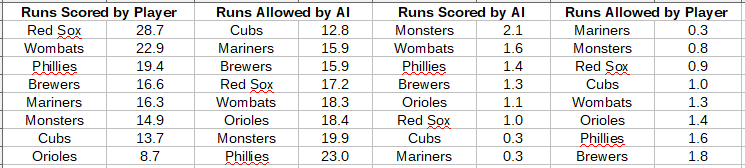
KiiiiiiiiiiiiiS is known as an offensive guru, but you wouldn’t think that to look at his team this season. The Boston Cubs were built to be a tough-to-crack defense, and they did exactly that, producing the Backyard’s #1 defense with 12.8 runs allowed per game and only one game where they gave up 20 runs or more (Week 9, vs. the Purple Sox). The tradeoff for this was a weak offense, and the Cubs were the second-worst offense in the Backyard Conference, scoring only 13.7 runs per game and winning several close games on their way to a 10-4 record. That doesn’t change the fact that the Cubs were frustrating to get around, and they mostly shut down offense after offense as they just kept doing enough to win. Somehow, it seems rather fitting the manner in which they lost: two close games against another incredibly strong defense in the form of the Junior Athletics. There’s nothing the Cubs did wrong; they just happened to have their luck run out against an opponent that was built in a similar style and managed to scratch out a series win, and the Cubs can hold their heads high knowing that they were a good team but this just wasn’t their season.

Purple Sox
Coach: aesnop
Record: 11-3 (1st place, Backyard Conference)
Preseason projections: 10-4 2nd place (crazyei8hts), 1st place (Eauxps I. Fourgott)

What do you say about a team that does everything correctly and still falls short? Because that’s what happened with the Purple Sox this season. They were placed in the toughest conference and rose to the top. They broke the legendary 50-run barrier twice this season. They had the best offense in the league by almost 6 runs per game (Purple Sox: 28.7 runs per game, Wizard Wombats: 22.9 runs per game). Despite pursuing a pitch-to-contact strategy, they managed 8 shutouts. They only lost once through the final nine weeks of the season, and even in that game they put up 24 runs. They were the marriage of a great coach with a great team. They weren’t supposed to be anywhere near this list unless they faced the Diamondbacks in the second round. They were supposed to be in the World Series!

There’s been a running joke about aesnop being the Marty Schottenheimer of the league. He has great regular seasons, his teams look like world-beaters, and then they fall short in the playoffs. Thing about Schottenheimer? A lot of his playoff failures weren’t his fault. He was one stop on a 98-yard drive from reaching the Super Bowl, one goal-line fumble from forcing an AFC Championship game into overtime, one inopportune Joe Montana injury from putting up a fight against the early 90s Buffalo Bills, and one fourth-down-interception-fumbled-back-to-the-New-England-Patriots-in-the-fourth-quarter from making the Super Bowl. Some of Marty’s playoff failures can be blamed on his coaching, but a lot of them just boil down to bad luck.

Which brings us to aesnop. I don’t know about his previous experiences in the playoffs, but the way this season ended can’t really be blamed on him. Aesnop drafted an incredibly solid team, building a roster of arms, bats, and speed, with the only neglected area being pitching. It wasn’t just strong in visible stats, either; his roster was highly-rated in all of the invisible stats Vissery discovered (with the exception of stamina, which is heavily correlated with pitching ability). And what’d he do with his (as usual) impeccable draft? He backed it up with playing ability. It wasn’t just his offensive skills that were put to the test. Defensively, he thought about what he wanted to do to compensate for his poor pitching, and it worked. I might be opposed to the concept of “pitch to contact.” I might draw back from it in disgust and confusion. I might actively disdain and hate it. But it worked very, very, very well for aesnop, as he relied on his arms-heavy defense to keep the runs down while keeping stamina use on the mound low. His user-controlled defense only gave up 13 runs–third in the conference behind the Montana Floss and Green Monsters, and eighth in the league overall.

I don’t know how much more I can do to emphasize the simple fact that the Purple Sox were devastating. Their AI defense was solid, their AI offense was strong, their player-controlled defense was even stronger, and their player-controlled offense was on tornado-in-a-trailer-park levels of destruction. They were good at the start of the season, and untouchable at the end of the season, finishing on a six-game win streak. They were the team to beat.

The Dodgers were supposed to be just another bump in the road. Their weak-armed catcher was supposed to open up third base from the instant the game started, and that was supposed to allow the Purple Sox to rampage to at least one 50-burger. Instead, it was the Dodgers rampaging to a pair of consecutive 50s, mashing the ball at will and making it impossible for the Purple Sox to catch up. It’s not that the Purple Sox did poorly, either; 23 runs in two games would be enough to go at least 1-1 in most instances, and would quite often sweep the series. Instead, Los Angeles managed to slam the door on the Purple Sox before they even had a chance to make their case.

So what’s next for the Purple Sox? There’s really no answer to this question. They did everything right. Their strengths covered up their weaknesses. They were consistently strong through the regular season, and even improved as it went on. They didn’t fail in the playoffs due to poor performance, they didn’t lose because they were a bad team, they didn’t do anything wrong. Bad luck just fell on them at the worst time. If there’s an answer to how you fix that, well, I don’t know what it is. 

QUOTES OF THE WEEK

“I would love to see the Sox eat the Dodgers for lunch to be honest. ‘Catharsis’ would be the best way to describe it.” ­– MelloMathTeacher, Junior Athletics head coach, on dreams that don’t come true

“Dodgers would roast the Purps. Of course, Aes vs Gretchen? Eek.” – Yurya, on the Dodgers/Purple Sox matchup

“The Purple Sox will take this one, probably quite easily.” – JorgesBankAccount, on the Dodgers/Purple Sox matchup

“One or more 50s from the Sox looks pretty likely here. Not going to be a pretty series.” – Eauxps I. Fourgott, Super-Duper Melonheads head coach, on the Dodgers/Purple Sox matchup

“I think playing an away game at Steele would be cool.” – hitace, Los Angeles Dodgers head coach, on playing the first round of the playoffs entirely at Steele Stadium

“Trophy or bust baybee.” – aesnop, Purple Sox head coach, on the Purple Sox’s ambitions

“You should really pick the Purple Sox to win it.” – KiiiiiiiiiiiiiS, Boston Cubs head coach, on whom he expects to win the World Series

“I’m ready to disappoint.” – aesnop, Purple Sox head coach, on self-confidence

“I’m shocked that aes picked himself in his series.” – KiiiiiiiiiiiiiS, Boston Cubs head coach, on aesnop’s prediction bracket

“Playoff Aes is able to make it to the second round.” – aesnop, Purple Sox head coach, on his coaching abilities

“I think Steele is slightly overrated as a hitters paradise.” – KiiiiiiiiiiiiiS, Boston Cubs head coach, on Steele Stadium

“Mercy rule please.” – Marco, New York Yankees head coach, on the Los Angeles Dodgers posting a 59-0 score

“Suddenly I’m rethinking my preference for the Dodgers over the Purple Sox.” – JorgesBankAccount, Montana Floss head coach, on why you should always be careful what you wish for

“If Dodgers win the World Series I never want to hear talks about how a strong catcher is the most important part of your draft because literally they have a bottom-tier-armed catcher and have been very dominant nearly all season.” – Vissery, former Humongous Hornets head coach, on the power of offense

“Hitace going to the World Series. Book it.” – Sisu, Arizona Diamondbacks head coach, on the power of offense

“This is the reverse of what I expected.” – Eauxps I. Fourgott, Super-Duper Melonheads head coach, on the Dodgers destroying the Purple Sox

“Think I’m retiring.” – aesnop, Purple Sox head coach, on being swept in the first round

“CAN ANYONE STOP THE DODGERS???” – Eauxps I. Fourgott, Super-Duper Melonheads head coach, saying what we’re all thinking

“Playoffs Aes! Playoffs Aes! We all love playoffs Aes!” – Marco, New York Yankees head coach, dancing on the Purple Sox’s grave

“The Wombats are back!” – crazyei8hts, Red Phillies head coach, on the Wombats winning their first game against the Rangers

“Wombats scores through Week 9: 20+ in all but one game. Wombats scores after Week 9: 13, 13, 12, 16, 12. Wombats score in this game: 15. The Wombats aren’t back.” – JorgesBankAccount, Montana Floss head coach, expressing cynicism about the Wizard Wombats

“Yeah but this week they won.” – crazyei8hts, Red Phillies head coach, on reality

“The Wombats in a slump score more than the Rangers in a slump. I’m interested to see what happens when the Wombats go to Dirt Yards.” – Eauxps I. Fourgott, Super-Duper Melonheads head coach, on the Wombats winning their first game against the Rangers.

“I am confident we will bounce back at home for Game 2.” – Jyknight, Texas Rangers head coach, on being on the brink of elimination

“Daily update: still no one but the team I flogged has scored 50 in the playoffs.” – Marco, New York Yankees head coach

“Seasons 6 and 7: 3 50s, all from Aesnop. First round, Season 7 playoffs: 3 50s, none from Aesnop. Nice job, Jy!” – JorgesBankAccount, Montana Floss head coach, on the Texas Rangers Game 2 score

“Wombats don’t like dirt.” – Yurya, Green Monsters head coach, on the Texas Rangers defeating the Wizard Wombats at Dirt Yards

“De Pablo Casa gives me PTSD.” – Marco, New York Yankees head coach, on the Wizard Wombats home field of Casa de Pablo

“If all four Backyard teams lose, what happens to the division system next season?” – Vissery, raising an important question

“That’s a bold what-if to be making considering Wizard is winning.” – crazyei8hts, Red Phillies head coach, on the in-game situation

“But will Wizard be winning in five minutes?” – JorgesBankAccount, Montana Floss head coach, on how quickly momentum can shift

“Pete on the house!” – Sisu, Arizona Diamondbacks head coach, on Pete Wheeler making the game-winning catch

“I’m scared for what you did to Randy.” – Sisu, Arizona Diamondbacks head coach, on the Montana Floss’s foul-heavy strategy

“I haven’t done anything to the big boy. Yet.” – JorgesBankAccount, Montana Floss head coach, on making threats

“Gotta get by the Floss first.” – Sisu, Arizona Diamondbacks head coach, on a possible future series against the Los Angeles Dodgers

Never have a slow first baseman. I got so lucky.” – JorgesBankAccount, Montana Floss head coach, on winning Game 1 against the Arizona Diamondbacks

“Gotta rebound for Game 2 at the Farm!” – Sisu, Arizona Diamondbacks head coach, on returning to Dubois Diamond

“As previously stated: Diamondbacks to beat the spread.” – JorgesBankAccount, Montana Floss head coach, in a rare moment of optimism

“I have to be in the right mindset to play at Sandy.” – Sisu, Arizona Diamondbacks head coach, on winning Game 2 and playing at Sandy Flats again

“Dude they lost by one run for the like sixth time.” – Aesnop, Purple Sox head coach, on the Montana Floss barely losing in Game 3

“I’M GOING TO THE CHAMPIONSHIP SERIES!” – Sisu, on winning his first playoff series

“Tina managed to keep her streak of making playoffs every year since her debut yet somehow winning zero series. A masterclass of consistency.” – Vissery, on Montana Floss member Tina Herrara

“The runs against me were all from homers down the alleyway. It was painful.” – KiiiiiiiiiiiiiS, Boston Cubs head coach, on giving up runs at home

“Two of three of mine were the same.” – MelloMathTeacher, Junior Athletics head coach, commiserating with KiiiiiiiiiiiiiS

“I expected the As to struggle more against the Cubs defense.” – Eauxps I. Fourgott, Super-Duper Melonheads head coach, on the Junior Athletics winning Game 1

“It’s ironclad. Very, very tough. Some lucky drops and a very lucky homer from Todd.” – MelloMathTeacher, Junior Athletics head coach, on the Boston Cubs defense

“Todd Xavier looking good boys.” – Vissery, on Junior Athletics starting pitcher Todd Xavier

“Toddfather is easily player of the game. You had to see it to believe it. I don’t care that Todd gave up three runs, or that Wendy hit two homers, Todd is indisputably the player of the game.” – MelloMathTeacher, Junior Athletics head coach, on Todd Xavier’s Game 1 performance

“And the Athletics do the impossible and take the game and the series! 2-0! That’s both Frontyard teams sweeping the top two teams! In the Backyard! Purple Sox: done! Cubs: done! I don’t believe it. I don’t think anyone believes it, I don’t think Mello believes it! I think Mello might’ve just passed out!” – Sisu, Arizona Diamondbacks head coach and Matchup Of The Week commentator, amazed by the Athletics hanging on to win

“TODD! [Censored]! XAVIER! IS THE TODD! [Censored]! SAVIOR!” – JorgesBankAccount, Montana Floss head coach, rooting for the Junior Athletics

“Todd Xavier the protagonist of this series.” – Vissery, on postseason storylines

“You got your wish. Xavier the Savior is Series MVP.” – JorgesBankAccount, Montana Floss head coach and writer of recaps, to MelloMathTeacher, Junior Athletics head coach, on Todd Xavier’s first-round performances

“The Cement Gardens homers they hit off me just angered me to no end. It makes no sense whatsoever that the ump rules them homers even though they were clearly grounders. I guess I took that energy through the rest of the series to do what I did. When I hit that line drive in Cement, I knew that if the ump was going to call things evenly, that it’d be a homer. I don’t think I’d have tried for that if they didn’t hit those on me before. Game 2, I just had to step up myself since I couldn’t rely on those kinds of weird calls. My arm is absolute Jell-O right now, I’m absolutely exhausted, but I’m so thankful it was enough. We’re on to Big City, where my brother played once when he was my age. My teammates had my back, like they did all season. I thank them with all my heart. I couldn’t be more proud of them.” – Todd Xavier, Junior Athletics starting pitcher, on being the Series MVP

“Awwwww, Todd! We’re so proud of you! Everyone, be gentle, but…GET HIM!” – Courtney Valentino, rallying the Junior Athletics to dogpile on Todd Xavier

“Boston in shambles.” – Eauxps I. Fourgott, Super-Duper Melonheads head coach, on the Boston Cubs being swept almost exactly a week after the Purple Sox were swept

“Boston and Boston-related teams are not having fun.” – aesnop, Purple Sox head coach, on the Boston Cubs being swept almost exactly a week after the Purple Sox were swept

“The Boston Reds are doing great.” – crazyei8hts, Red Phillies head coach, looking towards the consolation tournament alongside the rest of New England

“Go Yankees!” – hitace, Los Angeles Dodgers head coach, on the New York Yankees

“This is the first positive thing said about the Yankees in my time here. I teared up a little.” – Marco, New York Yankees head coach, on encouragement

“Everyone sucks, give the win to the Yankees.” – Vissery, on the Junior Athletics upsetting the Boston Cubs

“I agree with Vissery. Go Yankees!” – hitace, on the possibility of the New York Yankees being just handed a championship

“Wow. Backyard: Eliminated.” – jlund24, former Baltimore Bombers head coach, on all four Backyard Conference playoff teams losing in the first round

“I think the Athletics had the strongest defense I had to play this year. There were no holes.” – KiiiiiiiiiiiiiS, Boston Cubs head coach, experiencing shell shock

“YOOOOOOOOOOOOOO!!!!!! Those were two of the craziest games I’ve seen in my LIIIIIIIFE! The kids were dialed in, they played with such amazing guts against one of the best teams in the league, and it paid off! I’m so happy for them, and I’m so happy for Coach Mello. With how hard he’s worked, he deserves it all. I think he’s still recovering from the shock of this upset. They’re gonna enjoy their ice cream, they’re gonna party tonight, and I hope they soak it all in. Big City Stadium! I wonder how many of them dreamed to play there… I certainly did as a child. I wonder how Coach Mello celebrates this one. He’s never been one for big-time celebrations. Sometimes he needs to just let loose, like his kids do!” – FelloMathTeacher, Junior Athletics assistant coach, on the Junior Athletics upsetting the Boston Cubs

“I just refuse to believe that the Frontyard teams could beat the Backyard teams.” – crazyei8hts, Red Phillies head coach, experiencing shell shock and denying reality

“Clearly Backyard is not as good as they thought they were.” – Vissery, on all the Backyard Conference teams losing in the first round

“You did good, rookie.” – JorgesBankAccount, Montana Floss head coach, to MelloMathTeacher, Junior Athletics head coach

“Is this actually happening? Is it, really? Did we actually manage to pull this off? Good Lord, dude. I racked my brain for hours trying to figure something out for this series. To be honest, I couldn’t really come up with much. They’re just so good defensively over much of the field. This win was less on me and much more on the kids executing. We had some strategies going in, we knew what we shouldn’t do against them and did a generally good job of avoiding that. But the kids were the ones who placed hits well, played solid defense, and the bounces went their way. This series was two bad breaks or mental mistakes from going 2-0 the other way. All the credit in the world to KiiiiiiiiiiiiiS and the Cubs for their hard work all year. Cubs probably win seven or eight series if we played ten of them, if I’m being frank. But only one of them counts, and this was the one. I’m so happy for my A’s right now. Even if they dunked me in Gatorade.” – MelloMathTeacher, Junior Athletics head coach, experiencing shell shock and respecting the coach on the other side

“Aesnop and KiiiiiiiiiiiiiS are the two best players in the world. How did they lose to anybody?” – crazyei8hts, Red Phillies head coach, continuing to experience shell shock

“You could argue that I was the only one who was right but I also was a fake coach. Management is currently having to deal with the whereabouts of Terry Vega. Meanwhile I’ve already stolen all the money…I’m halfway to Mexico by now, they’ll never find me.” – Vissery, on embezzlement

“Gator Flats was my favorite in 2005.” – hitace, Los Angeles Dodgers head coach, on favorite fields

Love the swamp. It’s got a great aura.” – JorgesBankAccount, Montana Floss head coach, on being a slimy muck-dweller

“I only put Terry in the woods so he’ll probably be found eventually.” – Vissery, on inadequately hiding a body

“You’re going to prison bro.” – Repub92, current Baltimore Bombers head coach, on inadequately hiding a body

“Just a reminder that the Yankees beat the [censored] out of these same Dodgers you’re talking about.” – Marco, New York Yankees head coach, on the Los Angeles Dodgers

“That Dodgers loss vs. the Yankees influenced so much.” – MelloMathTeacher, Junior Athletics head coach, on playing the Boston Cubs instead of the Purple Sox

“Man it’s too bad for the Cubs that we got the As instead of the Dodgers.” – KiiiiiiiiiiiiiS, Boston Cubs head coach, on regrets

“And vice versa. We both ran into the worst team we could’ve played.” – aesnop, Purple Sox head coach, on regrets

“I’m more bewildered than enthralled at my upset win.” – MelloMathTeacher, Junior Athletics head coach, experiencing shell shock

“Has ei8hts gone soft?” – Yurya, Green Monsters head coach, on Red Phillies head coach crazyei8hts

“I’ll have you know that crazy is as hard as it gets! But only for his wife, whom he loves dearly.” – JorgesBankAccount, Montana Floss head coach, on marriage (true love)

Daft Punk is the only reason TRON: Legacy was worth making.” – jlund24, former Baltimore Bombers head coach, on the entertainment industry

“Why must reality constantly get in the way of my crappy jokes?” – JorgesBankAccount, Montana Floss head coach, on writing recaps

“Chicks dig the long ball.” – Sisu, Arizona Diamondbacks head coach, on picking up women

“What is the significance of the giraffe?” – crazyei8hts, Red Phillies head coach, getting philosophical

“Wow crazyei8hts, so ‘nice’ of you to make me play at Sandy again.” – Natetastic, Milwaukee Braves head coach, less than thrilled at having to play at Sandy Flats again

“Playing on Dirt Yards makes for an interesting game to say the least. Good luck Toast.” – Repub92, current Baltimore Bombers head coach, on playing the Minnesota Twins at Dirt Yards

“Bombers are a force to be reckoned with!” – Jyknight, Texas Rangers head coach, on the Baltimore Bombers winning their series against the Minnesota Twins in the consolation tournament

“I’m kinda hype for this Melons-Hornets series.” – aesnop, Purple Sox head coach, on being kinda hype for the consolation series between the Super-Duper Melonheads and Humongous Hornets

“They can’t both lose!” – crazyei8hts, Red Phillies head coach, on the consolation series between the Super-Duper Melonheads and Humongous Hornets

“Shout out Melonheads for beating the Hornets.” – Marco, New York Yankees head coach, looking at the consolation tournament

“Never bet against the Melonheads in the opening round of the postseason. 5-for-5 now.” – Eauxps I. Fourgott, on the Melonheads tendency to win the first game (or series) of either the consolation bracket or the playoffs

“If I recall correctly, I lost to the Fishes this season. Let’s go Reds!” – Repub92, current Baltimore Bombers head coach, on rooting interests

“Nice one shrewsbury!” – elchrisblanco, Seattle Fishes head coach, showing good sportsmanship over losing Game 1 of the consolation bracket to the Boston Reds

“Consolation Shrew is a thing I think.” – aesnop, Purple Sox head coach, on Boston Reds head coach shrewsbury’s abilities in consolation tournaments

“Shrewsbury and consolation tournaments. Name a better duo.” – crazyei8hts, Red Phillies head coach, on shrewsbury’s teams’ tendency to do well in the consolation tournament

“Hitace was actually me with a mustache and plastic nose.” – Vissery, on sockpuppeting

“Am I a joke to you?” – Aesnop, Purple Sox head coach, asking a question he really doesn’t want answered

“Quit calling out my poor decisions!” – JorgesBankAccount, Montana Floss head coach, to Vissery

“I’m gagging and vomiting at the same time. I’m–I’m gavomiting.” – Dr. Cox, Scrubs, on how well the Backyard teams performed in the first round

“Those sure are some great quotes from me.” – KiiiiiiiiiiiiiS, Boston Cubs head coach, on being quoted

Playoff Primer: Semifinal Round [Season 7]

We’re one round into the playoffs and already proving that I’m not the best predictor, as I only called 1 of 4 series correctly! Well, whatever. Let’s set ’em up and do it again as four get whittled down to two!

#2 Los Angeles Dodgers vs. #1 Arizona Diamondbacks
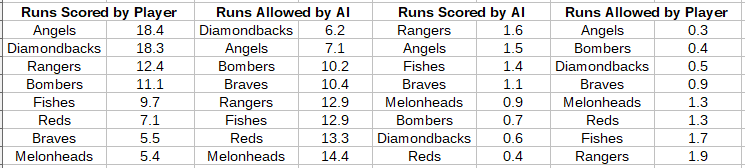
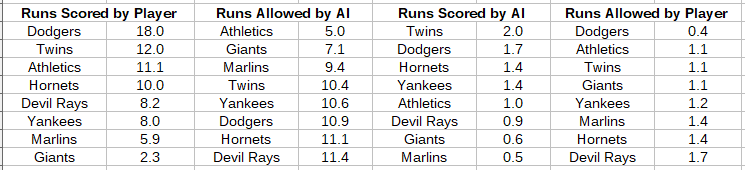
Los Angeles Dodgers: 10-4 (3-0 playoffs), 18.0 runs scored per game, 23.0 including playoffs (1st Frontyard Conference), 10.9 runs allowed per game, 12.1 including playoffs (8th Frontyard Conference), coached by hitace
Arizona Diamondbacks: 13-1 (2-1 playoffs), 18.3 runs scored per game, 19.3 including playoffs (2nd Indoor Conference), 6.2 runs allowed per game, 8.8 including playoffs (1st Indoor Conference), coached by Sisu

The Dodgers enter this series as unknowns; while they were expected to be easily handled by the Purple Sox in the first round, instead they posted two 50s in a row and kicked the Purple Sox cleanly out of the playoffs. Meanwhile, while the Diamondbacks had a tougher time with the Montana Floss than expected, Arizona actually played above expectations; it’s just that Montana also played above expectations (and by a significantly larger margin). Which one will keep the momentum going? Well, I’ve got my guesses.

Los Angeles Dodgers
The Dodgers were always a strong offensive team. They were also considered the best team in the Frontyard for much of the season and even now. Yes, they finished second and needed a play-in game just to make it to the dance, but two of their losses were due to circumstances not completely in their control, and they performed well throughout the year. But now? The Dodgers are looking absolutely monstrous, and it’s because one thing has changed: dingers. They’ve put up a total of 139 runs over their three postseason games, including a pair of 50+ scores at Steele Stadium, and it’s been largely due to the fact that their bats have exploded. In the regular season, the Dodgers hit 50 homers; in just these three games, they’ve hit 39. I don’t care if that’s due to the short fence at Parks Department Field #2 or getting a bunch of hits to bounce off the top of the shed at Steele Stadium when they hadn’t so far, the Dodgers have changed from a strong offense to a devastating one. Big City Stadium does have slightly deeper fences, it’s true, but the fences there are fairly low, and if the Dodgers can keep hitting the way they’ve been hitting they might just be unstoppable; after all, it doesn’t matter what the opponent’s defense looks like if you just keep hitting bombs.

Arizona Diamondbacks
Speaking of strong offensive teams, we’ve got the Arizona Diamondbacks, who after starting a bit slow to begin the season with only one game of 15 runs or more in their first five matches finished with nine straight games of 15 runs or more–a streak that they continued in the playoffs, posting scores of 15 or more thrice in a row there and firmly establishing their floor. At this point, the Diamondbacks look like worldbeaters…but can they outscore the Dodgers? The Dodgers have been on fire recently, and the Diamondbacks may be putting up good scores, but not quite as good as the Dodgers of late. Plus, Jay Green has been carrying the team all season, and you’d think he’d have to falter sooner or later; if this is the time that Jay Green stumbles, the Diamondbacks might have a problem on their hands.

Projection
This is going to be a high-scoring series. There’s practically no question about that. But the question is which team will score more, and the answer will be decided by two players on the AI end. For the Diamondbacks AI, Randy Johnson is the most important player; the Dodgers were mostly stifled by a very similar pitcher in Amanda Hellerman when they played the Little Giants this season, and their hitting has seemed to peak against weak pitching and falter against strong pitching, so if Randy Johnson can stay on the mound and keep the scores down the Dodgers could bow out very fast. On the other side of the equation is Gretchen Hasselhoff at catcher for the Dodgers, and with her it’s not a question of whether the Diamondbacks will take advantage of her arm–but how much. When every base hit is a triple, scores balloon, and if Arizona gets a lot of runners on base they’ll get a lot of runners across the plate. In this instance, I’m inclined to side with the Diamondbacks; I’m just not sure that the Dodgers have what it takes on a foreign field and facing a great pitcher to pull this one off.

#1 Junior Athletics vs. #2 Texas Rangers
Junior Athletics: 11-3 (2-0 playoffs), 11.1 runs scored per game, 10.8 including playoffs (3rd Frontyard Conference), 5.0 runs allowed per game, 5.2 including playoffs (1st Frontyard Conference), coached by MelloMathTeacher
Texas Rangers: 10-4 (2-1 playoffs), 12.4 runs scored per game, 14.3 including playoffs (3rd Indoor Conference), 12.9 runs allowed per game, 13.5 including playoffs (6th Indoor Conference), coached by Jyknight

This is something I didn’t expect and yet am not surprised to see. When I predicted the matchup between the Boston Cubs and the Junior Athletics, I thought it would be really close (it was) but that the Cubs were more likely to win (they didn’t). When I predicted the matchup between the Wizard Wombats and the Texas Rangers, I thought it would come down to which one was able to break out of their slump (it did) and that the Wombats were more likely to do so and they’d win if both teams continued slumping (which didn’t happen). So which of these two underdogs do I like more to make it to the World Series?

Junior Athletics
We all know that the Junior Athletics started off playing a bunch of scrimmages, putting up low scores, and occasionally losing to the AI. We also all know that the team ground out some close, low-scoring wins before starting to put it together around the middle of the season and producing decent offense to couple with their monstrous shutdown defense. The crown jewel in their season may well be their most recent series, where they took on another strong defense in the Boston Cubs and swept them (although their coach will admit that they were a couple bad bounces from being swept by the Cubs; such is the struggle of a defense-focused team). But now, they’ve got another challenge: a streaky team with momentum on their side.

Texas Rangers
Throughout the first two-thirds of the season, I said that the Texas Rangers did just enough to win. Then they fell off a cliff and lost four straight, and I didn’t expect them to get their mojo back the instant the playoffs started. They…kind of did and kind of didn’t. Let me summarize their season for you: 10-game winning streak, 5-game losing streak, 2-game winning streak. Which brings us to now. The Rangers may have gotten their mojo back (putting up more than 50 runs will do that), but on the other hand, they’ve never shown any great ability outside of that lone 50. It’s not that the Rangers are a bad team; it’s just that they don’t come off as particularly great in any way. They’re a team that has in many respects not stood out in any way apart from their constant streakiness–and that’s hard to quantify.

Projection
What it all comes down to is whether I think the Rangers can break the Athletics defense. If they can, they’ll probably win. But if the Junior Athletics hold strong, they’re likely moving on; I think they’ve got enough offense to keep up and then some. It’s completely possible that the Rangers break the Athletics defense, or that Pete Wheeler on third is enough to shut down the Athletics offense, but in this matchup, I’m pretty clearly thinking that the Athletics can do more than the Rangers.

WORLD SERIES

As you can tell, I’m predicting that the World Series will be between the Junior Athletics and Arizona Diamondbacks, and personally…I think the Diamondbacks will win it. I like the Athletics, but nobody has slowed down Jay Green, and I don’t think the Athletics will do so with everything on the line. Runner-up is very good for a rookie, and it’s well deserved for the Athletics, but I don’t think they have quite enough to win it all.

Now watch as the Dodgers end up taking on the Rangers and winning in 5 games.

Play-ins Recap [Season 7]

All the chaos that had been building up over the course of the season culminated in Week 14, when…three Backyard teams ended up tied for the final Backyard spot? Two Frontyard teams tied for the final Frontyard spot? Only six teams were definitely in the playoffs, and only two matchups were actually set? That’s right, folks, we get a week of extra games: play-ins to decide who makes it in and who goes home!

RULES

The basic rules were the same throughout the league. Both teams would play a home game against each other at the neutral site of Parks Department Field #2. The higher score would win. If both teams tied, the first tiebreaker would be runs allowed, with the team that allowed fewer runs taking the win. If they tied in runs allowed, the next tiebreaker would be runs scored in the first inning, then runs scored in the second inning, then runs scored in the third, and so on. If both teams scored the exact same amount in every inning, all hell would break loose.

The structure varied by conference. In the Frontyard Conference, the Minnesota Twins and Los Angeles Dodgers were tied with records of 10-4, so a single game was all that was needed to determine who would make the playoffs. In the Backyard Conference, the Red Phillies, Green Monsters, and Montana Floss were all tied at 6-8; consequently, this necessitated a different structure. The Green Monsters were considered the strongest of these three teams due to tiebreakers, so they were chosen as the “top seed” in the play-in games. The Red Phillies and Montana Floss would therefore play each other, with the winner moving on to face the Green Monsters. Whichever team won that game, be it the Monsters or the winner of Phillies/Floss, would move on to the playoffs.

FRONTYARD CONFERENCE

Minnesota Twins vs. Los Angeles Dodgers

The Minnesota Twins had been an also-ran for most of the season, quietly having a good season but always a bit ignored in favor of the stifling defense of the Junior Athletics and the bombastic offense of the Los Angeles Dodgers. They were also quietly a constant thorn in the side of the Dodgers and Athletics, defeating both of them in their first meeting and actually entering the All-Star Break in a three-way tie for the division lead with a 5-2 record. Although they dropped games to the Athletics and Dodgers in the second half of the season to fall to third place, they were a constant threat to make the playoffs if only one of their opponents would falter. In this instance, it was the Dodgers who faltered; although they defeated the Athletics in Week 9 to claim sole possession of first place, a loss to the Florida Marlins (guest-coached by aesnop) meant that both they and the Junior Athletics had three losses entering the final three weeks of the season. With the Twins winning out, all they needed was a loss from one of those two teams, and the New York Yankees were the ones to pull off the upset, knocking off the Dodgers 14-1 in the final game of the season when Los Angeles couldn’t stop popping up.

It might’ve been a longshot, but Minnesota had a chance to snatch a playoff spot at the very last second, and they certainly weren’t going to waste it, as they took the field at Parks Department Field #2 with intent to win. The Twins had one of their better games offensively, putting up 18 runs on 21 hits and 2 walks, but one of their worst games defensively as they allowed 4 runs on 8 hits (although Julie Dunkel did manage to throw 10 strikeouts). It didn’t end up mattering, though, as the Los Angeles Dodgers had one of their best games by getting 30 runners across the plate on 32 hits and 2 walks while shutting out their opponents. Los Angeles won the game, and will face off against the Purple Sox in the first round of the playoffs.

Los Angeles Dodgers 30, Minnesota Twins 14

Player of the game: Everyone took advantage of the short fence at this field, as these two teams combined to hit 20 home runs (6 from the Twins, 14 from the Dodgers). The leader in home runs? Leah Wayne, who smashed 5 (8 RBIs). She’s not the player of the game, though; instead, that award goes to Los Angeles Dodgers pitcher (at least for this game) Albert Pujols, who had a fantastic game both ways. Offensively, he went 5-for-5 with a single, a double, and 3–count ’em, 3–home runs, finishing with 6 RBIs and scoring every time he came up to bat. Defensively, he pitched one of the greatest performances the Dodgers saw all season (and this is a team that set/tied the record for most strikeouts in a season), throwing twelve strikeouts in a two-hit shutout performance. The Dodgers look good as they enter the playoffs; they’d just better hope that they didn’t expend all their efforts on this game.

BACKYARD CONFERENCE

Montana Floss vs. Red Phillies

Something interesting about these teams is that they both went 3-4 in the first half of the season, 3-4 in the second half, 3-4 at home, and 3-4 on the road. They also got their records through a pair of sweeps and a pair of splits: the Floss swept the Cubs and Monsters while splitting with the Orioles and Brewers, while the Phillies swept the Floss and Orioles while splitting with the Wombats and Brewers. How they did overall was far different, however. The Floss were fairly consistent throughout the season, winning approximately every other game and scoring between 13 and 17 runs in almost every game. The Phillies were much more mercurial, varying in their scores a lot but more importantly being streaky, starting the season 3-1 and winning their last two games but going 1-7 in the middle. That one win was important, though, as it was against the Floss; in fact, given the short fences of Parks Department Field #2 and the Floss’s generally inability to keep up with the Phillies, it was expected that the Phillies would take the game.

That didn’t happen for two reasons. The first reason is that the Phillies had their weakest performance against the Floss yet, only managing 17 hits (although they did turn these hits into 14 runs with the aid of 7 homers). The second reason, though? The Floss took advantage of the Phillies weak infield (as well as some other elements including field conditions), using infield singles and steals to work their way to a 33-0 win on 47 hits and 3 walks. This allowed the Floss to advance and take on the Monsters in a game to decide who would get the final playoff seed from the Backyard Conference.

Montana Floss 33, Red Phillies 14

Player of the game: A big offensive game requires almost everyone to contribute. Instead of trying to sort through everyone who had a hand in the Floss’s victory, let’s look at the defensive side of the equation, where Montana Floss pitcher Brad Radke had arguably his best performance yet (and this in a season where he set the record for most strikeouts from an individual pitcher). What’d he do? Well, he pitched yet another shutout (his 11th so far), and while he did allow three hits, he also pitched an absolutely monumental 15 strikeouts. He wasn’t too shabby on the basepaths, either, going 6-for-7 (all singles) with an RBI, scoring five times, and stealing four bases.

Montana Floss vs. Green Monsters

Both of these teams had reason to be optimistic entering this game. For the Montana Floss, the reason for optimism was simple: they were riding a two-game winning streak, had gone 3-1 over their last four games, and had beaten the Monsters in both of their regular season matchups. For the Green Monsters, the reason was also simple: they were away from their home field. The Monsters had attempted to draft for Tin Can Alley and had ended up missing the mark, posting a 2-5 record at home but a 4-3 record on the road. While this was technically a dual home game, they’d be playing at a field that wasn’t Tin Can Alley, and with the paucity of power hitters on the lineup combined with the short fences of Parks Department Field #2, it was quite plausible that the Green Monsters would punch above their weight.

They didn’t. As in their Tin Can Alley bout, the Monsters found themselves stymied by the Montana Floss’s strong arms and were only able to score 3 runs on the Floss while allowing two. Meanwhile, Montana just rolled, as although they allowed a run (a solo shot from Greg Vaughn in the top of the 5th) they put up 18 off of 29 hits and a walk and cruised into the playoffs. The Montana Floss will take on the Arizona Diamondbacks in the first round; we’ll see if they keep their momentum from the play-in games or if they fall to the mighty bat of Jay Green and the mighty arm of Randy Johnson.

Montana Floss 17, Green Monsters 1

Player of the game: The Floss have spent most of their season relying on the bat of Jeff Bagwell to clear the bases and bring in bunches of runs. Once again, he delivered, going 5-for-5 with 5 extra-base hits (3 doubles, a triple, and a home run). How many times did he score? Two. How many RBIs did he get? Eleven. He’s not likely to have too many more performances like this in the playoffs, but if he does, watch out.

PLAYOFFS
#1 Purple Sox [aesnop] (11-3) vs. #2 Los Angeles Dodgers [hitace] (10-4)
#2 Boston Cubs [KiiiiiiiiiiiiiS] (10-4) vs. #1 Junior Athletics [MelloMathTeacher] (11-3)
#3 Wizard Wombats [Wizard] (9-5) vs. #2 Texas Rangers [Jyknight] (10-4)
#4 Montana Floss [JorgesBankAccount] (6-8) vs. #1 Arizona Diamondbacks [Sisu] (13-1)

ODE TO THE ELIMINATED

Three more teams hit the bricks this week, but they deserve a memorial too. This is the story of their seasons: what they did right, what they did wrong, what they can improve on, and what they should keep doing.

FRONTYARD CONFERENCE

Minnesota Twins
Coach: Toast
Record: 10-4 (3rd place)
Preseason projections: 6-8 6th place (crazyei8hts), 1st place (Eauxps I. Fourgott)

The Twins are who we thought they were. They’re a good, solid team with a good, solid coach playing a good, solid brand of baseball. They finished second in offense in the Frontyard Conference with 12.0 runs per game, fourth in defense with 10.4 runs allowed per game, and overall did a good job throughout the season. Toast drafted well, building a solid defense while not neglecting offense, and performed decently as well (as was borne out by his rankings and overall record). The only problem for the Twins this year? They just weren’t that fantastic. They didn’t boast the killer defense of the Junior Athletics. They didn’t boast the unstoppable offense of the Los Angeles Dodgers. They were just a good team in a conference with two better teams. Minnesota has nothing to be ashamed of: they played well, fought the good fight, and split with that killer defense and unstoppable offense. They just didn’t quite have enough to make it into the playoffs, even if they got really, really close.

BACKYARD CONFERENCE

Red Phillies
Coach: crazyei8hts
Record: 6-8 (t-5th place)
Preseason projections: 8-6 4th place (crazyei8hts), 5th place (Eauxps I. Fourgott)

This team was the brainchild of last season’s champion, crazyei8hts. Coming off a season where he’d built a great defense and good offense centered around doing what he does best–specifically, smacking dingers–crazy decided to double down on the whole home runs thing, mostly ignoring speed and instead relying on arms to get it done defensively. This was already a nebulous concept–strong arms getting outs is contingent upon them just getting to the ball to start with–but it was made worse by the fact that there were two things crazyei8hts didn’t account for in his drafting. The first one is something he didn’t see but probably should’ve: his rocket-armed catcher was one of the highest-rated pitchers on the team, and would frequently come in as the second or third reliever, putting an exhausted arm behind the plate and opening up third base quite often. The second was something he couldn’t account for.

This season, another coach in the league (Vissery, Humongous Hornets [formerly]) dug into the code in ways we’ve never seen before and was able to pull up lots and lots of hidden data: power and contact rather than just a hitting rating, exact speed (and subsequently speed tiers), glove…oh, and things like focus, game IQ, and aggression, which have a huge impact on error ratings, choices about where to go with the ball, and willingness to at least go after the ball. Investigation into these ratings revealed that crazyei8hts had drafted a team that was worst in the league in terms of focus, worst in the league in catching, very unaggressive, and very low in terms of game IQ. This meant that even when his team was not only slow, they were slow to even start going after the ball, had trouble handling it well, and generally were poor at defense on the whole. It showed, too; despite the fact that the Phillies were not one of the two teams the Purple Sox put up 50+ runs on, they had the worst defense in the league, giving up 23 runs a game (322 in total). These twin vulnerabilities overshadowed their third-ranked offense (19.4 runs per game), and eventually led to their loss against the Montana Floss in the play-in game where the Floss hit grounder after grounder after grounder to exploit their weak infield.

There’s hope for next season, though. The Phillies were able to bang in many runs, and if they could have fixed just one of their vulnerabilities they could’ve won a couple games more. Plus, crazyei8hts has won a championship before, and recently, so there’s a decent chance that next season will be a rebound year.

Green Monsters
Coach: Yurya
Record: 6-8 (t-5th place)
Preseason projections: 7-7 5th place (crazyei8hts), 3rd place (Eauxps I. Fourgott)

There are several types of drafting strategies. Some coaches draft for defense. Some draft for offense. Some try to go for a balance. Some go after their favorite players. And some draft for their home fields. Naturally, all of these strategies have the possibility of either working out fantastically or leading a team to fall flat on its face. This team leaned closer to the latter than the former, and it’s a testament to their coach that they got as far as they did.

The Green Monsters were drafted to suit their home field of Tin Can Alley. With its structure of incredibly short, high fences, Tin Can Alley makes it very, very easy to grind out singles just by hitting the ball to the wall, even if home runs are mostly off the table, and consequently TCA is known as a very offense-friendly field. Naturally, Yurya was looking to take advantage of that with his draft, and so went after good hitters that he felt could continually hit the ball to the wall and drive in runs.

This isn’t a bad strategy. It could work; in fact, it probably should work. It didn’t, though. The Monsters routinely struggled at home, posting a 2-5 record and frequently having their worst games at the field (the nadir? A game against the arms-heavy Montana Floss where it took them extra innings to crank out a 2-1 score). At home, the Monsters weren’t able to produce, as they only scored 70 of their 197 runs there. On the road, the Monsters fared much better, going 4-3 and scoring an average of 18.1 runs per game (home average: 12 [prorated] runs per game).

Despite their struggles at home, the Green Monsters came very close to making the playoffs, only missing out because they met a team they’d habitually struggled with in the play-in game. If they had been at another home field, they might well have won more games and made it in. In the end, this seems to be a story of either field/coach/team mismatch like the Milwaukee Braves, or one of just getting nicked with bad luck at the worst time. One of those is fixable, and the other tends to go away eventually, so there’s plenty of hope for next season.

MATCHUP OF THE WEEK

It’s back! After taking a week off for the play-in games (and at the commissioner’s “request”), the Matchup of the Week returns! This week’s battle is Game 2 between the Boston Cubs and Junior Athletics, two defensively-oriented teams who have overshot expectations and are locked in a tight struggle to move on and face the more offense-oriented winner of the duel between the Wizard Wombats and Texas Rangers. To make things even more interesting, we won’t know the results of Game 1 until that evening, so which team is on the chopping block won’t be known until right before the game! Catch it this Saturday, October 9th, at 8:30 PM Mountain Time, only on Sisu’s twitch!

QUOTES OF THE WEEK

“I race in RuPaul’s Drag Race.” – KiiiiiiiiiiiiiS, Boston Cubs head coach, on hobbies

“You think I was awake for those Floss MOTWs?” – Vissery, former Humongous Hornets head coach, on foul balls

“I didn’t pick you guys because you were any good. I picked you guys because I thought it would be funny.” – MelloMathTeacher, Junior Athletics head coach, summarizing Vissery’s draft strategies

“‘I picked you guys because I thought it would be funny’ is my Backyard Football fantasy team.” – Vissery, former Humongous Hornets head coach, confirming what we all suspected

“There are home runs that are unexpected?” – crazyei8hts, Red Phillies head coach, on hitting strategy

“How are the playoffs going for you?” – aesnop, Purple Sox head coach, to crazyei8hts, Red Phillies head coach

“Good game hitace! You and MelloMathTeacher will represent the Frontyard well!” – Toast, Minnesota Twins head coach, showcasing good sportsmanship

“See you in the consolation tournament, Toast! Congrats on a quality rookie season!” – Eauxps I. Fourgott, Super-Duper Melonheads head coach, encouraging Toast, Minnesota Twins head coach

“Thanks! I’m proud of how I ended it.” – Toast, Minnesota Twins head coach, being optimistic about next season

“Contact is a two-edged sword, it boosts some hits but also doesn’t foul off the bad ones.” – Yurya, Green Monsters head coach, justifying the drafting strategy of the Montana Floss

“8-8. I made it to .500 after all!” – JorgesBankAccount, Montana Floss head coach, trying to come up with a good retort and just looking pathetic

“Eat a bag of stale pretzels.” – Vissery, former Humongous Hornets head coach, coming up with a good retort

“I’ve thought about this long and hard, but yes jibbo is a hibbo.” – KiiiiiiiiiiiiiS, Boston Cubs head coach, on Junior Brewers head coach jibbodahibbo

“Standards are for losers.” – jibbodahibbo, Junior Brewers head coach, on his wife

“Just give me one good reason, and I won’t ask you anymore. Just give me one extra season, so I can figure out the other four.” – John Prine, Blue Umbrella, in a song that got stuck in my head

“Playoffs Aes is my favorite Aes.” – Marco, New York Yankees head coach, on expecting the Purple Sox to fail

Week 14 Recap [Season 7]

The last week of the season has happened and–wait, what? Playoffs aren’t starting yet? Play-ins due to ties? There’s still a bunch of chaos? We don’t have a final eight? Aw, geez…

MATCHUP OF THE WEEK

Junior Brewers vs. Montana Floss

This match was one where everything was on the line. Both teams were 5-8, and yet somehow­–improbably–still in the playoff hunt. Since the Green Monsters sat at 6-7, if they lost it was still possible for either of these teams to make the playoffs, either by beating them on tiebreakers or by beating them in a play-in game (depending on external factors as well as their record against the Monsters.

This was, of course, a rematch. The first time these two teams met, the Junior Brewers defeated the Montana Floss, 18-16 in a very close game (one of the few close games the Brewers won this season). That time, the Brewers were at home at Scrapco Field; this time, the host was the Montana Floss at Sandy Flats. There were a lot of similarities between these two teams, however; both had posted 2-4 records since the All-Star Break, both had kept most games close, and both had strong defenses, with the Brewers having the #2 defense in the Backyard Conference with 195 runs allowed and the Floss the #3 defense with 207 runs allowed. There were differences, however; while the Brewers had a positive overall run differential of +23, the Floss were in the red with a run differential of -6. While the Brewers were considered one of the more fearful teams in the conference by several of their prognosticators and opponents, the Floss appeared to be a team that could get close to opponents but only occasionally surpass them.

Still, both teams sat at 5-8, and a playoff spot was on the line in this one. That is, of course, as long as the Green Monsters lost to the Boston Cubs.

Francis Blewer started things off well, as she smacked a line drive down the left field line and off the log for a home run. She was followed by PJ Shareef, who grounded out to the pitcher, and Parker Collum, who knocked one deep into left field and over the log that was ruled a ground-rule double. Brenda Markart then came to the plate and hit another pitch into left field, this one for a single when left fielder Ricky Johnson got to the ball quickly and threw it to the shortstop to hold runners at the corners. Brenda stole second, and then with two runners in scoring position Vincent Sweet proceeded to hit a dribbler a few feet in front of home plate. The throw to first was dropped, however, and in the ensuing scramble for the ball home plate was left uncovered, allowing Parker Collum to score and Brenda Markart to make a try for third that turned into another run when Emily Lewbell’s frentic throw to an uncovered home plate went out of play, putting the Brewers up 3-0 with one out and a runner on second. Carlos Delgado then came up and hit a ball into shallow left field, but Ricky quickly got to it and threw it in, keeping Vincent from making a try for third. Artie Pimbleton then popped out to right field, and the inning ended when Nomar Garciaparra hit a fly ball to left field that was caught by Ricky Johnson.

The Floss’s response started with back-to-back infield singles from Kathy Wolf and Tina Herrara. Then, when Vic Soufle hit another soft grounder, the catcher chose to throw to second base on a fielder’s choice. The throw was dropped, however, and Kathy Wolf took off for home, making it easily to cut the Brewers lead to two. Jeff Bagwell then came up with two on and no outs, and proceeded to hit a pitch into shallow center, loading the bases for Ricky Johnson. After fouling off several pitches, he hit a ball that landed between the first baseman and the second baseman. It was picked up by first baseman Carlos Delgado, and after a bit of dithering he chose to run to first to make the fielder’s choice. This meant another run scored, but it at least got the Brewers their first out with Brad Radke heading to the plate. The Floss’s pitcher managed to work a full count, but then hit a grounder directly to Brewers’ shortstop Brenda Markart, who flung it to first for the second out. This brought one of the Floss’s only two power hitters to the plate in the form of Emily Lewbell, who looked at two pitches before hitting the third into the right-side power alley. Everyone advanced a base on this hit, and when the throw by the second baseman was flubbed Jeff Bagwell headed for home and made it on a close play where the catcher dropped the fast throw from the shortstop. This game the Floss a 4-3 lead with Jody Palmer heading to the plate, but they weren’t able to increase it as she hit a weak dribbler in front of the plate, allowing the catcher to make the throw to second to easily get the slow Emily Lewbell out.

This brought Tracy Hoban up to bat for the Brewers, and she started things off with a liner into left. This brought up the top of the order, and Francis Blewer hit a grounder down the left field line that turned into a fielder’s choice where Tracy was thrown out at second. Francis stole second, and PJ Shareef hit an infield single, bringing up Parker Collum, who hit the ball into Sandy Flats cavernous center field. The ball stayed inside the park, but it took too long for centerfielder Jody Palmer to get to the ball and throw it in, allowing three runs to score on an inside-the-park home run that gave the Brewers a 6-4 lead with one out in the top of the second. The Floss changed pitchers at this point, bringing in right fielder Kathy Wolf, and Brenda Markart hit a single to right field. She got greedy when Brad Radke initially flubbed the throw, however, and was caught in a pickle between first and second which ended with her being tagged out attempting to return to first. This brought up Vincent Sweet with two outs and nobody on, and he popped out to the pitcher. She dropped it, but it didn’t matter, as shortstop Tina Herrara picked up the ball and threw it to first before he could get there for the third out.

The bottom of the second brought the opportunity for the Floss to reclaim the lead and a new pitcher for the Brewers, as they exchanged a tired Nomar Garciaparra for first baseman Carlos Delgado. His introduction was not that great, as while Linda Potter hit an easy grounder to the right side of the infield, Nomar dropped the throw, allowing her to reach first safely. This brought Kathy Wolf to the plate, and although Carlos Delgado got to the ball, he wasn’t able to make the throw to second. With two on and no outs, Tina Herrara fouled off several pitches and eventually worked a walk, loading the bases for Vic Soufle, who hit a short pop-up that dropped in front of the pitcher. Carlos Delgado quickly scooped it up and threw it to home for the first out, but catcher Tracy Hoban got greedy and flung it to third in an attempt to get the double play. The throw went wide, and Kathy Wolf took off for home, scoring the Floss’s fifth run and tying the game at a prorated 6-6. This brought Jeff Bagwell to the plate, and he delivered a ground-rule double that barely splashed into the waterfront in right field. Ricky Johnson loaded the bases with an infield single, and this was followed by a Brad Radke blooper towards third where Vic Soufle got past Tracy Hoban to score when she went for the ball. Tracy did get Jeff Bagwell out at third, but this put the Floss up 8-6 with runners on first and second for Emily Lewbell. She hit a ball directly in front of the second baseman, but he had a hard time getting to it, and shortstop Brenda Markart picked it up and hurled it to first base. Nomar Garciaparra hadn’t arrived at the bag yet, however, and it slammed into a log, staying in play and allowing everyone to advance another base. To make matters worse, when Nomar tried to make the throw to second, he couldn’t even get it halfway there, allowing Brad Radke to try for home and make it when Carlos Delgado was slow to pick up the ball and couldn’t quite get it to the plate. This put the Floss up 10-6, and even though their rally ended there with a Jody Palmer walk and Linda Potter strikeout (which saw the Brewers bring in right fielder Francis Blewer as a reliever), they still took a 4-run lead into the third inning.

The Brewers weren’t dead yet, however, and they started the third inning with a Carlos Delgado home run that got trapped behind the left field logs. They weren’t able to build on this, however, as Artie Pimbleton grounded out, Nomar Garciaparra popped out to first, and Tracy Hoban popped out to the pitcher. This allowed the Floss to take a 10-7 lead into the bottom half of the inning, and they capitalized on it, starting with a Kathy Wolf single and then a hit from Tina Herrara that would’ve been an infield single had the ball not been thrown past Nomar at first again. Instead, Kathy was able to cross home plate to give the Floss a prorated 12-7 lead, although Tina did get thrown out at third base when she tried to stretch the play into a triple. Vic Soufle then grounded out to the catcher, and it looked like the Brewers might escape the inning with minimal damage, as Jeff Bagwell came to the plate with nobody on for the first time. He had his best hit of the day then, smacking one into deep right center that a gassed Carlos Delgado took a while to get to and making it to third base. He would then score when Ricky Johnson hit a ball up the right-field line that Nomar Garciaparra had to go past Ricky to get and subsequently threw past Francis Blewer as she tried to cover first, sending the ball into right field. Brad Radke then hit a short dribbler up the third-base line, and it almost turned into another hit when Nomar flubbed the catch; however, he recovered and stepped on the bag to get the pitcher out, allowing the Brewers to enter the fourth inning down only 6 runs.

For the first time since the start of the game, Francis Blewer was allowed to start things off for the Brewers. She started with another ball off the log in left field, although this time it was a ground-rule double, and advanced to third on a single to center from PJ Shareef. With runners on the corners, Parker Collum came up looking for another three-run homer; instead, he hit a grounder that was thrown past Floss first baseman Emily Lewbell on the relay, allowing a run to score and putting two runners in scoring position for Brenda Markart. Brenda hit the ball into shallow center, and everyone attempted to advance; the strong arms of the Floss meant that the ball was thrown to third, and they could’ve gotten an out there (albeit while allowing a run to score), but instead third baseman Jeff Bagwell threw the ball to home a second too late, putting runners on the corners again and cutting the Brewers deficit to 4. After Brenda stole second, Vincent Sweet popped up to the pitcher. Carlos Delgado then hit a grounder that would have been an out, but jibbodahibbo chose to wave Parker Collum home. This was a poor choice, as Parker was not allowed to retreat under the rules, and instead waddled into an easy tag, leaving the Brewers with runners on first and second, two outs, and Artie Pimbleton at the plate. He delivered, however, smacking a long fly ball that just barely chunked off the log in left field for a three-run homer that cut the Floss’s lead to 13-12!

A Nomar Garciaparra single kept them in business, but at this point the Floss changed pitchers, bringing in Linda Potter from second base, and a grounder from Tracy Hoban ended the inning when she was thrown out at first. This brought the Floss back to the plate guarding a one-run lead, and they started things out with an Emily Lewbell single that came very, very close to being an out due to her poor speed. Naturally, she was a liability on the basepaths, and on the subsequent at-bat she was thrown out at second on a fielder’s choice. This left Jody Palmer on first, however, and Linda Potter advanced her with an infield single where Nomar Garciaparra just barely didn’t have the arm to get the ball to second base. Kathy Wolf then hit a single into shallow right field, and Jody Palmer scored on the relay towards home; Tina Herrara then walked to load the bases, and a run scored when Vic Soufle hit a dribbler between the pitcher and catcher that both of them went for.

The Floss were now up 15-12, with the bases loaded and Jeff Bagwell coming to the plate. Bagwell was 3-for-3 on the day, with each hit gaining another base; he’d hit a single, a double, and a triple, in that order. If trends were to hold, this next hit would be a home run, and he didn’t disappoint, as he worked a full count until he got the pitch he wanted. This one was sent sailing into right field as a high fly ball that landed well in front of an unmoving Carlos Delgado as the second baseman ran to try and catch up with the ball. It was only after the ball landed that Delgado grabbed it, and when the second baseman tried to run back to the infield, Carlos threw it into the back of his head. Naturally, the second baseman fell over, and Carlos went for the loose ball again. When he picked it up, however, he threw it to the second baseman again–despite the fact that the second baseman was deeper in the outfield than he was. Naturally, the second baseman attempted a desperate heave towards the infield, and it didn’t even get close. By this point, two runs had crossed the plate, a third was about to, and Jeff Bagwell was heading to third. As the closest player to the ball, Carlos Delgado went after it, and this time when he picked it up instead of throwing it deeper into the outfield he went to first base with the relay. By the time Nomar got the ball, Jeff Bagwell was halfway down the third base line, and his exhausted arm got the ball nowhere near the plate, allowing Bagwell to score on an error-filled inside-the-ballpark GRAND SLAM.

With proration, this put the Montana Floss up 20-12. Things would get worse for the Brewers from there, as they moved catcher Tracy Hoban to pitcher and put an exhausted (and weak) arm behind the plate. Ricky Johnson proceeded to hit an infield single that he turned into third base with a pair of steals, and scored when Brad Radke hit a bloop single into the outfield. Radke would then steal second, and would end up on third when Emily Lewbell was thrown out at first for the second out. Thankfully for the Brewers it would end there, as Jody Palmer struck out to end the inning.

Now down nine runs, the Brewers would need a miracle to claw their way back into the game. It would not come from Francis Blewer, as she would pop out to the catcher to start the inning, but PJ Shareef would provide the Brewers with some hope as he hit a single to left field. A pop-up to no-mans-land between third base and home plate seemed like it would put two runners on, but Linda Potter got to the ball just in time and made a fantastic throw to second base for the second out. Brenda Markart then hit the ball to right field, but it was scooped up quickly and thrown to second base by Brad Radke before Parker Collum could get there. The throw was dropped, however, and now with two runners on and two outs Vincent Sweet came up to bat. He hit a dribbler in front of the catcher and beat the throw to first to load the bases, giving Carlos Delgado (who had already hit a home run) a chance to be the hero. He did not deliver, however, instead popping out to the catcher to end the inning.

The Floss then took over, looking to extend their lead, and started things off with a single from Linda Potter. This ended in an out when a failed steal of second led to a rundown, but Kathy Wolf got on base with an infield single and subsequently stole third. A dribbler from Tina Herrara put runners on the corners, and after she stole second another dribbler from Vic Soufle loaded the bases for Jeff Bagwell, who laced another drive into the right-side power alley for a 3-run triple. Ricky then hit an infield single and stole second, freeing up first for Brad Radke, who hit a grounder to the left side that turned into a run when Jeff took off for home and Ricky took off for third, both making it easily. Emily then hit a single to score a run and put runners on the corners before stealing second herself, but Jody Palmer and Linda Potter both grounded out to the pitcher to end the inning. Still, this left the Brewers down 27-12 with only three outs to try and stage a comeback.

The Brewers’ final charge started well, with a first-pitch homer from Artie Pimbleton to make the score 27-13. Unfortunately for them, this was followed by a groundout to the pitcher from Nomar Garciaparra. Tracy Hoban got to first on a sharp line drive to centerfield, but a deep fly ball to center provided the second out. Now down to their very last chance, the Brewers sent PJ Shareef to the plate, and he provided a grounder that allowed Tracy to make it to second when pitcher Linda Potter flubbed the throw. Parker Collum then came up and hit a towering fly ball to left center that dropped just inside of the fence line before hopping over for a ground-rule double to make the score 27-14 and put two runners in scoring position for Brenda Markart. She got on base with an infield single, and then with the bases loaded Vincent Sweet provided a fly ball to center that Ricky Johnson dropped when trying to come over and make the play from left field. With the score now 27-15, Carlos Delgado came up to bat, but he would be denied as he hit a fly ball to Jody Palmer for the final out of the game.

Montana Floss 27, Junior Brewers 15

Player of the game: In Week 4 of Season 5, Brewers coach jibbodahibbo made it his personal mission to humiliate Jeff Bagwell. It may have taken more than two and a half seasons, but Bagwell got his revenge in this one, and in convincing fashion no less, as he hit a single, a double, two triples, and an inside-the-ballpark home run–that last one a grand slam where the Brewers made several very, very, very poor decisions on what to do with the ball. For his efforts, he finished with 8 RBIs and scored four times, knocked jibbodahibbo’s team out of the playoffs, got his team a chance at the playoffs, and was named the Backyard Conference’s BATTER OF THE WEEK!

FRONTYARD CONFERENCE

Minnesota Twins 12, Little Giants -2

Let’s not bury the lede here: Minnesota needed to win to have a shot at making the playoffs. Of course, they needed either the Dodgers or Athletics to lose to force a play-in game, but step one was always going to be grabbing a win. That’s exactly what they did against the overmatched and over-their-head Little Giants, who struggled once again at Dirt Yards, losing to the AI 2-0. All the Twins had to do was just not die, and they did more than required, scoring 10 runs on 13 hits and a walk and shutting out the Giants anemic offense. End result? The Twins forced their way into a play-in game–provided that either the Dodgers or the Athletics (or both) lost.

Player of the game: Once again, Julie Dunkel did it all for Minnesota, going 2-for-4 on offense with a single and a home run to score twice and knock in 2 runs, while on the mound she pitched a 4-hit shutout complete with a massive 11 strikeouts to get named the Frontyard Conference’s PITCHER OF THE WEEK. The Twins will need these types of performances if they do manage to make a play-in game (or, for that matter, the playoffs).

New York Yankees 14, Los Angeles Dodgers 1

Unlike the Twins game, this one was a surprise. Los Angeles struggled mightily against the Yankees and produced their worst game of the season run-wise, as they scored 2 runs on 11 hits and allowed a run defensively in a game filled with pop-ups and stranded runners. (Turns out the Dodgers aren’t so great when they can’t hit it out…that, or they just had a really bad day.) As for New York, they got back to .500 by hitting 17 singles to score 12 runs and shutting down their opponent. What’s this mean for the future? Well, Marco will probably stay on as the New York Yankees head coach, but more notably this means that the Twins and Dodgers will face off against each other in a play-in game for the second seed from the Frontyard Conference and the chance to face off against the Purple Sox. Unless, of course, the Athletics lost as well, in which case Los Angeles would clinch the top seed and a battle against the Boston Cubs.

Player of the game: Who’s that making a late push for the Ace Wilson? Why, it’s none other than New York Yankees pitcher Tom Glass, who faced down 21 batters, allowed five hits, and threw eight strikeouts in just fifty pitches of work. He also went 1-for-3 at the plate with a single and ended up scoring a run. After the game, he thanked Jody Palmer for saving him from a bully earlier in the week.

Junior Athletics 9, Humongous Hornets 5
With the Dodgers and Twins now 10-4, the Junior Athletics had a chance to clinch the best record in the Frontyard Conference and a playoff berth. It was all on the line for them: a win would get them in, and a loss would force them into a play-in game. So what’d they do? They took care of business, with a game that was good enough if not fantastic. The Athletics posted a 9-0 shutout against the Hornets as they turned 18 hits (including 3 home runs) into those runs, while the Hornets ended their season not with a bang but with a whimper, scoring 6 at home off of 16 hits and a walk while allowing two runs defensively. Consequently, the Athletics finish their season with the #1 seed in the Frontyard Conference and an opening playoff matchup against the Boston Cubs, while the Humongous Hornets have now fought back from being 0-6 to start the year to going 4-4 to end it and finishing 4-10.

Player of the game: The Athletics may have struggled a bit against the Hornets defense, but one batter who didn’t struggle was Wendy Parsons. In the final game of the season, the Athletics catcher went 3-for-4 with 3–count ’em, 3–home runs, knocking in 5 RBIs with her blasts. Also, she’s on the shortlist of Goldie Glove nominees!

Florida Marlins 2.6, Tampa Bay Devil Rays 2

Since Tampa Bay was now decisively eliminated from the playoffs, their coach showed up hungover, and it showed up on the field, as while the Devil Rays shut out their competition they were only able to score a pair of runs on the Marlins defense. We have no word on whether the Marlins coach was suffering under the same ailment, but his team did slightly better offensively by using 11 hits to score 3 runs while doing slightly worse defensively and giving up 7 hits and a run. In the end, both teams finished with a run differential of 2; since the Marlins were the home team, they got the proration bonus and the benefit of the doubt, and took home their sixth win of the season to finish 6-8. The Tampa Bay Devil Rays finished 7-7 and tied for fourth place with the New York Yankees.

Player of the game: On a day when nobody did much, Barry Bonds did the most, almost willing the Marlins to a win. He went 2-for-3 with a single and a triple, and although he didn’t finish with any RBIs, he scored twice. These scores proved to be what the Marlins needed, and so he takes home the award.

Playoff Status

The Junior Athletics are in with the best record in the division, the #1 seed, and an opening series with the Boston Cubs. The #2 seed? That’s going to come down to a play-in game between the Los Angeles Dodgers and Minnesota Twins on the neutral site of Parks Department Field #2 (both teams will be at home for this one). The winner gets to play the Purple Sox in the first round of the playoffs, while the loser gets to play in the consolation tournament.

INDOOR CONFERENCE

Super-Duper Melonheads 8, Boston Reds 3

Neither of these teams had strong seasons, and they were both hunting for a final win to close things out and give them a tiny bit of positive momentum for next year. For the Boston Reds, it was once again a story of not enough offense, as they struggled once again, managing only three runs and six hits. This was the reprieve the Melonheads needed, as they put up an above-average performance for them, scoring 7 runs at home off of 14 hits and a walk and throwing a shutout complete with 8 strikeouts. Did this help the Melonheads out of last place? No, they still finished 2-12, and the Reds finished 3-11. It’s probably best for both these teams to just put the season behind them as soon as possible.

Player of the game: You can say what you want about the Super-Duper Melonheads, but they never stopped fighting. Emblematic of this is their pitcher, Angela Delvecchio, who worked her way to a conference-leading 112 strikeouts, 8 of which were contributed in this game as she threw a 5-hit shutout. Also of note is her batting performance, where she went 2-for-3 with a single and a double, scoring once and batting one run in. After the game, when asked her thoughts on the season, she merely requested to never play on the same team as her brother ever again.

Arizona Diamondbacks 24, Seattle Fishes 18

It was the Seattle Fishes last hurrah, and against the best team in the conference they certainly made a good showing as they produced their best score of the season. Their 15-0 home win saw them grab 21 hits and a walk, including 5 home runs, and had them procure a three-hit shutout from starting pitcher Kristen Sullivan and reliever Perry Marx. Unfortunately, it wasn’t quite enough for them to keep up with the Diamondbacks, who once again layered on the runs by scoring 24 on 30 hits and pitching a shutout of their own. This means that the Fishes won’t finish at .500, instead ending the season at 6-8 on a two-game losing streak, but also means that the Diamondbacks finish 13-1 with their only loss being a very close game to the Rangers.

Player of the game: Remember how I said I wasn’t going to give Jay Green any more recognition in this space in the regular season this year? Well consider that promise upheld! Randy Johnson was deadly on the mound in this one, going the distance with a 1-hit shutout where he threw 9 strikeouts and made a late push for the Ace Wilson award and got named the Indoor Conference’s PITCHER OF THE WEEK!

Los Angeles Angels of Anaheim Pink Angles Association 30, Texas Rangers 1

It’s been said that Jomar would be a great coach if he could just focus for an entire season (and the postseason too, of course). That was well on display this season, as the Los Angeles Angels of Anaheim Pink Angles Association put up the third-best run differential in the league (+154, behind only the Purple Sox [+161] and the Arizona Diamondbacks [+172]). The Angeles once again showcased their occasional dominance in the last game of the season, as they slapped 34 hits and drew 3 walks on their way to scoring 30. Along the way they put Johnny Omar on the mound for a last hurrah, where he threw a shutout with 10 strikeouts (although Mr. Clanky did most of the heavy lifting, throwing 33 of the 60 pitches thrown by the Angels). Meanwhile, the Texas Rangers just bumbled through their final game, laying an egg as they only scored 3 runs on 12 hits and allowing 2 runs to cross the plate defensively. This leaves the Angels out of the playoffs, but does raise the possibility of what might have been if they had been able to win just one more game (or the Rangers had lost one more) and force a play-in game against the Rangers.

Player of the game: Mr. Clanky has an unusual award this week. Usually, when he wins, it’s as the Indoor Conference’s PITCHER OF THE WEEK. This time, however, he was the Indoor Conference’s BATTER OF THE WEEK, as he strung together two doubles, a triple, and two home runs to create a 5-for-6 game where he scored 4 times and finished with 9 RBIs.

Baltimore Bombers 8.6, Milwaukee Braves 8

The Braves once again put up a good fight on the road, but it wasn’t quite enough, as Baltimore snuck past them to claim their ninth win. For the Braves, it went as many of their away games have gone: strong pitching coupled reasonable hitting. Milwaukee scored 8 runs on a walk and 13 hits, 5 of which were homers, and saw Shohei Ohtani shut down the Bombers AI as he tossed a 4-hit shutout complete with 9 strikeouts. Unfortunately, the Bombers did just a little better, scoring 8 runs as well off of 15 hits. While the Bombers did allow a run, this was more than made up for by home proration, and Milwaukee took another tough loss.

Player of the game: A man, a plan, a pair of bombs; am I talking about a terrorist attack? No, it’s Fred Benson, who went 3-for-3 with a single and a pair of homers for the Bombers. More interesting than that, however, is that he finished with 8 RBIs. That’s right, Fred Benson batted in every single run the Bombers scored this week. Is that overreliance on one player? Maybe, but it works for the Diamondbacks.

Playoff Status

The Arizona Diamondbacks claim the #1 seed and will start the playoffs with a series against the Backyard Conference’s #4 seed. The Texas Rangers claim the #2 seed and will have a series against the Wizard Wombats.

BACKYARD CONFERENCE

Red Phillies 14, Wizard Wombats 12

The Red Phillies playoff hopes were dangling by a thread, but in the final game of the season the Phillies kept those hopes alive. Facing a fading Wombats team, they did just enough to win, scoring 15 runs on 20 hits and a walk while allowing only a single run. Meanwhile, their AI stood up for the first time since the start of the season (aka before it got figured out), allowing only 12 and scoring 2 as the Wombats stumbled their way to a prorated 12-run performance. The Wombats now find themselves permanently locked into the #3 seed, while the Phillies have definitely forced a series of play-in games if the Monsters lose.

Player of the game: With a lot of the Phillies worse games, the bombs have still fallen, but nobody’s been on base when they do, limiting their effectiveness. That’s what happened this week, as the Phillies hit 7 homers but only got 15 runs in total. Perhaps the crown prince of this turn of events was Sammy Sosa, who went 4-for-4 with a single and 3–count ’em, 3–home runs, but only garnered 4 RBIs for his efforts. (To add insult to injury, he didn’t end up scoring on his single.) A great effort deserves recognition, though, and a 3-homer day is definitely a great effort.

Purple Sox 26, Baltimore Orioles 9

As far as playoff positioning went, this game was the least important one in the Backyard this week. The Purple Sox already had a one-game lead over everyone else in the conference, and a win here would simply lock them into the #1 seed while a loss would only push them into second place if the Boston Cubs also won. Faced with the weakest team in the Backyard Conference, the Purple Sox took care of business. The Baltimore Orioles did put up a fight, winning 8-0 at home in a game where they produced 13 hits and 4 walks, but it wasn’t enough to keep up with the Purple Sox, who concluded their dominant run through the second half of the season with a 26-0 romp that destroyed the Orioles, locked the Purple Sox into the first seed, and saw them finishing the season with six straight wins.

Player of the game: Great Scott, did Scotty Roth of the Purple Sox do well! He may have only gone 4-for-7 (“only”), but those four were a single, two doubles, and a triple that combined to bring in 7 runs. He also scored four times himself, and is definitely looking to continue his work as the Purple Sox enter the playoffs.

Boston Cubs 13, Green Monsters 12

This game was arguably the most important one of the week, as far as the Backyard Conference goes. If the Monsters won, they’d claim the final Backyard seed and render the wins by the Phillies and Floss unimportant. If they lost, though, there would be a three-way tie with extra baseball to make it in. It all came down to which team could perform better, and as was characteristic of almost every Cubs game this season, it was a close, low-scoring affair. Boston had nothing to play for, as they’d clinched the second seed regardless of what happened, but they put up a solid showing offensively, scoring 14 runs on 28 hits. Defensively it was another matter, as they allowed 3 runs on 5 hits, but that was still good enough to put them at +11. It then came down to the Monsters to show what they could do, and although they started slow, they picked up the pace at the tail end of the game, finishing with 13 runs scored off of 18 hits and a walk (with 8 of those hits being homers). Defensively, they allowed a run, but this still gave them a +12 on the day, which would have been enough for a win–were it not for home team proration, which bumped the Boston Cubs from a +11 to a +13 and allowed them to slide past the Monsters. This means that the Green Monsters are now in a three-way tie with the Red Phillies and Montana Floss–a tie that they have the advantage in but that will be decided by play-in games over the course of the next week.

Player of the game: Give Yvonne Carter credit, she wanted the playoffs! She was okay at the plate, going 2-for-4 with a single and a triple and finishing with 1 RBI and scoring once. But on the mound–oh, on the mound, she was fantastic, as she threw an incredibly efficient 35-pitch perfect game and was named the Backyard Conference’s PITCHER OF THE WEEK! She also expressed confidence in the Monsters chances after the game, saying that she thinks they can take care of business.

Playoff Status

The Purple Sox have the #1 seed and will face the winner of the Frontyard play-in game. The Boston Cubs have the #2 seed and will face the Junior Athletics. The Wizard Wombats have the #3 seed and will face the Texas Rangers. As for the #4 seed…that’s gonna have to wait a bit. The Montana Floss, Red Phillies, and Green Monsters are in a three-way tie, with the Monsters slightly ahead of their competition on tiebreakers. What this means is that the Montana Floss and Red Phillies will face each other in a play-in game on the neutral site of Parks Department Field #2–so that the winner can get to another play-in game against the Green Monsters on the neutral site of Parks Department Field #2. (As with the Frontyard play-in game, all teams will be at home.) Whomever ends up surviving this bracket will end up facing the Arizona Diamondbacks.

FINAL STANDINGS

Backyard Conference
Purple Sox [aesnop] (11-3)
Boston Cubs [KiiiiiiiiiiiiiS] (10-4)
Wizard Wombats [Wizard] (9-5)
Green Monsters [Yurya] (6-8)
Red Phillies [crazyei8hts] (6-8)
Montana Floss [JorgesBankAccount] (6-8)
Junior Brewers [jibbodahibbo] (5-9)
Baltimore Orioles [Mavfatha] (3-11)

Indoor Conference
Arizona Diamondbacks [Sisu] (13-1)
Texas Rangers [Jyknight] (10-4)
Baltimore Bombers [jlund/Repub] (9-5)
Los Angeles Angels of Anaheim Pink Angles Association [JOMAR] (9-5)
Seattle Fishes [elchrisblanco] (6-8)
Milwaukee Braves [Natetastic] (4-10)
Boston Reds [shrewsbury] (3-11)
Super-Duper Melonheads [Eauxps I. Fourgott] (2-12)

Frontyard Conference
Junior Athletics [MelloMathTeacher] (11-3)
Los Angeles Dodgers [hitace] (10-4)
Minnesota Twins [Toast] (10-4)
New York Yankees [Marco] (7-7)
Tampa Bay Devil Rays [T-Boz] (7-7)
Florida Marlins [skolgamingnetwork] (6-8)
Humongous Hornets [Vissery] (4-10)
Little Giants [SilverBullet102] (1-13)

PLAYOFFS

BACKYARD
#1 Purple Sox [aesnop] (11-3)[y]
#2 Boston Cubs [KiiiiiiiiiiiiiS] (10-4)[x]
#3 Wizard Wombats [Wizard] (9-5)[x]
#4 Green Monsters [Yurya] (6-8)

IN THE HUNT
#5 Red Phillies [crazyei8hts] (6-8)
#6 Montana Floss [JorgesBankAccount] (6-8)

INDOOR
#1 Arizona Diamondbacks [Sisu] (13-1) [y]
#2 Texas Rangers [Jyknight] (10-4) [x]

FRONTYARD
#1 Junior Athletics [MelloMathTeacher] (11-3) [y]
#2 Los Angeles Dodgers [hitace] (10-4)

IN THE HUNT
#3 Minnesota Twins [Toast] (10-4)

x=clinched playoff berth, y=clinched #1 seed in conference

ODE TO THE ELIMINATED

The season is over (well, kind of), and because of so many ties, there’s going to be a week of play-in games. Consequently, there are 11 teams still technically alive for the playoffs at the end of the season, but the other 13 deserve some attention of their own. Without further ado, here it is: a spotlight on the eliminated teams.

FRONTYARD CONFERENCE

Little Giants
Coach: SilverBullet102
Record: 1-13 (8th place)
Preseason projections: 5-9 7th place (crazyei8hts), 8th place (Eauxps I. Fourgott)

It wasn’t the best year for the Little Giants. And the reason for that is simple: the Giants just weren’t a very well put-together team. They had bright spots, like Ichiro (always good to have) and Amanda Hellerman on the mound, the latter of which they rode to the second-best defense in the Frontyard Conference (7.1 runs allowed per game). The offense was weak, however, with only one true power hitter and a huge lack of speed, and this combined with SilverBullet’s inexperience meant the Little Giants suffered through a long season of failure, made worse by the fact that the little offense they were able to muster dropped off halfway through the season–which is a shame, because they did look to have turned a corner in Week 5 and Week 6, where they scored 7 runs twice and snatched their only win. If they were ever able to regain that momentum, they would’ve been…well, probably not a force to be reckoned with, but they definitely would’ve been able to play spoiler at times.

Humongous Hornets
Coach: Vissery
Record: 4-10 (7th place)
Preseason projections: 7-7 5th place (crazyei8hts), 4th place (Eauxps I. Fourgott)

As is the case with several struggling teams, the Humongous Hornets problems started with the draft. Vissery intentionally pursued a “studs and duds” draft style, intending to pick up great players by trading up to have a bunch of picks in the first two rounds and finish off his team with one-trick ponies in the later rounds where he’d also have a bunch of picks. (Part of this strategy was also to have Albert Pujols on the team twice; this plan was destroyed when the Los Angeles Dodgers inexcusably took him at #7 overall.) His plan left him heavy on power hitters and fairly low on speed–and not even necessarily the best power hitters. This was capped off by Vissery deciding to play all his games in a single week and get it over with–long story short, this did not work out that great for the Humongous Hornets, and they started 0-6 before going .500 down the stretch. There’s hope for next season, though: Vissery now has a better grasp of everything that impacts draftability, and he’s had plenty of time to practice.

Florida Marlins
Coach: skolgamingnetwork
Record: 6-8 (6th place)
Preseason projections: 9-5 2nd place (crazyei8hts), 2nd place (Eauxps I. Fourgott)

Unlike with the previous two teams, something that was never in doubt with the Marlins was the quality of their draft. As the fastest team in the conference with a lot of solid hitting that would allow them to play small ball, it was expected that the Marlins could effectively compete for a playoff seed, with the only question being their coach’s abilities. This turned out to be the downfall of the Marlins, as an examination of the team’s game videos shows a simple problem: the coach didn’t know how to stance shift. Being perpetually stuck in Squared mode is a significant handicap, and because of it the Marlins struggled, with their offense unable to produce as well as they might have otherwise. The Marlins still came close to a .500 record, and with a better understanding of the mechanics, they could’ve moved beyond “what might have been.”

Tampa Bay Devil Rays
Coach: T-Boz
Record: 7-7 (t-4th place)
Preseason projections: 8-6 3rd place (crazyei8hts), 6th place (Eauxps I. Fourgott)

There were two multi-season veterans in the Frontyard Conference this season (Vissery was technically a veteran as well, but three games as a substitute for another coach doesn’t really hold the same cache as two seasons of competition). T-Boz was the only one with playoff experience, having won an incredibly weak NL West with a 5-9 record, but was still kept in the Frontyard largely because of that 5-9 record. In drafting his team, he went for speed, speed, and more speed, and it seemed to work out for the most part; the Tampa Bay Devil Rays came the closest to a playoff spot of all the now-eliminated teams, sitting at 7-4 with three weeks to play after going 4-3 through the first half of the season and then 3-1 through the first part of the second half. The wheels fell off there, however, as the Dodgers dismantled their defense with a 41-run outing, the Twins took care of business to stay alive, and the Marlins won a squeaker to push the Devil Rays down to .500. Still, this is an improvement over last season (record-wise, if not results-wise), and T-Boz should look to build on it.

New York Yankees
Coach: Marco
Record: 7-7 (t-4th place)
Preseason projections: 9-5 1st place (crazyei8hts), 3rd place (Eauxps I. Fourgott)

Not that fun fact: Marco was the other multi-season veteran in the Frontyard this season. Actual fun fact: he and T-Boz had very similar records entering the season, at 7-19 for Marco and 8-19 for T-Boz. Even more fun fact: at the end of this season, they’re still in a dead heat, with Marco holding a career record of 14-26 and T-Boz a record of 15-26. (The Devil Rays swept the Yankees this season, though.) For the Yankees, it was a season of ups and downs. They started off well, winning their first two games, and held reasonably steady until Week 8, where they were 5-3. Disaster struck over their next four games, as they fell to 5-7, but they won their last two games to finish 7-7. In the end, the Yankees were once again an also-ran, but this time they weren’t murdered by their home field (they finished 4-3 at Tin Can Alley) and there’s reason to believe they might be better next season.

INDOOR CONFERENCE

Super-Duper Melonheads
Coach: Eauxps I. Fourgott
Record: 2-12 (8th place)
Preseason projections: 9-5 3rd place (crazyei8hts), 5th place (Eauxps I. Fourgott)

That bit about how many of the poorer teams have problems that started with the draft applies here. Like Vissery, Eauxps pursued an unorthodox drafting strategy, but instead of trying to pick up a bunch of early picks and accept a bunch of late picks, Eauxps instead pushed the entirety of his draft to the fourth and fifth rounds. He drafted suboptimally there, however, as he admitted in his projections; since he focused more on individual players than the team, the Melonheads weren’t as well-structured as they could’ve been, although they did end up as the speediest team in the league. As with a lot of other poorly-performing teams, however, there were problems with coaching as well as structure. Although the Melonheads performed reasonably well in preseason, Eauxps entered a hitting slump pretty much from the moment he entered the season, and consequently the Melonheads had trouble putting runners on base and getting them in, finishing the season with the worst offense in the conference. When coupled with the worst defense in the conference, the results shouldn’t be surprising: an incredibly disappointing season (and, perhaps, proof that the opposite of studs and duds isn’t necessarily success). Eauxps has had success in the past, though, and with some better drafting he should be able to put this season behind him.

Boston Reds
Coach: shrewsbury91
Record: 3-11 (7th place)
Preseason projections: 4-10 8th place (crazyei8hts), 8th place (Eauxps I. Fourgott)

Technically the Boston Reds did better than predicted, but that’s not because the projections were wrong about them. (They were wrong about the Melonheads–and the Diamondbacks, while we’re on the subject–but that’s another thing entirely.) The big red flags came from the fact that the previous season, shrewsbury had put together a very strong defense but had trouble scoring runs; with an offense that appeared just as weak and a defense that was nowhere near as good, it was expected that the Reds would struggle to score and would give up too much. This wasn’t exactly inaccurate, as Boston’s 7.1 runs per game ranked 6th (7th place: Milwaukee Braves, 5.5 runs per game; 8th place: Super-Duper Melonheads, 5.4 runs per game) and their 13.3 runs allowed per game ranked 7th. These troubles saw them lose 11 games, and the Reds finished near (but not at) the bottom of the standings.

Milwaukee Braves
Coach: Natetastic28
Record: 4-10 (6th place)
Preseason projections: 4-10 7th place (crazyei8hts), 6th place (Eauxps I. Fourgott)

For teams with really weak records, I’ve blamed drafting and coaching (and often both). In this case, drafting was an issue, and the jury’s still out on coaching, but here I’d like to throw the field into the mix. As the last coach in the Indoor Conference to pick his field, he was stuck with whatever was left, and consequently found himself stuck at Sandy Flats. Now, I personally love Sandy Flats (it’s tied for my favorite field in this version of Backyard Baseball with Dirt Yards), but a lot of people hate it, and it’s not hard to see why: it’s a huge, defensively-oriented field where running is hard to do and runs are hard to come by. On top of this, the strategy that I’ve found works best is counterintuitive: instead of trying to blast the ball deep into the cavernous outfield, it’s best to load up on speed and outrun the throws to first. (I know, it’s the opposite of what you’d expect would work at a speed-negating field, but the fielders are slowed down getting to the ball too, and if they’re already slow, that provides opportunities for a faster team that they wouldn’t necessarily get on a faster field.) Natetastic went with the “big bats” strategy, but ended up fairly low on speed and had trouble hitting home runs at Sandy Flats (probably because the deepest part of the park is over 300 feet from home plate). Stuck with a field they didn’t want, with a team that wasn’t built right for it, the Milwaukee Braves struggled through a tough season, where at home they won one game (a 1-1 game won on the home tiebreaker where they only scored one run) and only put up 15 runs total (if you don’t want to do the math, that’s 2.14 runs per game, which isn’t exactly fantastic). On the road, they did much better, going 3-4 and scoring 62 runs (8.86 runs per game), so Natetastic at least has hope that next season will be better–especially if he can get off the beach.

Seattle Fishes
Coach: elchrisblanco
Record: 6-8 (5th place)
Preseason projections: 10-4 2nd place (crazyei8hts), 2nd place (Eauxps I. Fourgott)

This season was…a disappointment for the Fishes. There were high hopes for the team coming into the season, buoyed by how elchrisblanco caught fire once he got used to his team the previous season (seriously, he went on a rampage as he swept the back half of the schedule and won a tiebreaker game to slip into the playoffs after starting out 1-3). Many prognosticators thought that he’d be able to carry that momentum into the new season but that turned out to be not the case. It was to a large extent a worse replay of Season 6 for the coach, as the Fishes started the season 0-4, went into the All-Star Break 2-5, gained momentum in the latter half of the season to rise to 6-6. The problem is that Seattle started worse, faced tougher competition, and there were fewer playoff spots available (2 spots fought over by 8 teams instead of 4 spots fought over by 12 teams). Oh, and there’s also the fact that the Diamondbacks and Rangers clinched those two spots very, very, very fast. Ultimately, it was a disappointing season, but the biggest question is whether elchrisblanco will ever start out hot; since he tends to need time to figure out his team, a hot start would be very, very, very worrying for his competition. If he can do that next season, watch out.

Baltimore Bombers
Coach: jlund24/Repub92
Record: 9-5 (t-3rd place)
Preseason projections: 10-4 1st place (crazyei8hts), 3rd place (Eauxps I. Fourgott)

Say what you will about Baltimore, they were one of the toughest teams in the Indoor Conference. They weathered a coaching change, a minor cheating controversy, playing a couple of home games at the wrong field, and being an a conference where there were two dominant teams vying for two playoff spots with skill and aplomb. In the end, what it comes down to is a bit of bad luck, a bit of not quite being good enough, a bit of just being in the wrong place at the wrong time. Had the Diamondbacks not been so dominant, or had the Rangers stumbled earlier in the season, or had the Bombers won just one more game, they’d be in the running for a playoff spot, but the fact that despite a midseason coaching change from jlund to Repub, Repub accidentally cheating by using power-ups in what ended up being a loss (let’s be clear here: the rules were not clearly explained to Repub, and he stuck to them once they were. Repub plays fair), and playing a couple of home games at the wrong field, Baltimore stuck it out and did so well? I’d say that this season should leave both coaches feeling good (especially Repub, who went 5-2 in his stint as head coach).

Los Angeles Angels of Anaheim Pink Angles Association
Coach: Jomar aka NateInDisney aka #Kobe aka whatever he’s calling himself this month
Record: 9-5 (t-3rd place)
Preseason projections: 6-8 5th place (crazyei8hts), 4th place (Eauxps I. Fourgott)

I had a long rant here, but it’d be beyond the pale to post it. So let me just summarize why the Angels aren’t getting a nice summary.

Jomar refused to play unless he wasn’t in the top tier, despite the fact that he would likely have been on the same level as much of Backyard. (The fact that he had the #1 offense and #2 defense in the Indoor Conference bears this premise out.) He therefore forced his way into Indoor under the assumption that it’d be easier for him to win. Then, when it turned out that two teams were dominating the conference, he protested the “unfairness” of him being unlikely to make the playoffs by throwing a game. (He didn’t mention the unfairness of forcing a schedule against weaker competition, you’ll notice.) The funny thing is that because the Texas Rangers dropped four games to end the season, including their final game against Anaheim, the Angels would have forced a play-in game with them if they had just won one more game…such as, for example, the one they forfeited in protest.

BACKYARD CONFERENCE

Baltimore Orioles
Coach: Mavfatha
Record: 3-11 (8th place)
Preseason projections: 3-11 8th place (crazyei8hts), 2nd place (Eauxps I. Fourgott)

Prior to the season, there were two schools of thought about this team. One of them was that the Orioles were well-drafted and set up to make a run at the playoffs. The other held that Mavfatha wasn’t quite good enough to be in the top tier of teams and would suffer. That second group was proven correct, although there’s more to it than that: in addition to Mavfatha not really being strong enough to compete with the top coaches (at least at the present moment), there’s also the fact that Vissery’s discovery of several hidden stats made the Orioles seem much weaker overall (the Orioles were very weak in terms of game sense, stamina, and catching ability). On top of that, despite having drafted a couple of renowned mashers, their home games took place at The Paveway, a field that isn’t very homer-friendly. To make matters worse, Mavfatha’s experiment with putting Marky Dubois and Billy Jean Blackwood on the same team didn’t work out as he planned, as while Marky Dubois was permanently boosted, becoming reasonably fast with good pitching ability, Billy Jean Blackwood was a permanent anchor on the team’s prospects. The ultimate verdict from him and others was that this experiment didn’t work, and neither did many things for the Orioles this season. It’s not his fault, though; the Orioles were just placed in several bad situations that they couldn’t recover from.

Junior Brewers
Coach: jibbodahibbo
Record: 5-9 (7th place)
Preseason projections: 8-6 3rd place (crazyei8hts), 6th place (Eauxps I. Fourgott)

Although the Brewers finished with the fourth-best offense (16.6 runs per game) and second-best defense (15.9 runs allowed per game, tied with the Montana Floss) in the Backyard Conference, they were the second team eliminated and barely missed out on a play-in game. That’s a shame, because they have the best run differential of any team outside the top three (+11, with the Floss posting a +6, the Phillies posting a -50, and the Monsters posting a -70; those three are engaged in play-ins). So what’s the culprit behind this deserving team missing out? Close games. There were plenty of those this season, and the Brewers found themselves on the wrong end of those games more often than not, with a 2-5 record in games decided by 2 runs or less. Flip one of those losses, and the Brewers have a play-in game; flip two, and the Brewers make the playoffs. They were a pretty good squad, and should arguably be in the playoffs right now; it’s just bad luck that kept them out, so the future looks bright for jibbodahibbo.

QUOTES OF THE WEEK

“Hey, I’m a real journalist! There’s at least one error in every article I write, and that’s if you exclude the outright fabrications.” ­– JorgesBankAccount, Montana Floss head coach and writer of recaps, on reporting standards

“The Phillies season is complete! Filled with more ups and downs than I’m used to, but we had a blast. Now time to see if the miracle happens or if we join the consolation bracket.” – crazyei8hts, Red Phillies head coach, on finishing the season

“This team sucks. I’d rather be dead than pick Terry again.” – Vissery, Humongous Hornets not-coach, on finishing the season

“I have the second-most strikeouts among all teams behind the Giants. How?” – Marco, New York Yankees head coach, on finishing the season

“Thankful for the offseason. This nightmare is over.” – SilverBullet102, Little Giants head coach, on finishing the season

“Rest assured I’ll milk the postseason for all it’s worth.” ­– MelloMathTeacher, Junior Athletics head coach, on just being glad to make the playoffs

“Never. Put me. With Tony. Again.” – Angela Delvecchio, Super-Duper Melonheads starting pitcher, on finishing the season

“Right backatcha, sis.” – Tony Delvecchio, Super-Duper Melonheads, on finishing the season

“Hungover. If you wanna write that into this week you can.” – T-Boz, Tampa Bay Devil Rays head coach, who probably shouldn’t be in charge of children

“Start drinking again. It’ll fix it.” – Marco, New York Yankees head coach, on being the all-American kid from New York City

“If Marco wins, he should be put in the playoffs over hitace.” – Vissery, Humongous Hornets not-coach, on the Dodgers-Yankees matchup

“I don’t think the Dodgers will lose.” – crazyei8hts, Red Phillies head coach, on the Dodgers-Yankees matchup

“I think the Dodgers would be better off if they faced the Purple Sox. Maybe hitace needs to lose a game to up the chances of winning.” – JorgesBankAccount, Montana Floss head coach, on looking towards the future

“Hit nothing but pop-ups. Still annoyed.” – hitace, Los Angeles Dodgers head coach, on the poor performance of the Los Angeles Dodgers

“Now that is losing with style.” – KiiiiiiiiiiiiiS, Boston Cubs head coach, on the value of making your own decisions

“The Junior Athletics have claimed sole possession of the Frontyard League title!” – MelloMathTeacher, Junior Athletics head coach, on having the best record in the Frontyard

“YANKEES WON! WE’RE THE FRONTYARD CHAMPS!” – Wendy Parsons, Junior Athletics, on being on the best team in the Frontyard Conference

“I’m good at this game.” – Marco, New York Yankees head coach, on finishing 7-7

“WE’RE AMAZING! CUBS WON’T KNOW WHAT HIT ‘EM!” – Dawn Cozart, Junior Athletics, on overconfidence

“Oh, my goodness. Can’t believe this is happening. It was an arduous journey, and I could never have anticipated doing this well. Multiple preseason pundits [Editor’s note: one guy] predicted us to finish last, and for good reason. I had almost no idea what I was doing to start off. Asked so many questions and got so much help. Did a ton of reading, got to know my kids, studied up on opposing teams, lots of practice and strategy meetings, and it’s led to this level of success. I want to thank my family for supporting me, my assistant coach for helping me manage my crew of kids. Most important, I want to thank the kids themselves. They’re so fun to be around, they’re super coachable, and they remind me of what’s great about being a kid. Huge thanks to the media too for covering our season and quoting us responsibly and fairly. It’s on to the playoffs now. I know the top dogs of the Backyard division are incredibly good at what they do and have coached for much longer than I have. It’ll be a monumental task to try to emerge victorious against one of them. But we’re going to try. We’re going to throw the kitchen sink at them. The kids will be ready. Speaking of, where are…oh. Oh god! AAAAAAAAAHHH!” – MelloMathTeacher, Junior Athletics head coach, on being brutally devoured by the children he coached in a sacred ritual designed to bring them victory in the postseason

“Dogpiles feel better than I thought they would.” – Todd Xavier, Junior Athletics starting pitcher, on participating in a sacred ritual designed to bring his team victory in the postseason

“Phillies stay alive!” – Jyknight, Texas Rangers head coach, on the Red Phillies forcing a play-in game

“Let our opponents tremble before our bats.” – Yvonne Carter, Green Monsters, on the upcoming play-in games

“If I win this game, it should be titled ‘Bagwell’s Revenge.'” – JorgesBankAccount, Montana Floss head coach, on Jeff Bagwell’s revenge on jibbodahibbo

“I don’t think it’s physically possible to handle this much floss.” – Vissery, Humongous Hornets not-coach, on the Montana Floss’s constant foul balls

“And with that the regular season is over.” – MelloMathTeacher, Junior Athletics head coach, on the final result coming in

“And just like that, the regular season is done!” – Sisu, Arizona Diamondbacks head coach, on the final result coming in

“Well what do you know, the season has ended.” – Vissery, Humongous Hornets not-coach, on the final result coming in

“It appears the regular season is complete.” – Toast, Minnesota Twins head coach, on the final result coming in

“Hey guys, I think we might be finished with the regular season.” – Eauxps I. Fourgott, Super-Duper Melonheads head coach, on the final result coming in

“I bit the inside of my cheek yesterday and now it hurts. Life is eternal suffering.” – Vissery, Humongous Hornets not-coach, on pain

“I hurt myself today to see if I still feel.” – Trent Reznor, Nine Inch Nails, agreeing with Vissery

“I LOVE YOU GUYS! THIS TEAM IS THE BEST!” – Courtney Valentino, Junior Athletics, on participating in a sacred ritual designed to bring her team victory in the postseason

[Season 7] End-of-Season Scoring Data Analysis

The end of the regular season has come, and with it, the time to examine another season’s worth of information about how many runs teams scored and gave up. A tradition every season that has expanded over the years, this information can give us a better look at, broadly speaking, what the different teams did well or not so well, and give a bit more insight as to why the final standings ended up the way they did.

Information was gathered across the season as results came in, to tally up how many runs each team was scoring and allowing, both under player control and as an AI. The important factors are how many runs the player scores and how many runs the AI allows, but information on the AI scoring and player defense was also collected for this season. When tallying this data, only raw run count was taken into account – not the run differential. The multipler was included, with fractions resulting from it dropped (so a team that scored 17 runs in a home game was logged as scoring 20 runs). Additionally, a couple of exceptional cases were dropped from the overall totals – notes on the specifics are in the appropriate sections below.

Below, going by division, are tables showing the average per-game values for each of the four values for each team, followed by analysis and some further numbers.

Backyard Division

Looking at the Backyard totals, it’s immediately clear why the three teams that secured playoff spots without play-in games did so: they are at the top of their class in one of the two most important categories. The Red Sox and Wombats were able to frequently overwhelm their opponents with sheer force of runs scored, while the Cubs took the opposite approach, keeping their opponents’ totals down much better than any other team to allow them to win games without having to score a lot of runs. There was a lot of focus this season on the success of offense-oriented draft strategies, but the Cubs (and similar teams in the other two divisions) showed that prioritizing defense is still a valuable strategy as well. Among the other five teams, four are more or less jumpled together in these stats without any really sticking out, while score comparisons make it clear why the Orioles were the only team not in contention for a playoff spot.

The Red Sox’s dominance is especially clear from these numbers, as they ended the season with the most runs scored by a huge margin – a total of 81 more runs than the Wombats, while at the same time their AI defense graded out in the top half of all teams. They proved that ignoring pitchers can be a viable strategy if, like them, you make good use of that to load up on the other skills. An offense-heavy team led by one of the best coaches in the league would likely have taken the Sox to the playoffs on its own, and their defense was also strong enough to do a solid job of making up for the lack of pitching depth, preventing it from being a critical Achilles’ heel. More numbers to demonstrate their dominance: the Sox’s lowest score in the entire season was 12 runs, higher than the top scores of four other teams in the league this season. They only scored less than 20 runs four times during the season, and at the same time only gave up more than 20 runs five times. It’s a wonder they only took the first seed by a single game, but then two of their losses came by margins of 1 and 2 runs – only their opening week loss to the Monsters saw them perform significantly worse than their rivals. Overall, the Sox outscored their opponents by 11.5 runs on average, truly a ridiculous count, making it clear why they deserved the first seed and are the team to beat heading into the playoffs. Aesnop has done it again.

The Wombats are comparatively lost in the shuffle thanks to having to be compared with Aesnop. Aside from the Red Sox, though, the Wombats were the top-scoring team in the division by a healthy margin, as might be expected from Wizard’s offense-heavy draft strategy. More surprising is how their AI defense held up; this was expected to be a massive weakness for them, and most people before the season would have predicted them to give up the most runs by a good amount. Yet they actually graded out as average in this regard, fifth-best in the division and with only the Cubs doing significantly better in this regard – all other teams were within 35 runs allowed of the Wombats (except the Phillies, who did significantly worse). In fact, if you take out the high score against them, a 52 by the Red Sox, their average jumps all the way up to second place in the division! Anecdotes during the season pointed to Star Moonbeam as a significant factor in this, as her speed at first base proved an effective counter to grounder-heavy strategies. Whatever the specific reasons, the AI Wombats were able to hold out decently, even contributing some to the player effort with the second-highest AI run total of the division, and that allowed their strength in offense to make the difference. The Wombats outscored their opponents by an average of 4.6 runs, pathetic compared to the Red Sox but strong compared to everybody else, and that’s a clear reason why they secured a playoff spot without much trouble.

On the other side of the coin, it’s a bit surprising that the Cubs secured the second seed if you just look at their run total, the second-lowest in an overall very high-scoring division. This clearly was an overall weakness, as their AI counterparts only scored 4 runs across the entire season (3 of those runs coming in a single game, making the difference in a tight contest with the Brewers, leaving just 1 run across the other 13 games). But they made up for it by having an AI defense far better than any other in the division, keeping their opposition’s score low and thus giving themselves a good chance at success. In a division where the higher-scoring teams would regularly put up 20 or more runs, the Cubs only reached that mark once during the season… but they also only gave up that many runs once. Their outfield was a source of concern in the preseason, but once the season itself began, those fears proved to be unfounded, and instead it proved just as strong as the infield. For those wondering if a defensive meta is still viable, look no further than the Cubs, whose defensive dominance gave them the second seed almost entirely on its own.

Of the three teams who tied for fourth place, the Monsters are probably the most surprising. They’re among the bottom teams in the division in terms of both runs scored and runs allowed; especially in as hotly contested of a division as the Backyard, one would expect this to result in a poor record, and in fact on average they were outscored by 5 runs per game. Looking at game-by-game totals, it becomes clear what was going on: the Monsters were a very inconsistent team. They were able to put up a few very strong scores, which resulted in victories, but more of the time, they were putting up middling or poor scores, and their subpar defense resulted in most of those turning into losses. When the Monsters were good, they were great, but they weren’t good more often than not. However, they did get some help from their AI offense – leaving aside thrown games, no AI team scored more runs this season than the Monsters, who racked up 30 across the season, averaging over two per game and only getting shut out twice. Most of the time this didn’t matter in the grand scheme of things, but in two of the Monsters’ wins, their AI’s contributions on offense did indeed make the difference – without this boon, they would’ve been 4-10. It’s interesting that their position in the play-in series for the fourth playoff spot was in no small part due to the AI offense that so rarely matters in these games.

The Mariners were essentially a lite version of the Cubs this season. They had a somewhat better player offense than the Cubs while still being in the bottom half of those rankings, and a somewhat worse AI defense while still tying for second-best in that regard. However, the shift in defensive strength was slightly larger than the shift in offensive strength: the Mariners did score more runs than their AI let up this season, but only by the narrowest of margins (6 runs total), outscoring their opponents by 0.4 runs on average compared to 0.9 for the Cubs. They also suffered from a lot of very close losses – 6 of their 8 losses this season saw them less than 5 runs behind their opposition. They would often come close to getting it done, but not quite close enough, preventing them from claiming a playoff spot outright and relegating them to play-in games. They weren’t helped at all in this regard by having one of the worst AI offenses in the league; at just 4 runs, their AI tied with the Cubs for the least runs scored across the season and so couldn’t help them at all in close contests. At least on the flip side, they had one of the best player defenses in the league: led by likely Ace Wilson pitcher Brad Radke, the Mariners gave up just four runs across the entire season, tied for the lowest total in the league. On the whole, despite being the only team in the play-in series to outscore their opponents on average, the Mariners just couldn’t get it done quite well enough.

The final team tied for fourth place, the Phillies, stand out by virtue of having this season’s worst AI defense. Over the course of the season, they gave up 44 runs more than the next closest team, and that resulted in them being outscored by over 3 runs on average, losing more games than they won despite having the third-highest run total in the league. Several factors contributed to this, including an offense-friendly home park and an overall very slow crew of fielders, but another big, unanticipated weakness was their AI’s propensity to bring catcher Esmeralda Heimann as their first relief pitcher, sending Lindsy Felgate behind the plate and ruining their entire defensive setup. The Phillies were a force to be reckoned with on offense, with a season low score of 13 runs and totals of 20 runs or more in eight of their games, but their defense made it easy to reckon with them, as their opponents also scored 20 runs or more in eight of their games and they only held the other team to less than ten runs once. Three of the seven other teams got their highest scores of the season off the Phillies’ defense, and this overall weakness explains why they only barely made the play-in series despite their strength at the plate.

The Brewers missed out on the play-in series by a single game, going 5-9 overall, and at first glance this seems confusing – their offense was in the top half of teams this season, and their AI defense was tied for the second best. Surely with numbers like these, they wouldn’t be one of the two teams left entirely out of playoff contention at the end of the season? Yet they were, for reasons that aren’t terribly easy to understand. One factor helping is the outlier status of a single game they played, where they outscored the Orioles 38 to 3. Across the entire season, the Brewers outscored their opponents by 0.7 runs on average, but in the thirteen games other than this one, that drops to them being outscored by an average of 1.8 runs! Still, even without that game, they’d have the fourth best defense and fifth best offense in the league, so it doesn’t explain things on its own. One factor that haunted the Brewers this season was their player defense, which gave up a total of 25 runs across the season – the second-highest total in the entire league! Opposing AIs scored nearly 2 runs per game on average against the Brewers, and indeed they lost four games this season that would have been wins had they shut out their AI opponents! That alone flipped their record and made the difference between a guaranteed playoff spot and elimination, and it also highlights perhaps the best explanation for their mismatch between record and run totals: the fact that they were in a lot of very close matches this season. A full half of the Brewers’ games this season were decided by 2 runs or less, and five of those seven games were losses for the Brewers – that’s more than half of their losses all season!. They frequently fell just short of getting the job done, and a mere nine runs applied to the right games would’ve made them a 10-4 team this season. Thus it was a bit of a rough break for the Brewers, left out in the cold despite many considering them to be a playoff-worthy team.

Finally, the Orioles were the runt of the division, the only team not at least contending for a playoff spot at the end of the season, and it’s not hard to tell why: they had the worst-performing offense of the division by a country mile. On average, they scored a full five less runs per game than the next-closest Cubs, which translates to a full 70 runs less over the course of the season. No other team in the Backyard was outscored by more than three out-of-division teams this season, but the Orioles finish below 9 of the 16 other teams this season. They had massive trouble with run production this season compared to the rest of the division, and that would have sunk them even before factoring in their bottom-three AI defense. Even in the two less important categories, they were in the bottom half of the division! The Orioles were further very top-heavy in their performances: they only had four games where they scored over ten runs, and those games contributed more than half of their total runs across the season. Discounting their top four performances, the Orioles averaged less than 6 runs per game in a division where even the lowest-scoring other teams were scoring in the mid-teens or higher most of the time, and then to add insult to injury, they were outscored in two of those four performances. This simply was not the Orioles’ season, and they’ll have to hope to bounce back next season.

Run Production: The Backyard vs. Everybody Else

Last season, when the decision was made to split teams based on coach veterancy/skill, it was borne out by the fact that the Backyard league scored far more runs than their Frontyard counterparts, with only a couple of the latter able to keep pace. That continued to be the case this season, as the Backyard continued their dominance in scoring, with an average total of 17.7 runs per game compared to 11 for the Indoor and 9.4 for the Frontyard.

Only three teams from the other divisions were able to keep pace with the majority of the Backyard teams this season: the Diamondbacks, Angels, and Dodgers, all of whom put forth average run totals good enough for them to place fourth in the Backyard, while still clocking in below the Red Sox, Wombats, and Phillies. Aside from the struggling Orioles, every Backyard team scored more runs this season than each and every other Indoor or Frontyard team. That also resulted in the Backyard teams’ defenses looking comparatively much worse than the other divisions’: aside from the Cubs, every Backyard defense gave up more runs than any team from the Indoor or Frontyard, period. Even the Cubs defense struggled to compare to the other divisions, finishing ahead of just four of the eight Indoor defenses and grading out as worse than each and every Frontyard defense based on raw runs scored. This demonstrates not a lack of drafting for defense in the Backyard (which, among other things, had a much stronger lineup of catchers than the other two divisions), but simply the power of veterancy that its coaches brought, allowing them to lap the field in scoring. If you’re looking for an argument to continue separating the divisions based on coach veterancy and skill, this is perhaps the best one you can draw on.

Meanwhile, it is interesting to note that there were no significant differences in how much the AI teams scored in the three divisions. The Indoor teams tended to give up slightly fewer runs to the AI and the Frontyard slightly more, but on the whole all three divisions gave up about the same amount, with similar spreads of values among individual teams. This indicates that, while some are able to mostly avoid it, for the most part AI teams can squeeze in a run or two against just about anybody, regardless of skill level. As long as you’re not letting up an exceptionally high number of AI runs, you don’t need to worry about the fact that you’re letting some slip by.

Indoor Division

Note: The Fishes’ AI totals and the Angels’ player totals both discount one game that was thrown by the player Angels, where they deliberately failed to score and allowed the AI Fishes to score over 20 runs.

Looking at these numbers tells a clear tale of three tiers: one pair of teams that dominated the division, another that was a step below but stronger than the rest of the field, and a cluster of less effective and less relevant teams. This ended up being what we saw in the results as well, with just one difference: one of the dominators and one of the “step below” teams swapped places!

The Diamondbacks were the clear top dogs of the division, both scoring the most runs all season and allowing the least as AIs, thus befitting their 13-1 record. The Angels were their only competitors in either of these categories – aside from them, the D’Backs outscored their closest rivals by 83 runs and allowed 56 less runs! On average they outscored their rivals by a truly ridiculous 12.1 runs. Jay Green carried the team to a dominant performance that wasn’t expected and, if their AI offense is any indication, was primarily fueled by their coach instead of the players themselves. The D’Backs only scored less than ten runs twice, both in the opening four games of the season, and broke 20 runs in seven of their last nine games. Their defensive strength was more expected but still remarkable; they were the only team in the division to never give up 20 runs or more, only surrendered more than 10 runs twice, and held their opponents to 5 runs or less in a truly amazing nine out of fourteen games. This resulted in them being the second-best AI defense league-wide in terms of runs allowed, and confirmed preseason impressions of this being a primary strength for them. This likely would have secured them a playoff spot on their own; coupled with their prodigious run total, it made them almost completely unstoppable.

As mentioned, the Angels were the only team who could compete with the Diamondbacks in the raw numbers this season, outscoring their opponents by 11.3 runs on average. Due to the thrown game, their average score actually slightly edges out the Diamondbacks’ even though they scored 17 less runs during the season, and their AI defense also graded out in a competitive second place with an even 100 runs given up this season, well ahead of the rest of the division. They even were strong in the less important categories, coming in second in AI runs scored and tying for the least AI runs allowed during the season, with only four outside of the thrown game, leading to them being the only team in the league to be in the top two in their division in all four categories! Based on the raw numbers, then, it’s baffling that the Angels would finish the season with a mere 9-5 record and no spot in the playoffs – but those familiar with how their season went will understand much more easily. Put simply, the Angels were a very high-variance team. When they were good, they were very good – they scored over 25 runs in five separate games, a feat which the other Indoor and Frontyard teams combined to do only seven times across the season, and they had three games of 30+ runs, compared to just two for the rest of the Indoor and Frontyard combined! On the other hand, when they weren’t on their game, they didn’t do very well. Discounting the throw, they had four games where they scored less than ten runs, including three scores less than five, and they lost all of those games. The high variance gave them some very big wins, but also several more losses than a more consistent performance would have yielded. The final piece in them missing the playoffs was the game that they threw, providing the fifth loss and a critical one that ruled out a play-in game with the Rangers for the second Indoor seed. It’s rather ironic, considering that the throw was in protest of the limited number of playoff slots available; in any case, the Angels this season were the top team when they were on their game, but were off their game enough to have a merely “good” record in the end.

Meanwhile, based on the scoring data, the actual second-seed team, the Rangers, are clearly a step below the top dogs, if still a step above the bottom-feeders of the division. The third-best offense and fifth-best defense in the league certainly isn’t bad, but it’s not what one would expect from a team that won ten straight games to begin the season – indeed, the Rangers were actually barely outscored by their opponents across the entire season! (A margin of 7 runs, or half a run per game.) However, this makes more sense when accounting for the massive fall from grace they suffered in the last four weeks of the season – during the first ten games, they averaged 13.9 runs scored and just 9.1 allowed, a clear third-best in the division, while during their four-game losing streak, they averaged just 8.5 runs scored and a whopping 22.3 runs allowed per game! The three highest scores against their AI all came in the last three weeks of the season, which doesn’t bode well for their playoff chances. So the Rangers were clearly a level better before this disastrous end-of-season skid, but the numbers themselves still don’t make it clear why they edged out the still much more impressive Angels. Ultimately, this comes down to the Angels’ inconsistent performances, combined with some narrow wins by the Rangers. Four of their ten wins came on margins of two runs or less, compared to just one of their four losses. The Rangers were a step above most of their division in any case, and these good breaks made the difference to give them a superb start to the season and a playoff spot. It’s also interesting to note that the Rangers both had the most AI runs scored and allowed the most AI runs, although this doesn’t seem to have affected the season much – they won one game thanks to their AI scoring enough runs, and lost one thanks to giving up to many AI runs, so it all balances out in the end.

The other higher-tier team from this division was the Bombers, whose fourth-place position in runs scored and third-place position in runs allowed puts them clearly ahead of the lower four teams in the division. Still, they had an inconsistent season, undoubtedly not helped by the midseason change in coaches. They had three games where they scored 20 or more runs, but then scored 13 or less in the other eleven games of the season, perhaps inflating their numbers somewhat. Similarly to the Rangers, they also benefited from being on the right end of several close matchups, winning four games by margins of 2 or less (including the last three of the season!) while losing only one such game. Nevertheless, the numbers are clear: they scored significantly more runs than the bottom four teams, gave up significantly less than any of them except the Braves, finished three games ahead of the fifth-place team, and were the only team outside of the two juggernauts to outscore their opponents on average (by a narrow 0.9 runs on average). Perhaps they had some good breaks along the way, but in the end their performance was clearly one of the better ones, all the more impressive considering that it was achieved by two different coaches.

The four other teams in the division were all clearly below the top four teams to varying degrees. Of these teams, the Fishes had the best record, which can be easily explained by the fact that they scored the most runs, over 30 more than any of the other bottom four teams across the season. Their runs allowed number isn’t great (three allowed scores of 20+ runs is the third-worst such number in the division) and probably looks better than it should owing to the Angels’ thrown game, but it was decently competitive with this group, so their better run production translated to a few more wins that deservingly put them at the top of the group – four of their six wins came from four of the six games where they scored 10 runs or more. On the other hand, they were definitely worse than the top teams in both categories, on average getting outscored by 3.2 runs per game, so their lack of playoff contention is hardly a surprise. Similarly to the Rangers, they both scored a relatively high number of runs as an AI and let up a relatively high number of AI runs, though again this ultimately didn’t have a great overall impact on their performance.

The Braves, on the other hand, had a much better performance on defense than the other teams in this tier. Their four-place ranking in AI runs allowed makes them the only team to rank up with the upper tiers of teams in either of the two important categories. They were also more consistent than the third-place Bombers, only giving up 10 runs or more five times across the season compared to 7 for Baltimore, and a pair of very high scores at the end of the season threw them off significantly in this category; without the 53 combined runs from those two games, they would’ve been well ahead of the Bombers and close behind the leaders. Unfortunately, while the Braves did well in defense, they struggled to produce many runs of their own, only recording two more across the season than the last-place Melonheads. Their cap of 17 is the second-lowest such cap in the division, and without three stronger 10+ run performances, they would have averaged a dismal 3.3 runs per game. Ultimately, this poor run production resulted in them too often being able to put quite enough runs on the board to capitalize on their defensive strength, resulting in their poor record as they were outscored by 4.9 runs on average. The Braves were also on the wrong side of a lot of close games this season, losing 5 games by close margins of 3 runs or less compared to getting just one such win. Overall, the Braves were an average team for their division in most respects, but dragged down by their troubles scoring.

The Reds avoided the cellar of the division by virtue of doing slightly better at scoring than a couple of other teams. They only scored 10+ runs three times across the season, but they usually scored in the 6-9 run range, as opposed to the Braves and Melonheads which frequently clocked in 1-5 runs, and that slightly better performance allowed them to take a couple of close games when their opponents couldn’t perform up to snuff, in addition to one strong win when they logged a season-high score of 18 runs. On the other hand, they had one of the worst defenses in the division, just 16 runs away from the last-place position, so it’s no surprise that they were jockeying for the cellar position this season. They only gave up 5 runs or less once all season – each other team in the division accomplished this at least twice – and the overall high scores that they allowed prevented them from being close to victory very often at all. Only two of their eleven losses were decided by less than five runs, indicating that minor improvements (like their AI offense actually contributing instead of scoring in just two games all season) would have barely helped them at all this season. In the end they were outscored by an average of 6.2 runs per game this season, making it clear why they struggled to win many games.

However, as rough as they may have had it this season, the Melonheads had it even worse. They took last place in the division this season, and the numbers bore that out as they both scored less runs under human control and gave up more runs as an AI defense than any other team in the division. With a dismal cap of 11 runs and only three games scoring over 6, they struggled to score in almost every single game this season, simply failing to get it done. Their situation wasn’t quite so bad on defense, where their numbers are skewed somewhat by the Angels scoring 75 runs off of them in two games, while nobody else in the division reached as high as 20 – but even without those two games in consideration, they had one of the worst defenses in the division, letting up totals in the teens or higher in the majority of their games. Amazingly, despite their overall weakness, the Melonheads came very close to ending this season with a decent 6-8 record, as four of their losses came on games where they could have flipped the result by scoring a single run – including three games that they lost due to home-team tiebreaker! However, when the ‘Heads weren’t losing by narrow margins or winning games, they were getting blown away. In the other 8 losses of the season, they were outscored by an average of 16.7 runs per game, giving up 10+ runs in all but one of those games and only coming within 10 runs of their opposition in two of them. Thus, while they could be competitive in the right matchups, for the most part their abysmal offense and fragile defense combined to leave them without hope of victory in this season, and they finished at the bottom of their league/division for the second season in a row.

Frontyard Division

Note: The Dodgers’ player totals reflect Weeks 1 and 2 performances by current coach hitace, not the originally reported and later invalidated numbers. (hitace inherited a Week One forfeit, but still played that game, and his numbers from this were used.) Additionally, the Marlins’ player totals discount one game where they were guest-coached by Aesnop, resulting in uncharacteristically high numbers.

The Frontyard numbers clearly explain how their two playoff teams got to their positions, as each one put forth an exemplary, best-in-division performance in one of the two key categories. Beyond that, it’s largely a big jumble with the rest of the teams. The relatively balanced nature of this division compared to the Indoor is reflected in the fact that six of the eight teams finished in the top half in one of the two categories, and it’s the only division where no team finished in the bottom three of both categories.

The Dodgers came extremely close to taking the #1 seed for the division, only missing out because of a Week One forfeit inherited by their current coach, and that’s quite obviously because they far outclassed the rest of the field in terms of player performance. They scored a total of 252 runs across the season – a whopping eighty-four runs more than the closest competitor! (It is true that their average here is slightly inflated by a single monster game where they scored 49 runs, but even with that result discounted, they finished well ahead of the rest of the field.) They were the only team in the division to put up numbers that could compete with the majority of the Backyard division, and would have finished in the top half there as well. They only scored 10 runs or less three times in the entire season (although interestingly enough, they won two of those three games anyway), and broke 20 runs six times – by comparison, the rest of the Indoor combined reached that mark only four times in the entire season! Numbers like this allowed them to run away with the competition despite being stuck with a mediocre AI defense that allowed only 17 runs less than the worst in the division (and that with one game discounted). The Dodgers gave up relatively high scores of 10 or more as often as most of the division, and this was an issue for them, as all three of their non-forfeit losses came from among these games, but at other times, they’d score more runs anyway, and any opponent that failed to hit double digits against the Dodgers was left without a chance. Overall, the Dodgers weren’t quite as dominant as the top teams from the Backyard and Indoor divisions, with an average margin of victory of only 7.1 runs (compared to 11.5 or 12.1), but their sheer power on offense allowed them to easily be one of the division’s top teams anyway. It’s also worth noting that they far outclassed their division in terms of player defense, only giving up 5 AI runs all season in a division where all other teams allowed at least 15.

On the other side of the coin, the first-seed Athletics were the best overall-performing team in the division, with top-three values in both key categories, but the big focus for this team was their amazing defense, which ultimately grades out as the best in the league this season, allowing a mere 70 runs over 14 games. They only allowed 5 or more runs in five different games this season, and only gave up double digits once – without that single 21-run performance by the Dodgers, their average drops to just 3.8 runs per game! Such an exemplary defensive performance would have allowed the A’s to prosper even with a weak effort on offense, but instead they paired it with a strong performance at the plate that scored double digits in the majority of games and extended their average margin of victory to a healthy 6.1 runs. They only won by 3 runs or less once, and even their worst loss only saw them losing by 4. With only three 15+ run games and their cap of 21 runs being the only time all season that they hit 20, they weren’t the most dominant offense in the league, but when paired with their defense it was still far more than enough to get the job done, as the A’s were one of only three teams whose total runs scored was more than double their total runs allowed. On the whole, then, despite their preseason struggles, it ended up being no surprise that they took a spot in the playoffs.

Narrowly missing out on such a spot were the Minnesota Twins, who tied for second place in the division, only to then lose to the Dodgers in a tiebreaker. Like the Athletics, the Twins put up a strong overall performance, finishing in the top half in all four categories, but it was a step below the A’s, and not quite enough to secure the playoff spot. They finished the season with the second-highest run total in the division, and were the only non-playoff team in the Frontyard to score in double digits in the majority of games. That fact alone helped them to a strong record, and indeed all but one of their losses came from the 5 games where they put up single digit-scores. On the other hand, they weren’t the most dominant offense – like the Athletics, they only scored 15 runs or more in three games and only hit double digits once, and compared to the entire league this season, they finished in position 12 of 24 in terms of runs scored. On defense, the Twins sometimes were strong, giving up 6 runs or less in half their games, but at other times didn’t look so great, with six double-digit scores let up. Indeed, all four of the Twins’ losses came in the five games where they gave up the most runs as AIs. It wasn’t frequent to see a strong performance on offense make up for a weak one or defense or vice versa for the Twins – usually, both would be in or out of sync at the same time, and the Twins would win or lose accordingly, almost always by a high margin. (Only two Twins games this season were decided by less than five runs, both of them four-run wins.) This boom-or-bust nature of the Twins is reflected in their much lower average margin of victory compared to the other top teams in the division, as they outscored their opponents by a mere 1.6 runs on average. Still, the Twins were an above-average team for this division, clearly more associated with the top dogs than with the rest of the crowd, and these numbers make it seem appropriate for them to only narrowly miss out on a playoff spot. It’s also worth noting that they scored the most AI runs of any Frontyard team, although this only made the difference in a single game this season.

After the top three teams, there’s a noticeable drop off in the Frontyard’s performance. None of the other five teams finished with winning records, and all were outscored by their opponents on average. Looking at the numbers, one might expect the Devil Rays and Yankees to be near the bottom of the heap, since neither one finished in the top half in either major category – but that’s not the case, as they actually finished at the top of the heap, both finishing the season with 7-7 records! In the case of the Devil Rays, this disparity can be easily explained by a single game – a 49-8 blowout against the Dodgers at Steele Stadium where their defense got mercilessly slaughtered. Outside of that sole exception, the Rays’ defense averages out as the third-best in the division, with a high score allowed of 16 and giving up single-digit runs in the majority of their games. Coupled with a middle-class offense that scored in the upper single digits or higher most of the time, the Rays were able to perform decently. With the Dodgers blowout discounted, they were outscored by a mere 3 runs on the season, or 0.3 on average, and have the record (7-6 with one of those wins a forfeit) to match. They weren’t in any way dominant, but their performance was serviceable and about average for the Frontyard. They did allow more runs to the AI than any other Frontyard team, but this never swayed the result of a game, and most of the Devil Rays’ games weren’t very close.

The Yankees don’t have the same massive outlier skewing their stats. Instead, their numbers genuinely are weaker to the point where they’re in the bottom half legitimately in both important categories. They only scored in the double digits in four games with a cap of 14 runs, compared to giving up double digits as an AI defense seven times with a cap of 25, and on the whole their mediocre offense in particular left them struggling in the numbers and outscored by an average of 2.6 runs despite their break-even record. How’d they get such a good record then? It turns out that even moreso than the Twins, the Yankees managed to coordinate their good performances on offense and AI defense, scoring well when it counted and not bothering when it didn’t. They needed their defense to come through – six of their seven wins came when they held their opponent to single digits – but when it did, their offense was right behind it, with five of their seven highest scores logged within those seven single-digit defensive days. The only exceptions were a lone game where they outscored a double-digit score, 13 runs to 11, and one 9-run game where they lost in a blowout. This coordination led to the Yankees doing better this season than one would expect from their numbers, the disparity coming from the fact that they tended to lose by more than they won by. Five of their seven losses were by margins of ten runs or more, with their closest loss still a five-run affair, while by contrast they only won one game by more than ten runs and took three by less than five. On the whole, then, the Yankees were a relatively weaker team that benefited from some good coordination of player and AI performances.

Each of the bottom three teams in the division had a notable weakness that gave them trouble and led to their worse records. The Hornets’ weak point was their defense, as their lack of speed on the field resulted in them giving up relatively high scores with the greatest frequency. All but two of their games saw their opponents score 7 runs or more, including six double-digit scores. The Hornets didn’t suffer any blowouts as huge as those felt by teams like the Twins, Dodgers, and Devil Rays, but with their opponents reliably scoring near or in the double digits, they still had an uphill climb to win their games. Victory was almost always precluded if the Hornets scored in the single digits, and even when they did get higher scores, they were still frequently overshadowed – three of their five double-digit scores saw them lose the game anyway. This issue resulted in the Hornets having a difficult season indeed, and largely overshadowed the fact that they had one of the better offenses in the Frontyard. They usually scored at least in the higher end of the single digits, only scoring five runs or less three times, and several bigger scores, including a season high of 25 runs that was the third-best high score in the division, brought their average up to an even ten runs per game – a better value than any of the other Frontyard teams not competing for a playoff spot. That also meant that, despite their rough record and not actually being in very many close games, the Hornets were only outscored by 1.1 runs on average, again better than any other Frontyard teams outside the big three. All this suggests that the Hornets were an overall solid team whose defense was just a little bit too weak – a slightly stronger defense and they could have been firmly established as a top-half team in the Frontyard.

The other two teams had the opposite problem, with better defenses but weak offenses. The Marlins are a surprising team to see in the top half of the standings for AI defense, as they only gave up less than 7 runs three times and their mark of eight double-digit scores is the highest in the division, but while they gave up double-digit scores frequently, they were always at the bottom end of the double-digit scales. Their season high of 17 runs allowed is the second-lowest high in the division, and they gave up less than 15 runs in every game apart from that one. However, they also had trouble putting up many runs themselves, a single 11-run game being their only double-digit score aside from Aesnop’s guest-coaching stint. During the first half of the season, they tended more towards the upper single-digits, with only a single score below 7, but they fell off in production in the second half, scoring less than 5 runs in five of the last seven games. Overall, the Marlins were another team that needed their defense to deliver in order to have a shot at victory. They were able to capitalize when this did happen, winning five out of the six games where their opponents scored in the single digits, but when it didn’t, they were locked out – their only victory over a double-digit score was when they were being guest-coached. Overall the Marlins struggled a lot this season; they were outscored by an average of 2.9 runs in their thirteen regular games, the third-worst margin in the division (and second-worst if the Dodgers’ 49 against the Devil Rays is discounted), but managed to nearly break even thanks to a series of close wins when their defense delivered – all of their normal wins were by margins of 3 runs or less.

As for the Giants, they quietly had one of the best defenses in the league, tying with the Angels at exactly 100 runs given up by their AI over the course of the season, outdone by only the Athletics and Diamondbacks. Their high runs-allowed of 13 was the best in the entire league, and almost half their games saw their opponents scoring only five runs or less. Their user defense performed in the top half of the division as well. However, they struggled more than any other team this season with offense. Not much needs to be said here – they never scored in the double digits and had a high score of 7 runs, and going into more detail would just be rubbing salt in the wound. The Giants were clearly a team built for defense as well, as their AI offense was only able to score eight runs across the entire season, the fifth-worst such mark across the league. Their strong defense came at the expense of good tools for offense, and they struggled all season to make up for this.


Overall, the scoring data this season correlates pretty well to teams’ actual performances and explains how certain teams got ahead or behind. For the most part, the playoff field matches what one would expect from this data; the Brewers and Angels are probably the most surprising teams to not make the playoffs, but neither of these cases are egregious, and the Rangers are the only true surprise to see in the postseason. Thanks for reading along with this analysis!

Playoff Primer: Divisional Round [Season 7]

The play-ins have ended, the final seeds are set, and the playoffs are just about to begin. Who are you gonna bet on? I dunno, but don’t take my advice. I’m lousy when it comes to making predictions. Which brings me to this post, where I analyze each match and make a prediction about the outcome.

Look, I never claimed to be smart.

#1 Arizona Diamondbacks vs. #4 Montana Floss
Arizona Diamondbacks: 13-1, 18.3 runs scored per game (2nd Indoor Conference), 6.2 runs allowed per game (1st Indoor Conference), coached by Sisu
Montana Floss: 6-8, 16.3 runs scored per game (5th Backyard Conference), 15.9 runs allowed per game (t-2nd Backyard Conference), coached by JorgesBankAccount

This first match is between two teams drafted primarily for defense with a couple of big hitters to knock in the runs. The similarities end there, however. While the Diamondbacks dominated their conference, only losing a single game (and that one a close road loss), the Floss struggled through the season and barely made it in by winning play-in games. While the Diamondbacks have the record-shattering consensus MVP on their side, the Floss don’t have a single player who’s hit more than 10 home runs (and only three players that have hit any). While the Diamondbacks are led by a shocking rookie coach who’s taken the league by storm, the Floss are led by…a coach with only one season of experience who took the league by storm last season. Maybe they aren’t so different.

Arizona Diamondbacks
At the beginning of the season, there were questions about Sisu’s ability to win games with this team, with crazyei8hts worried about the weak bottom of the lineup enough to predict Arizona would have a 5-9 6th place finish and Eauxps I. Fourgott believing that Sisu would have a difficult time scoring enough runs with his defense-focused team and projecting the Diamondbacks in 7th place. With a 13-1 record where their only loss came against the then-strong Texas Rangers in Week 7, I think it’s safe to say that those predictions of doom have failed to hit the mark. There are two big reasons for this. The first one is Jay Green, who under Sisu’s guidance had a season so amazing that it’s almost impossible to believe, leading the league in batting average, home runs, runs batted in, and slugging percentage and along the way setting all-time records in three of those categories (batting average, home runs, and slugging percentage). The second reason, though, was that Sisu’s defense was absolutely devastating, allowing an average of 6.2 runs per game (by comparison, the next-strongest Indoor Conference defense was that of the Angels, who allowed 7.1 runs per game; after these two teams were the Bombers, who allowed 10.2 runs per game). All this adds up to a team that was underestimated at the start of the season but certainly isn’t now, with many believing that the Diamondbacks have the best chance of all the non-Backyard teams to advance past the first round of the playoffs.

Montana Floss
If there were questions about the Diamondbacks ability to produce runs, there were no questions about the Floss’s ability. They drafted speed and arms but almost no bats–in fact, they drafted as close to the opposite of batting ability as you can get. With easily the worst batting in the league, it was assumed that the Floss would have the weakest offense possible and would struggle constantly. As it turns out, these assumptions were wrong, because the Floss would utilize a grinding approach predicated on fouling off pitch after pitch to wear down pitchers and in turn defenses and create an actual workable offense out of the exhaustion. This approach, combined with the Floss’s fairly high speed, meant that Montana was able to parlay grounder after grounder (frequently earned after multiple fouls) into infield single after infield single, setting the table for their two players with actual batting power to knock in runs. As for their defense, after a weak start in the first half of the season it got stronger, holding more teams down and helping the Floss finish with the second-least runs allowed in the Backyard. (More time at Sandy Flats also assisted in this endeavor.) While the Floss were up and down, going 3-4 in both the first and second half of the season, they turned it on at the end, going 4-1 over their last five games, including two play-in games. With a strong defense and a workable offense, it only remains to be seen whether the Floss can turn it up a notch and compete with the best of the best (their only losses of 5 runs or more came against the Wombats).

Projection
Whatever else might be said about it, this is an interesting matchup. Both teams boast strong defenses, both teams put up similar amounts of runs (although 2 more runs per game isn’t to be discounted), and both teams were doubted before the season. But ultimately, the Arizona Diamondbacks have shown more power and consistency. Sure, the Floss went 4-1 down the stretch and got into the playoffs with 3 blowout wins. Sure, the Floss have home field advantage and love Sandy Flats. Sure, the Floss have played tougher competition overall. But look at the facts: those three blowout wins came against a team whose AI couldn’t stop messing up (Junior Brewers), a team with no infield (Red Phillies), and a team that struggled mightily against the Floss every time they met (Green Monsters). That home-field advantage isn’t as strong as you’d think, either; the Floss went 3-4 at home this season as well as 3-4 away. And that competition might have been tougher…but pound for pound, the Diamondbacks did better overall (just because they didn’t need to score as much as the Floss doesn’t change the fact that they scored more than the Floss). Plus, the Diamondbacks are riding a 7-game win streak, they didn’t require a bunch of effort to just make it into the playoffs, and they’ve had extra time to practice because of play-ins. And even besides all that, the deciding factor to me is Randy Johnson; wearing out the pitcher doesn’t work when the pitcher doesn’t wear out. Give me Arizona moving on to the second round, and I will take them to beat the spread.

#2 Texas Rangers vs. #3 Wizard Wombats

Texas Rangers: 10-4, 12.4 runs scored per game (3rd Indoor Conference), 12.9 runs allowed per game (5th Indoor Conference), coached by Jyknight
Wizard Wombats: 9-5, 23.6 runs scored per game (2nd Backyard Conference), 18.5 runs allowed per game (5th Backyard Conference), coached by Wizard

At a glance, these two teams are very similar, with both teams being middling in defense but above-average on offense. Both have also had similar seasons, starting out hot before falling off at the end of the season. Also of note is that both teams are run by multi-year coaches who were in the same conference last season (Backyard), and each had a middling Season 6 that they’ve rebounded from. Season 6 also contained the only matchup between these two coaches, with Wizard’s Super-Duper Wombats winning 17-16 over Jyknight’s Pittsburgh Pirates.

Texas Rangers
No team’s hype has fallen off faster or farther than the Texas Rangers, and it’s a shame. Just a month ago, the Rangers were undefeated, had been the first team in any conference to clinch the playoffs, and were taking a 10-0 record up against the flailing Milwaukee Braves. Since then, they’ve fallen off a cliff, losing four straight to the Milwaukee Braves, Baltimore Bombers, Arizona Diamondbacks, and Los Angeles Angels of Anaheim Pink Angles Association. In a vacuum, this might not have been too concerning; all but the Braves have winning records, and even the Braves have been a decent team when not confined to their home field of Sandy Flats (Week 11 had them visiting the Rangers). It’s the way they’ve lost that’s so concerning. In only one of these games did the Rangers break a run differential of 10 (+18 against the Bombers on the road), and their scores in their final two games were a +2 and a +1. Needless to say, this is not the note anybody wants to enter the postseason on, and there are plenty of questions around the Rangers about whether they can return to competitive form.

Wizard Wombats
Speaking of teams that have fallen off, we have the Wizard Wombats. The Wombats are a team built to blast the ball around the park, with strong hitting and reasonable running and a complete lack of focus on the defense. This turned out to not be a bad strategy, as the Wombats screamed through the first two-thirds of their schedule, putting up 20 runs or more against 8 of their first 9 opponents with the lone exception being the defense-focused Boston Cubs. But in the same way that the Rangers fell apart after Week 10, the Wombats fell apart after Week 9. Their scores fell off, as they only scored above 13 runs once–and that instance was a 16-run game at Tin Can Alley. In fairness to the Wombats, they still went 2-3 over this five-game stretch, but those two wins were against the Baltimore Orioles and Montana Floss–two teams that haven’t exactly been known for their prowess this season. As with the Rangers, perhaps the nadir was in their final game, where they only put up 12 runs at home against the weakest defense in the conference. This doesn’t mean the Wombats are doomed, but it doesn’t make them look very good, either.

Projection
Neither of these teams are out of it yet. Besides the obvious fact that anything can happen in the playoffs, there’s also the fact that these teams were very formidable foes before the final stretch of the season. The Wombats still have the offensive capability, and if they unlock it they could quickly become a fearsome team to deal with. As for the Rangers, they got most of their wins by doing just enough on each end, and while that’s hard to quantify, a 10-game win streak says that Texas can still go on a run. So what’s my verdict? Personally, I’m going to lean towards the Wombats in this one. Both teams have plenty of question marks around them, but the Wombats have faced stiffer competition than the Rangers, have put up better scores in their last few games, and perhaps most importantly their success has been directly attributable to a specific factor (offense) rather than what at this moment seems like a fair amount of luck.

#1 Junior Athletics vs. #2 Boston Cubs
Junior Athletics: 11-3, 11.1 runs scored per game (3rd Frontyard Conference), 5.0 runs allowed per game (1st Frontyard Conference), coached by MelloMathTeacher
Boston Cubs: 10-4, 13.7 runs scored per game (7th Backyard Conference), 12.8 runs allowed per game (1st Backyard Conference), coached by KiiiiiiiiiiiiiS

There’s an adage in football: offense wins fans, defense wins games. While that might not be precisely true (analysis suggests a split somewhere along the lines of 45% offense, 50% defense, and 5% special teams, assuming none of these squads are absolutely godawful), both of these teams decided to adhere to this line of thinking in constructing their teams–and it paid off very, very well. Both squads boast shutdown defenses with just enough offense to get by, and this strategy has served them well (admittedly, the Athletics have had more than “just enough” offense–but that’s due to often not having to score quite as much in the Frontyard to snag a win).

Junior Athletics
This team is one of the big surprises of the season. Head coach MelloMathTeacher came in looking to build a strong team, and in doing so sought the advice of many, many, many long-time players to get the best team possible. (I wasn’t consulted, but given my drafting abilities, that was probably the best decision he made.) This done, he set to work on running scrimmages and practicing, and early returns were…not good, to say the least. It paid off, though, as while the Athletics started slow with only one double-digit offensive performance in their first five games (14 runs against the Florida Marlins), they finished on a tear, scoring 10 runs or more in all but two games from Week 6 onwards (a pair of 9-run performances against the Tampa Bay Devil Rays in Week 10 and the Humongous Hornets in Week 14). The Athletics defense stayed strong throughout the season as well, only giving up double-digits in one game. Cap that off with them rounding into form and securing first place in the Frontyard Conference at the end of the season, and you’ve got a recipe for a team with a full head of steam as it rolls into the playoffs.

Boston Cubs
But what about their competition? Cubs coach KiiiiiiiiiiiiiS is a longtime veteran, and while his greatest successes came without playstyle restrictions (he was the Season 4 champion and won a championship in the no-holds-barred Paste League), he’s shown that his abilities translate throughout all styles (albeit some better than others). While last season his team struggled to win the weak AL West in the Backyard, this season he’s done much better. Admittedly, his team shows shades of the Texas Rangers, in that they’ve frequently done just enough to win, but unlike Texas, they’ve got a good reason: a defense-focused team is likely to have more trouble scoring runs, and consequently scores will be lower for both sides (and games will be closer). Unlike the Athletics, though, the Cubs were trending slightly down at the end of the season; their scores didn’t improve much over the course of the season, with their lone score over 15 runs being a 31-run beatdown of the Red Phillies, and their opponents scored more against them as the season went on (ostensibly due to growing comfort with their teams). They still did well at the end of the season, though, going 5-2 on the back stretch and 4-1 in their final five, so they might well be able to continue to ride their defense.

Projection
Of all four opening-round matchups, this is the one where I have the hardest time picking a winner. Both of these teams seem fairly evenly matched, and the fact that they share the same strength makes it even harder to compare them. I could see either one of these teams pulling it off, but when push comes to shove, I’m going to have to go with the Cubs in this one. It’s narrow, but Boston has scored more runs, their coach has more experience and is probably better, and the Athletics have tended to struggle more when they can’t steal bases. I don’t like it, and my gut is telling me there’s no good choices in this one, but if I have to make a bet…give me the Cubs in 3 and the under.

#2 Los Angeles Dodgers vs. #1 Purple Sox
Los Angeles Dodgers: 10-4, 18.0 runs scored per game (1st Frontyard Conference), 11.9 runs allowed per game (8th Frontyard Conference), coached by hitace
Purple Sox: 11-3, 28.7 runs scored per game (1st Backyard Conference), 17.2 runs allowed per game (4th Backyard Conference), coached by aesnop

If I had to choose one thing that’s similar between these teams, I’d say it’s the offense. Both of these teams are built to score, and score, and score, and they’ve delievered on that promise. If I had to choose something different, though, that’s a tougher choice. The two most notable differences are defense and pitching. Defensively, the Purple Sox are much stronger, boasting arms and speed in spades, while the Dodgers…do not. Pitching-wise, the Los Angeles Dodgers actually have the deepest corps in the league, with the best average pitching rating (albeit with nobody devastating to take the mound…which might be why Dodgers manager hitace has had almost the entire team’s roster throw pitches at some point), while the Purple Sox completely and utterly neglected the concept of pitching to such an extent that their starting pitcher would come in as the third reliever or worse on most teams. What do those difference mean for this matchup? Well…

Los Angeles Dodgers
Remember how I said the Junior Athletics were surprising? Well, these guys are even more of a surprise. Drafted for bats and pitching and very little else by Jarod Johnson, they started off well, but that hot start turned out to be a mirage fueled by cheating. Consequently, when Jarod’s cheating was revealed after Week 2, a new coach had to be found. Enter hitace, who took over and instantly did amazingly with them, taking full advantage of their fantastic offense to post high scores and finishing with an average runs per game that would’ve ranked 4th in the Backyard Conference and 3rd in the Indoor Conference. Despite having pulled the second seed, they might’ve actually been the strongest team in the Frontyard, as their four losses were a forfeit against the Tampa Bay Devil Rays (a penalty for Jarod’s cheating), a close game against the Minnesota Twins at Dirt Yards where the Twins posted 34 runs (the only time the Twins broke 20 all season), a loss to the Florida Marlins where a coach from the Backyard Conference (aesnop) took over and was allowed to play no-holds-barred, and an absolute stinker against the Yankees. The most important one of these is the Twins game; while like the others it’s somewhat of an aberration, it also speaks to the prime weakness of the Dodgers, which is that while they have an offense that can seemingly keep up with anyone, they also have a defense that can seemingly be shredded by just about anyone. The worst aspect of it is obviously Gretchen Hasselhoff’s incredibly weak arm at catcher, which leaves third base open for steals from the very beginning of the game, but the team as a whole is slow and tends to be fairly weak-armed. They’ve been fairly consistent throughout the season, though, and really seemed to turn it on through their final seven games (six regular season, one play-in), posting scores over 20 in five games and breaking 30 twice.

Purple Sox
That brings us to the Purple Sox. Remember that bit about how the Florida Marlins got taken over by a coach who was allowed to play without restrictions and proceeded to beat the Dodgers? That’s the person who coaches this team. Like the Dodgers, the Purple Sox have a very strong offense, as they spent the entire season beating up on other teams and actually broke the hallowed 50-run barrier twice (something only otherwise achieved in this era of play by…aesnop the previous season). Despite that strong offense, though, they also have a fairly strong defense that’s able to wing it around everywhere. The only real weakness for the team is the pitching staff, which is fairly low on stamina and definitely low on skill, but pretty much any hit that’s not a home run can turn into an out, mitigating a lot of the impact of the Purple Sox’s poor pitching. They’ve been strong on the back stretch, too, as they won their last six games and are clearly in a good place. The only worry for them is that they have to play the entirety of this series at Steele Stadium; while the Purple Sox were 7-0 on the road this season, at home they were significantly worse, going 4-3 and needing home proration to pull out two of those wins (although they may have figured their field out, as they’ve won their last three home games).

Projection
The Los Angeles Dodgers have several things going their way: they’re at their selected home field all the time, Ernie will be boosted throughout the series, they’re facing the weakest pitching corps in the league, the Purple Sox are weaker at Steele Stadium, and the Purple Sox are probably the best playoff team for them to play outside of the Junior Athletics or Texas Rangers. None of that changes the fact that aesnop has a longer history of play filled with better performances, that aesnop’s team has outperformed hitace’s this year, or that Gretchen is an awful catcher who gifts the Dodgers’ opposition a massive advantage. I’d say the Purple Sox will take this one, probably quite easily.

Week 13 Recap [Season 7]

Week 13 brought us closer to playoff time, brought us a few more eliminations, and brought us an immense amount of drama heading into the final week! I’m in a constant state of near heart attack, and the team I coach should’ve been eliminated three weeks ago! How tight are the playoff races? Heck, how tight were the games! (Very tight.) Week 13 recap ahoy!

MATCHUP OF THE WEEK

Super-Duper Melonheads vs. Baltimore Bombers

Both these teams had been eliminated from playoff contention well before this game began, and only one of them was in the race to begin with. The Baltimore Bombers had started their season by alternating wins and losses through their first few weeks and were 4-3 at the midpoint of the season when their coach jlund24 was forced to leave due to lack of time for the team; however, Repub92 was waiting in the wings to take over, and kept the Bombers at least competitive, going 3-2 and giving them an overall record of 9-5 (one that was unfortunately not enough to keep them in the playoff race with the Arizona Diamondbacks and Texas Rangers dominating the Indoor Conference). As for the Super-Duper Melonheads, their novel drafting strategy of going mostly for mid-round picks and trying to build a competitive team with no true studs on the roster had failed miserably, with them losing 11 of 12 games and the team falling to last place in the conference. Still, the Melonheads were almost always able to put up a fight if nothing else, and they were looking to do so again against the Bombers from Baltimore.

As the away team, the Melonheads were the first ones up to bat as both the player side and the AI. The player side started things off poorly with a Stuart Sullivan strikeout, but the AI got a runner on first, followed it up with a Tanya Uchida ground rule double, and then brought the runner on third home with an Angela Delvecchio sacrifice fly to left field. This quick lead seemed to give the player-controlled Melonheads confidence, as Alexis Weis hit a base hit to right field that she extended into a double with some sharp baserunning, and the Melonheads put Luanne Lui on with an infield single to give Tanya Uchida a chance to knock in up to three runs. Unfortunately for the Melonheads, Tanya popped up to third and the infield fly rule was called, and Angela Delvecchio ground out.

The Bombers entered the bottom of the inning down a run, and started out strongly. Facing a full count, Jason Kendall sent a hard line drive to left center that was dropped at the warning track, allowing him to get to second. Bret Olson then got on with a dribbler to the pitcher, and this was followed up by a 2-run double off the right field fence from Fred Benson to give the Bombers a 2-1 lead in their game and a 1-0 lead overall. Horace Young was the next Bomber up, and after fouling off a pitch he hit a grounder to shortstop that Vicki Kawaguchi had trouble picking up, allowing him to make it to first. This brought Nancy Chin to the plate, and after she produced the first out of the inning on a fielder’s choice, Esther French grounded out to the catcher for another fielder’s choice. The Bombers now had runners on first and second with two outs, and one last shot to extend the inning in the form of Dmitri Petrovich. With everybody playing back, he managed to hit an infield single to load the bases, and Sonja Hagen advanced everybody a base when Angela Delvecchio made a throwing error on another grounder to put the Bombers up by two. Jillian Paine now had a chance to bust the game wide open, and almost delivered with a hit into the outfield down the right field line, but the Melonheads right fielder scooped up the ball quickly and tossed it to first before Jillian could get there, ending the inning.

Now down two runs, the Melonheads started the second inning with Vicki Kawaguchi at the plate. After she grounded out to the shortstop, Tony Delvecchio came up to bat and popped out to center field. Facing a 1-2-3 inning, Stephanie Morgan came to the plate and managed to get a hit, lacing a line drive single between the second baseman and shortstop. Fernando Diaz lined out to left field, however, and that brought the Bombers up to bat.

Jason Kendall was once again the first one up, and he liked the first pitch he saw as he laced it down the left field line and over the fence for a home run to put the Bombers up by three. Bret Olson was the next one up, but grounded out to the catcher; after him, though, Fred Benson got on base a second time with a single to shallow center. Horace Young then hit a ball that bounced off the top of the fence in right field for a home run, and just like that the Bombers were up by a prorated 6-0 score. Nancy Chin continued the rally with a double to center field, and an infield single from Esther French put two runners on base with Dmitri Petrovich coming to the plate. Once again, he hit a grounder, but unfortunately for him the Melonheads weren’t playing back this time, and it turned into a rapid double play.

Stuart Sullivan started things out for the Melonheads in the third, and placed a grounder perfectly down the first base line for an infield single, arriving at the base almost before the catcher arrived at the ball. He then stole second, and after Alexis Weis flew out to left field, Luanne Lui advanced him to third on a grounder to first base. With two outs and a runner on third, Tanya Uchida hit a ball into shallow right field where the second baseman and right fielder both went for it and collided, allowing her to reach first and Stuart to score the first run of the day for the Melonheads. That was all they’d do, however, as Angela Delvecchio popped up to end the inning.

Now with a commanding 6-1 lead, the Bombers were looking to take complete control of the game in the bottom of the third. Things started out auspiciously for them in this regard, as Sonja Hagen got to first on an infield single and advanced to second on a hit through the gap into right field from Jillian Paine. Jason Kendall then came up to bat and hit a hard line drive into left center for a triple that came very close to being an inside-the-ballpark home run, putting the Bombers up 8-1 with no outs and a runner on third. Although Bret Olson would ground out for the first out, Fred Benson would hit a grounder that caught the Melonheads playing back and end up taking second while scoring Jason Kendall. Horace Young would then hit a fly ball to the second baseman that was dropped, putting runners on the corners for Nancy Chin; he would then steal second, putting two runners in scoring position. The rally would stall out there, however, as Nancy Chin grounded to first and Esther French popped up, ending the inning with the Bombers up 9-1.

Now halfway through the game, it was looking like the Melonheads would need a miracle to get back in it. That miracle started on the AI end of things, however, as the AI Melonheads put runners on the corners for Vicki Kawaguchi, who used a Crazy Bunt to knock in a run and cut the deficit to 7. Meanwhile, the player-controlled Melonheads started doing some work of their own, with Vicki Kawaguchi drawing a walk and then being advanced to third on a Tony Delvecchio single into the right-side power alley. They then scored a run when Stephanie Morgan hit a ball to the right side of the infield that got Tony out at second but allowed Vicki to score and left Stephanie on first. Fernando Diaz then hit a single to left field, and although Stephanie was out at second on Stuart Sullivan’s fielders’ choice grounder, this meant that there were two runners on base for Alexis Weis, who exhibited patience at the plate until she saw a pitch she liked that she hit into right field for a run-scoring single that put runners on the corners for Luanne Lui. After Alexis stole second, Luanne made it to first on an infield single, and Tanya Uchida came up with the bases loaded. Unfortunately for the Melonheads, Tanya popped up, and the inning ended with the Bombers up 8-3.

Having an ultimately neutral inning isn’t a bad thing when your team is up by five, and so the Bombers entered the bottom of the fourth in good spirits. Dmitri Petrovich got on base with a sharp single to left field, and although Sonja Hagen popped up, he stole second and got to third when Jillian Paine hit a single to left field. Jason Kendall then came up to the plate with runners at the corners and hit into a fielder’s choice, but Dmitri scored on the play and gave the Bombers a prorated 10-3 lead. The inning ended there, however, as although he stole second Bret Olson hit a grounder to Tony Delvecchio and Tony stepped on the bag an instant before Bret could get there for the third out.

Now down seven with six outs left, the Melonheads started things off with Angela Delvecchio, who grounded out despite a fielding error at first. Vicki Kawaguchi got on with an infield single, however, and advanced to second on a Tony Delvecchio single to centerfield. Stephanie Morgan struck out for the second out, however, and this brought up Fernando Diaz, who drew a four-ball walk to load the bases. Stuart Sullivan then came to the plate, and although he hit a grounder towards third base, a throwing error led to everyone being safe and a run scoring. Alexis Weis then hit a double to centerfield that cleared the bases, but got greedy and tried for third, where she was thrown out. Nevertheless, this meant that the Melonheads had cut the Bombers lead to three runs, and a Bombers win suddenly seemed not quite as much of a guarantee as it did just half an inning prior.

The Bombers still had a chance to shore up their lead, though, and they started off the bottom of the fifth with a Fred Benson blast out of left field to put them up 11-7. Horace Young then hit a single to left field and stole second, but the Bombers’ offense stalled out there, as Nancy Chin grounded out to first base for the first out, Esther French grounded out to the pitcher for the second out, and Sonja Hagen grounded out to the catcher after Dmitri Petrovich walked for the third out.

To win, the Melonheads now had to outscore the Bombers by five runs since the home team takes all ties. They started things out with Luanne Lui, who hit a grounder that turned into a double when the ball was thrown out of play on the relay to first. This brought up Tanya Uchida, and an infield single advanced Luanne to third. Angela Delvecchio came to the plate with runners at the corners, but fouled out to third base, sending Vicki to the plate with one out. After Tanya stole second, Vicki ended up drawing a walk to load the bases, and it was at that point that the Melonheads AI came through again, as Tony Delvecchio hit a ball that barely cleared the left field fence to close the score to 10-7.

This meant that the Melonheads had the bases loaded and needed to score four runs to win if their AI couldn’t do any more heavy lifting. And coming to the plate was Tony Delvecchio, who had just closed the gap some on the AI side. He ended up drawing four straight balls for a walk, and headed to first as the winning run. This brought Stephanie Morgan to the plate, and she hit a double to center to tie the game at 10 apiece. The winning run was now at third, and the game hung in the balance; if the Melonheads could bring Tony home, they’d win (assuming they didn’t give up any runs), but if they failed to do so, they’d lose. They had two outs to move Tony, and at the plate was Fernando Diaz.

Fernando proceeded to hit a grounder to the shortstop, but as Eauxps had already sent Tony towards him, the throw was there, and Tony ended up being caught in a pickle before eventually getting tagged out. This meant that the winning run moved back to second, and the Melonheads were down to their final out with the low-power Stuart Sullivan at the plate. To make matters worse, the Bombers ended the Melonheads AI by getting Vicki Kawaguchi out for the final out of the sixth inning, which meant that the Melonheads only hope was to get Stuart to advance everyone. This didn’t happen, as he hit a grounder to the pitcher, who threw it to third to end the game and preserve the Bombers win.

Baltimore Bombers 10.2, Super-Duper Melonheads 10

Next week’s game: Junior Brewers vs. Montana Floss

You know those tense playoff races? This is one of ’em, as the Junior Brewers and Montana Floss face off in the last Matchup Of The Week of the regular season. At stake? Elimination, as the loser is voted off the island, pushed off the cliff, and no longer in the race. The winner has at least a chance of forcing a tiebreaker (or even perhaps sneaking in outright)–so long as the Green Monsters don’t win and make it all moot, of course. Two teams with strong defenses and a bunch of close losses take each other on in what promises to be an exciting matchup, on Saturday, September 25th, only on Sisu’s twitch!

Player of the game: Jason Kendall was fighting hard for Baltimore, as he went 4-for-4 en route to hitting for the cycle. He finished with 4 RBIs and scored thrice. Also, he did a really good job in left field, as much as you might not believe it.

FRONTYARD CONFERENCE

Junior Athletics 12, Florida Marlins 7

The Junior Athletics continued to hold to their trend of only ever losing to two teams, sweeping the Florida Marlins as they continued their playoff push. The Athletics had a solid game at home, offensively pushing 10 runs across the plate with 17 hits and 3 walks while defensively seeing Todd Xavier pitch a 1-hit shutout; this was enough to get them past the Marlins, who also had a decent enough outing where they scored 8 runs on 13 hits and allowed a run across the plate. The Athletics are now still behind the Dodgers for the first seed on tiebreakers but stay a game ahead of the Minnesota Twins with a game to go.

Player of the game: Sally Dobbs had a good day for the Athletics, going 3-for-4 with a home run and 4 RBIs. She was outshone by Todd Xavier, however; while at the plate Todd went 2-for-3 (both singles) and scored twice (no RBIs), on the mound he remained a fearsome opponent, facing down the minimum number of batters and allowing only a single hit (that later led to a double play) while throwing 4 strikeouts–on only 38 pitches, no less. He’s completely dialed in and ready for the postseason.

Los Angeles Dodgers 22, Humongous Hornets 11

Once again, the Dodgers went on an offensive romp and continued to look invincible at home. Although the Hornets had one of their best offensive showings this season, putting up 15 runs on 22 hits, defensively they faltered, as they allowed 4 runs to score (including one with Annie Frazier on the mound; Annie had a 0.00 ERA prior to this game). Not that it mattered; the Dodgers scored 19 runs on 27 hits and would’ve won without the home proration or the runs the Hornets allowed. The Dodgers continue to sit in the first seed from the Frontyard Conference but haven’t clinched anything yet, as the Twins sit only a game back and the Athletics are only behind them on tiebreakers.

Player of the game: Who else could it be but the Frontyard Conference’s BATTER OF THE WEEK? Leah Wayne once again led the way for Los Angeles, going 5-for-5 with a single, a pair of doubles, and a couple home runs. She finished with 3 RBIs and scored every time she came up to the plate. Plus, she ended up closing out the game for the Dodgers. There’s no word yet on whether her uncle Bruce (the former minor league ballplayer, not the fictional billionaire superhero playboy philanthropist industrialist inheritor who adopts orphaned boys and puts them in life-threatening situations and whose parents are dead) has been helping out at practice, but signs point to yes.

Minnesota Twins 10, Tampa Bay Devil Rays 4

By the time this game started, Tampa Bay was already eliminated from postseason contention since the Los Angeles Dodgers had already beaten the Humongous Hornets. They played like it, too, as the Devil Rays put up a 5-2 home win. This wasn’t enough to even challenge Minnesota, as the Twins swatted 18 hits in an 11-1 road win that easily got them past Tampa Bay. While the Minnesota Twins sit a game out of the playoffs with a game left to play, they’re not done yet, and if either the Dodgers or Athletics stumble they can very easily force a tiebreaker game and work their way into the playoffs as the #2 seed.

Player of the game: Fabienne Callahan had a good day in a whole-team effort for the Twins, going 3-for-4 (all singles) and racking up 3 RBIs while scoring once herself. Plus, she has a great first name. Say it. It sounds…fabulous.

New York Yankees 5, Little Giants 3

The Giants best hope this season has been that they’ll be able to score runs and their opponents will not. (Yes, I know, that’s every team’s hope, but–look, with the Giants it’s exaggerated to a ludicrous extent, to the point where the Giants almost need their opponents to lose to the AI.) It hasn’t usually worked out for them, but they came reasonably close this week, as they put together their strongest offensive performance since the first half of the season with a 14-hit, 4 run day (although they did end up striking out 9 times and gave up a run). On the other side of the game, the Giants AI did a good job holding the Yankees offense down, keeping them to 12 hits and 5 runs, but unfortunately for the Giants this wasn’t quite enough, and the Yankees took a close win.

Player of the game: Tom Glass was one of the more potent offensive threats the Yankees had in this one, going 2-for-3 with a single and a home run (he was one of only two players to hit it out, the other being Vladimir Guerrero, who went 1-for-4). Although that solo shot was the only time he scored on the day, he definitely helped keep the Yankees offense afloat. It wasn’t just the batting, though; he also put on an amazing show as a pitcher, being named the Frontyard Conference’s PITCHER OF THE WEEK by throwing a 1-hit shutout complete with 10 strikeouts and bolstering his dark horse status as a possible Ace Wilson winner.

INDOOR CONFERENCE

Arizona Diamondbacks 28, Texas Rangers 2

There were two teams that put up 28 runs in the Indoor Conference this week. The first of these was the Diamondbacks, who saw their chance to clinch the #1 seed from the Indoor Conference and took it as they scored 24 runs on 27 hits and two walks. By contrast, the Texas Rangers just waved the white flag, scoring 5 runs off of 12 hits and two walks and allowing three runs to score. Remember the Alamo? Well, the Rangers did, and they decided that instead of dying in honorable battle and being remembered they’d just slink away in a disorganized retreat. The Diamondbacks have clinched the #1 seed from the Indoor Conference, and Texas is #2 and looking more and more like they’ve completely lost their mojo as the season draws to a close.

Player of the game: Give it up for…you know what? I’ve had enough of Jay Green. Yes, he was the BATTER OF THE WEEK from the Indoor Conference. Yes, he’s probably gonna be the MVP (unless all the voters decide they’re sick of hearing about Jay Green and vote for Butch Sherrod out of spite). Yes, he’s having the greatest season any player has ever had, leading the league in batting average, home runs, RBIs, slugging percentage, and runs created. But you know what? I’m sick of hearing about him. Sick of it! He’s had enough praise to last him Methuselah’s lifetime. He’s officially cut off from player of the game awards for…well, I guess only the last two games of this season. Whatever. Point is, I’m giving this one to Randy Johnson, and you can’t stop me. The ace pitcher was not only good on the mound, tossing 4 strikeouts and allowing 3 hits in a shutout performance, but also at the plate, where he went 5-for-5 with four singles and a shocking triple, finishing with two RBIs and scoring all five times he came up to bat. More importantly for the purposes of this award, he’s not Jay Green.

Los Angeles Angels of Anaheim Pink Angles Association 28, Milwaukee Braves -1

This one was another blowout where the winning team scored 28 runs, as Jomar once again showed why he’s considered one of the top talents in the league whenever he can be bothered to play. The Pink Angles Association put up 29 runs on Milwaukee, smacking 35 hits and gathering 2 walks, with the only blemish being the one run Mr. Clanky gave up. Meanwhile, the Braves suffered their second AI loss to the season and also their second to Los Angeles, as while they scored three runs on ten hits (with all scores coming off of a pair of home runs), Shohei Ohtani melted down on the mound, allowing 4 runs to score off of 9 hits and only tossing a single strikeout. The end result was that the Angels absolutely massacred the Braves in the biggest blowout of the week.

Player of the game: Maria Luna went 5-for-6 for the Los Angeles Angels of Anaheim Pink Angles Association, with two singles, a double, and a pair of home runs. She had 7 RBIs and scored 5 times. She would also like you to know that Pinkie Pie is not best pony, even if she is pink; that honor goes to Rarity.

Boston Reds 15, Seattle Fishes 8

For once, the Reds offense showed up, and they had the best game they’ve had all season, putting together a 15-3 home outing at the Paveway. With home runs all but taken off the table, the Fishes were handcuffed, and even with Indoor Conference PITCHER OF THE WEEK Kristen Sullivan leading the way by throwing 10 strikeouts in a 2-hit shutout performance, they were unable to catch up to the Reds, as they were only able to manage 8 runs off of 18 hits and ended up losing to drop below .500 again. The most notable outcome of this game? The Super-Duper Melonheads are now guaranteed to have the worst record in the Indoor Conference.

Player of the game: Derek Jeter was constantly in the right place at the right time for the Boston Reds, as he went 3-for-4 with a single, a double, and a home run. That’s not the part that was fantastic, though; while he did score every time he got on base, he also finished with 9 RBIs. Without him, the Reds probably lose, but with him, they were unstoppable. The only question is what would’ve happened if they’d been able to get him started earlier in the season.

BACKYARD CONFERENCE

Boston Cubs 14, Junior Brewers 12

This was a matchup between a team fighting for playoff position and another just trying to stay in the race. Although the Cubs sat a game behind the Purple Sox entering the game, they held the tiebreaker for position over them, and would take the lead if they could manage to tie the Purple Sox’s record (so basically, they needed the Purple Sox to falter). The Brewers, meanwhile, were in a dead heat for the final seat and tied with three other teams. As has been usual for the Cubs this season, the game was decided by Boston’s defense, which once again stepped up, holding the Brewers to 13 runs and 24 hits at home. This wouldn’t have been enough for the Cubs, as they only put up 15 runs on 28 hits, but defense made all the difference. While the Cubs allowed a run on five hits, the Brewers allowed three runs on six hits and ended up falling to the Cubs. The Junior Brewers are now tied with Montana Floss and Red Phillies at a game behind the Green Monsters (and a game out of the wild card spot), with a chance to force a tiebreaker if the Monsters lose and they can beat the Floss next week, while the Cubs remain a game behind the Purple Sox with a chance to steal the #1 seed in the Backyard Conference if next week they win and the Purple Sox lose.

Player of the game: Susan Gore bathed in the blood of her enemies, going 5-for-5 with four singles and a triple as she led the team by scoring 5 times and tied for the team lead in RBIs with Zoe Mallory with 4. [Editor’s note: Susan Gore did not literally bathe in blood. Elizabeth Báthory probably didn’t either, but I wouldn’t put it past her.] She also leads the team in runs scored, and leads the Backyard Conference in bases stolen, and thinks that A Hat in Time is a rather enjoyable game.

Purple Sox 21.6, Montana Floss 21

It was a close game this week at Steele Stadium, as the Purple Sox continued to battle for the #1 seed and the Montana Floss continued to fight for their playoff lives. For the Purple Sox, it was business as usual as they put up 18 runs on 24 hits and a pair of walks and shut out their opposition. The same could not be said for the Floss, who not only had another perfect game defensively but also had one of their best offensive games, largely helped by the fact that as a team they hit 7 home runs, more than they had gotten all season as a team. These seven homers helped them on their way to scoring 21 runs on 19 hits and 6 walks, but winning 21-0 wouldn’t be enough to get them over the edge, as the proration bonus for the Purple Sox put them just barely ahead and allowed them to squeak out a win. With the Wombats loss, the Purple Sox are now in sole possession of first place in the Backyard Conference, while the Montana Floss now find themselves a game behind the Green Monsters for the final seed and tied in that position with the Red Phillies and Junior Brewers (whom they play next week).

Player of the game: The Floss swept the awards this week. The Backyard Conference BATTER OF THE WEEK was none other than Jody Palmer, who went 5-for-5 for 5 home runs and 13 RBIs. The Backyard Conference PITCHER OF THE WEEK is Brad Radke, who pitched a perfect game complete with 10 strikeouts and tied the record for most strikeouts in a season with a game to go. And the player of the game is…none other than Purple Sox batter Nicky Winston, who in a marvelous effort for the winning side went 4-for-4 with 4 home runs and 11 RBIs and might have surpassed Jody if he came up a fifth time.

Red Phillies 25, Baltimore Orioles 22

The Phillies needed to win their final two games to have the barest chance of making the postseason, and they started out right with a close win over the Orioles. Baltimore produced its’ strongest game of the season, as they recorded 31 hits and 3 walks in a 22-0 road rout of the Red Phillies. Unfortunately for them, this wasn’t enough to keep up with the Phillies, who took advantage of their batter-friendly home field and home-friendly coach to smack 9 homers and score 22 runs off of 26 hits while allowing a run of their own. Home proration got the Phillies past the Orioles, and they now sit tied with the Montana Floss and Junior Brewers at a game back of the Green Monsters and needing a win just to hopefully force a tiebreaker.

Player of the game: Give Cheryl Reynolds credit: even if her home field is very unfriendly towards homers, she’s still got the goods on the road. She went 6-for-6 in Baltimore’s ultimately failed effort to win, hitting a single, a double, and a shockingly high four home runs. From these hits, she scored 5 times and smashed an astonishing 13 RBIs (tied for the conference lead). The only blemish on her game was an error, but let’s be honest: she did everything she could do, and her efforts (along with those of her team) came very close to forcing the Phillies out of the playoff race.

Green Monsters 17, Wizard Wombats 16

This was an enormous upset with massive ramifications for the playoff race. Prior to the game, the Wombats were the presumptive #2 seed with the possibility of snatching the #1 seed if the Purple Sox faltered, while the Green Monsters were looking like they’d fade. Afterwards, things are completely different. The Wombats had another weak game by their standards, scoring 21 runs at the offense-friendly Tin Can Alley off of 28 hits and a walks but allowing 5 runs and 14 hits [Editor’s note: as someone whose defense also struggled at TCA, I feel your pain, Wizard.]. As for the Monsters, they took care of business with only their second strong performance at home, scoring 16 runs on 20 hits and 2 walks and allowing only two runs on ten hits as they snatched the win. This puts the Monsters in the drivers’ seat for the final Backyard Conference playoff spot, as they’re guaranteed to at least get a tiebreaker game if they lose (unless the Floss are the only ones they’re tied with) and take the spot outright if they win. Meanwhile, the Wombats have to be worried, as not only have they scuppered their chances at the #1 Backyard Conference seed but they’ve also put up four straight games where they’ve scored less than 20 runs (they only had one outing where they scored less than 20 in their first nine games: a 14-run game against the treacherous Cubs defense in Week 6). Still, this might end up for the best for the Wombats, as if they end up as the #3 seed from the Backyard Conference they’ll face the similarly fading Texas Rangers.

Player of the game: The Monsters spent most of the day hitting doubles, but someone who didn’t hit a double was Sophie Meyer (no relation to the Jaguars coach). Instead, she went 2-for-3 with a triple, a home run, and a walk. She may have only scored once, but she finished with 5 RBIs, and was an integral part of the Monsters’ effort to get past the Wombats.

PLAYOFF SCENARIOS

FRONTYARD CONFERENCE

It’s a three team race for two seeds in the Frontyard Conference. The Los Angeles Dodgers and Junior Athletics are both tied at 10-3 and are a game up on the Minnesota Twins, but since they’ve each split their series with Minnesota, any tie between them will lead to a tiebreaker game. Let’s see how they can get in.

Minnesota Twins

Minnesota’s win this week kept them in the playoff race; if they had lost to the Tampa Bay Devil Rays, we’d be looking at a two-team race for the top two spots (far less interesting). So what do they have to do to get in? Well, the first thing they have to do is beat the Little Giants. Then, they have to see either the Athletics or Dodgers lose; whichever one loses is the one they’ll face in a tiebreaker game (if both the Junior Athletics and Los Angeles Dodgers lose, the Dodgers would take the #1 seed on tiebreakers and the Twins would play the Athletics for the #2 seed). If the Dodgers and Athletics both win, however, the Twins are out of the race for good, and if the Twins lose, they’re out of the race.

Junior Athletics

The Junior Athletics don’t have to beat the Humongous Hornets to make it in, but if they do they clinch a playoff spot. Which one it is depends on if the Los Angeles Dodgers win; if the Dodgers win, the Athletics are the #2 seed, but if the Dodgers lose the Athletics are the #1 seed. However, the Athletics can still make it in even if they lose; if they lose, they’re definitely the #2 seed at best, but if the Minnesota Twins lose as well they get that seed without any problems. If Minnesota wins and the Athletics lose, the #2 seed would go to a tiebreaker game, and the Athletics would have to win that one to make it into the playoffs.

Los Angeles Dodgers

Say what you will about Los Angeles, but they could still miss the playoffs. How does that happen? Well, the following things have to occur: they lose to the New York Yankees, the Junior Athletics beat the Humongous Hornets, the Minnesota Twins beat the Little Giants, and the Los Angeles Dodgers lose to the Minnesota Twins in the tiebreaker game. If any of these four outcomes don’t occur, the Los Angeles Dodgers make the playoffs, and if those failed outcomes are either the Dodgers beating the Yankees or the Hornets beating the Athletics, the Dodgers will be the #1 seed.

INDOOR CONFERENCE

The Arizona Diamondbacks and Texas Rangers have both clinched playoff spots. The Arizona Diamondbacks have clinched the #1 seed from the Indoor Conference, and the Texas Rangers have clinched the #2 seed. There’s no drama here. It’s set.

BACKYARD CONFERENCE

There’s four teams in a dogfight for the final Backyard Conference playoff spot. One of them has to make it in; the only question is which one.

Red Phillies

To get in, the Red Phillies were going to need to go on a run and have several things break their way. A lot of those things did happen last week, and now although the Red Phillies are back a game in the playoff race (true of several teams), they’ve still got a decent chance to fight their way into the playoffs. They need two things to happen: they need to beat the Wizard Wombats, and they need the Green Monsters to lose. If those two things fall, they’ll face a tiebreaker game against the winner of the Junior Brewers/Montana Floss matchup, and if they can win there, they’ll need to beat the Green Monsters in another tiebreaker game for the final seed. If they fail to get any of those four things to happen, the Red Phillies will miss the playoffs.

Montana Floss

The Montana Floss have two things they need to see happen: they need to beat the Junior Brewers, and they need the Green Monsters to lose. If those two things happen, what happens next depends on what the Red Phillies do; if the Red Phillies beat the Wizard Wombats, the Montana Floss will then have to win a tiebreaker game against them and then win another tiebreaker game against the Green Monsters in order to make the playoffs. However, if the Wizard Wombats beat the Red Phillies and the Montana Floss beat the Junior Brewers and the Boston Cubs beat the Green Monsters, the Montana Floss will swooce right in to the final playoff spot on tiebreakers.

Junior Brewers

As with all the other teams in this situation, the Junior Brewers need to win their final game and the Green Monsters to lose their final game. If this happens, they’re guaranteed to play in a tiebreaker game; if the Red Phillies beat the Wizard Wombats, it would be two games, the first one against the Red Phillies and the second one against the Green Monsters if they beat the Phillies, while if the Red Phillies lose to the Wizard Wombats, it would be a one-game match against the Green Monsters to see who takes the final seed.

Green Monsters

Last week I said that the Green Monsters were in simultaneously the best and the worst position. After beating the Wizard Wombats, they’re now in unquestionably the best position. If they beat the Boston Cubs, they make the playoffs outright on record. If they lose to the Cubs, they’ll still force a tiebreaker game if they’re tied with the Red Phillies, Junior Brewers, or two other 6-8 teams. The only way they don’t force a tiebreaker game is if the Montana Floss win, the Red Phillies lose, and they themselves lose to the Boston Cubs.

STANDINGS

Backyard Conference
Purple Sox [aesnop] (10-3)
Wizard Wombats [Wizard] (9-4)
Boston Cubs [KiiiiiiiiiiiiiS] (9-4)
Green Monsters [Yurya] (6-7)
Junior Brewers [jibbodahibbo] (5-8)
Montana Floss [JorgesBankAccount] (5-8)
Red Phillies [crazyei8hts] (5-8)
Baltimore Orioles [Mavfatha] (3-10)

Indoor Conference
Arizona Diamondbacks [Sisu] (12-1)
Texas Rangers [Jyknight] (10-3)
Baltimore Bombers [jlund/Repub] (8-5)
Los Angeles Angels of Anaheim Pink Angles Association [JOMAR] (8-5)
Seattle Fishes [elchrisblanco] (6-7)
Milwaukee Braves [Natetastic] (4-9)
Boston Reds [shrewsbury] (3-10)
Super-Duper Melonheads [Eauxps I. Fourgott] (1-12)

Frontyard Conference
Los Angeles Dodgers [hitace] (10-3)
Junior Athletics [MelloMathTeacher] (10-3)
Minnesota Twins [Toast] (9-4)
Tampa Bay Devil Rays [T-Boz] (7-6)
New York Yankees [Marco] (6-7)
Florida Marlins [skolgamingnetwork] (5-8)
Humongous Hornets [Vissery] (4-9)
Little Giants [SilverBullet102] (1-12)

PLAYOFF PICTURE

BACKYARD
#1 Purple Sox [aesnop] (10-3)[x]
#2 Boston Cubs [KiiiiiiiiiiiiiS] (9-4)[x]
#3 Wizard Wombats [Wizard] (9-4)[x]
#4 Green Monsters [Yurya] (6-7)

IN THE HUNT
#5 Junior Brewers [jibbodahibbo] (5-8)
#6 Red Phillies [crazyei8hts] (5-8)
#7 Montana Floss [JorgesBankAccount] (5-8)

INDOOR
#1 Arizona Diamondbacks [Sisu] (12-1)[y]
#2 Texas Rangers [Jyknight] (10-3)[x]

FRONTYARD
#1 Los Angeles Dodgers [hitace] (9-3)
#2 Junior Athletics [MelloMathTeacher] (9-3)

IN THE HUNT
#3 Minnesota Twins [Toast] (8-4)

[x] = clinched playoff berth
[y] = clinched #1 seed in conference

CURRENTLY ELIMINATED*
Tampa Bay Devil Rays [T-Boz] (Frontyard Conference)
New York Yankees [Marco] (Frontyard Conference)
Florida Marlins [skolgamingnetwork] (Frontyard Conference)
Little Giants [SilverBullet102] (Frontyard Conference)
Humongous Hornets [Vissery] (Frontyard Conference)
Los Angeles Angels of Anaheim Pink Angles Association [JOMAR] (Indoor Conference)
Baltimore Bombers [jlund/Repub] (Indoor Conference)
Seattle Fishes [elchrisblanco] (Indoor Conference)
Milwaukee Braves [Natetastic] (Indoor Conference)
Super-Duper Melonheads [Eauxps I. Fourgott] (Indoor Conference)
Boston Reds [shrewsbury] (Indoor Conference)
Baltimore Orioles [Mavfatha] (Backyard Conference)
*elimination calculations by Sports Club Stats

QUOTES OF THE WEEK

“[Censored] Brad Radke.” – Marco, New York Yankees head coach, on awards season

“We’re in the thick of the playoff race. We’ve gotta amp up our game to maximum overdrive and show everyone just how awesome we really are! And that starts with me teaching everyone how to put on game faces. Make them fear us! Unfortunately, it’s not going very well. Sally told me off for not encouraging welcoming, mature behavior in front of the opposition. I tried asking for Nan’s game face, but she just gave me a slight smile. Tried Courtney; she gave a bright and cute smile and said that friendship’s much better than fear. Tried Ray, and he just danced. Tried Todd; he gave a blank stare. Thinking I should try something else at this point.” – Dawn Cozart, Junior Athletics, on the playoff race

“Imagine JBA [Montana Floss head coach] with like 1 more power hitter.” – Vissery, Humongous Hornets head coach, on the Montana Floss’s need for bats

“I like hitting homers!” – Jody Palmer, Montana Floss, on her massive five home run day

“Nan may not be a heavy hitter on offense, but she’s been doing a fantastic job on defense for us lately. I’d say she’s our unsung hero and a dark horse candidate for the Goldie Glove. Just this game she did such a great job preventing a steal that I gave her a pat on the back! I think I may have patted her a bit too hard; sorry, Nan. She’s rather quiet and doesn’t exude much confidence in herself, but we try all we can to build it for her.” – Sally Dobbs, Junior Athletics, on Nan Porter and awards season

“Things that should be banned: grounders, Brad Radke.” – Marco, New York Yankees head coach, on what he disliked this season

“How did I end up joining a league with teams with this much internal structure, power, and motivation to overthrow league decisions? I’m just an adult trying to teach kids how to play baseball and help them grow into happier, better citizens.” – MelloMathTeacher, Junior Athletics head coach, on coaching and awards season

“[Censored] happier, better citizens! The Yankees have an Ace Wilson to win! Awards over everything! It’s the New York way!” – Marco, New York Yankees head coach, on growing up in New York City

“This has been an absolutely wild ride of a season and I’m enjoying every second of it! I think Mello’s getting quite stressed about it, but I do all I can to calm him down and remind him of what’s important. He’s done a phenomenal job helping the kids win games, but I’m even more proud of the way he’s grown as a coach and mentor. He’s been on fewer tirades over bad ump calls, he’s started to figure out ways to make the kids happier, and he definitely puts their well-being first. I feel like I’m needed less and less. I’m mostly the provider of postgame ice cream at this point, heh. No matter what, I think he’ll look back on this with fond memories of what’s great about childhood. And thank you, media, for giving us and the kids a voice here during this season. I know they have a lot of fun with it. Todd’s trained platitudes crack me up.” – FelloMathTeacher, Junior Athletics assistant coach, on his experiences coaching

“Has anyone ever unironically thought about what human meat tastes like?” – Vissery, Humongous Hornets head not-coach, on cannibalism

“Yeah, all the time.” – JorgesBankAccount, Montana Floss head coach, on being an incredibly creepy weirdo

“Don’t take this out of context, but I think eating babies would be a far more efficient means of resource conservation.” – Zach Weinersmith, Saturday Morning Breakfast Cereal, on being taken out of context

“Reminder to you all following at home: [censored] Brad Radke!” – Marco, New York Yankees head coach, on Brad Radke’s perfect game

Final Week Playoff Rundown [Season 7]

It’s the final week of the season, and there’s only a few games left that will impact who makes it in. Here’s a rundown on all of the possible outcomes.

FRONTYARD CONFERENCE

If the Dodgers and Athletics win:
The Dodgers would clinch the #1 seed. The Athletics would clinch the #2 seed.

If the Dodgers win, Twins win, and Athletics lose:
The Minnesota Twins and Junior Athletics would be tied on record, and since they split their series with each other, they’d play a tiebreaker game. This game is at the neutral site of Parks Department Field #2, and both teams would be at home for this game. The winner would advance to the playoffs…although if it’s a tie it goes to a bunch of in-game tiebreakers.

If the Athletics win, Twins win, and Dodgers lose:
Same as above, except this time with the Los Angeles Dodgers and Minnesota Twins.

If the Athletics win, Dodgers lose, and Twins lose:
The Junior Athletics claim the #1 seed and the Los Angeles Dodgers claim the #2 seed.

If the Dodgers win, Athletics lose, and Twins lose:
The Los Angeles Dodgers claim the #1 seed and the Junior Athletics claim the #2 seed.

If the Twins win, Dodgers lose, and Athletics lose:
It would be a three-way tie for the two playoff spots. As the Dodgers have the best combined head-to-head record, they would claim the #1 seed, and a tiebreaker game at Parks Department Field #2 would take place between the Junior Athletics and Minnesota Twins (both at home) for the final playoff spot; if that resulted in a tie, things get weird (no, actually, there’s a bunch of in-game tiebreakers, but let me have my fun).

If the Twins lose, Dodgers lose, and Athletics lose:
The Los Angeles Dodgers claim the #1 seed and the Junior Athletics claim the #2 seed.

INDOOR CONFERENCE

This one’s set in stone. The Arizona Diamondbacks have the #1 seed, and the Texas Rangers have the #2 seed. Nothing will change that, and none of the games in the Indoor Conference have any impact on anything (other than, perhaps, how strong these teams appear; the Rangers have been looking like a paper tiger the last few games).

BACKYARD CONFERENCE (final seed)

If the Monsters win:
If the Green Monsters win against the Boston Cubs this week, they snag the final playoff spot by virtue of record.

If the Phillies win, Floss win, and Monsters lose:
These three teams would proceed to a tiebreaker where they are seeded #1, #2, and #3 based on head-to-head and second-half record. At that point, the #2 and #3 teams, the Red Phillies and Montana Floss in this case, would play each other at the neutral site of Parks Department Field #2, both as home teams, with the winner going on to play the Green Monsters. If either game results in a tie, all hell will break loose. (Actually, there are tiebreakers for that, too, but it’s more fun to phrase it that way.)

If the Phillies win, Brewers win, and Monsters lose:
As in the above scenario, these three teams would move to a tiebreaker game. The difference is that the Red Phillies and Junior Brewers would play each other to decide who gets to play the Green Monsters to make it into the playoffs.

If the Brewers win, Phillies lose, and Monsters lose:
The Junior Brewers and Green Monsters would be tied on record, and since they split their series with each other, they’d play a tiebreaker game. This game would be situated at the neutral site of Parks Department Field #2, and both teams would be at home for this game. The winner would advance to the playoffs (again, if tied, there’s a bunch of weird tiebreakers).

If the Floss win, Phillies lose, and Monsters lose:
The Montana Floss and Green Monsters would be tied on record, but since the Floss swept the season series, they would advance to the playoffs.

BACKYARD CONFERENCE (top seeds)

If the Purple Sox and Cubs win:
Let’s get this out of the way from the start: any Purple Sox win guarantees them the #1 seed. On top of that, the Boston Cubs have the tiebreaker over the Wombats, so any scenario where they end up tied will guarantee the Boston Cubs the #2 seed. This would put the Wizard Wombats in the #3 seed.

If the Purple Sox win and the Wombats lose:
As above, the Purple Sox would clinch the #1 seed, while the Wizard Wombats would be stuck in the #3 seed. The Boston Cubs would get the #2 seed regardless of what happens.

If the Purple Sox win, Wombats win, and Cubs lose:
This is the only scenario in which the Purple Sox get the #1 seed, the Wizard Wombats get the #2 seed, and the Boston Cubs get the #3 seed.

If the Cubs win and the Purple Sox lose:
The Boston Cubs would get the #1 seed due to holding the tiebreaker over the Purple Sox. The Purple Sox would get the #2 seed due to holding the tiebreaker over the Wizard Wombats. The Wizard Wombats would get the #3 seed.

If the Wombats win, Purple Sox lose, and Cubs lose:
The Purple Sox would get the #1 seed due to holding the tiebreaker over the Wizard Wombats. The Wizard Wombats would get the #2 seed. The Boston Cubs would get the #3 seed.

If the Wombats win, Cubs win, and Purple Sox lose:
Three-way tie, decided by insanity. All bets are off if this happens.

Week 12 Recap [Season 7]

Week 12 saw AI losses come to the Backyard Conference, scores of 40+ come to the Frontyard Conference, and the first real change in the Indoor Conference’s playoff race since Week 3! (Yeah, two teams in the Indoor Conference definitely colluded to make it the least-interesting playoff race…oh well.) What’s this mean? It means that the league is getting tenser and tenser as playoffs approach and eliminations pile up! With two weeks to go, here’s what happened in Week 12.

MATCHUP OF THE WEEK

Montana Floss vs. Boston Cubs

At the start of the season, these teams seemed very similar. Both had drafted heavily for defense with an emphasis on effective grounders and a surplus of arms. Both had taken strong pitchers. And both teams were looking to compete for the playoffs. However, as the season wore on, it became more and more evident that while they had both tried to build strong defensive teams, only one had succeeded, with the Cubs clinching a playoff spot in Week 11 with an 8-3 record while the Floss foundered at 4-7 despite the Floss having scored far more runs overall. In other words, the Cubs built a better team. Interestingly, though, the first time these two teams met (in week 1), Montana took the win at home by a score of 12-6, and with most if not all of their playoff hopes on the line, the Floss would need to repeat that feat at Cement Gardens.

Their attempt started out well, as in the top of the first Montana came out hot, fouling off an exorbitant number of pitches as they loaded the bases with their first three batters on a bevy of infield singles. They then brought in a pair of runs when Jeff Bagwell hit a single to right field, and followed that up by loading the bases again on a Bagwell steal and Ricky Johnson single. After Brad Radke hit an infield fly for the first out of the game, Emily Lewbell came up to bat and blasted a powerful line drive single down the first base line and off the wall, bringing home two more runs and putting Ricky Johnson on third. Emily Lewbell then stole second when Cubs catcher Susan Gore chose not to attempt the throw and instead hold Ricky Johnson on third, and this was followed up by Jody Palmer grounding into right field through the gap. Although she was thrown out at first, this did bring Ricky home and sent Linda Potter up to bat with two outs and a runner on second. She got on base with a perfectly placed grounder down the third-base line, bringing up Kathy Wolf for the second time that inning. Kathy walked, but the rally ended there, as Tina Herrara grounded out to the catcher.

Starting in a 5-0 hole was not what the Cubs wanted to do, but they were ready to fight back, starting off with a Susan Gore single into shallow right field on the very first pitch. Susan stole second immediately afterwards, but didn’t advance any further on that at-bat as Lisa Crockett struck out. She didn’t have any more luck with Carlos Ocampo, as he popped out to the pitcher, but Alex Rodriguez provided the two-out spark Boston needed, hitting a single down the right field line that brought Susan Gore home from second when Floss right fielder Kathy Wolf flubbed the throw. Alex Rodriguez then proceeded to steal second, but Jorge Garcia ended the inning there as he lined out to left field.

Now up 5-1, the Floss were looking to capitalize on their strong first inning, but the Cubs’ strong defense clamped down on them, getting Vic Soufle to ground out to the pitcher for the first out. Although Jeff Bagwell hit an infield single to third, Ricky Johnson grounded to the pitcher for the second out on a fielder’s choice, and Brad Radke grounded to the second baseman to end the inning. The Cubs were held silent in the bottom of the inning, though, as Zoe Mallory grounded out to third base to start the inning, Jessica Wassersas lined out to the shortstop, and Kenny Kawaguchi grounded out to the pitcher. The Floss came up to bat again then, but failed to do much in the top of the third either, as they failed to score any runs despite managing to get Jody Palmer and Kathy Wolf on base.

The bottom of the third is where the game changed, as Paco Kaufman got to first on a Jeff Bagwell error. Susan Gore was the next one up to bat, and after Paco stole second she drew a walk. Lisa Crocket then hit a ball over the shortstop’s head into left center, and 2 runs were scored on the double. The Cubs weren’t done yet, though, as although Carlos Ocampo lined out to second for the first out of the inning Alex Rodriguez got on first with a single that got through the left-side gap into left field and then Jorge Garcia blasted a pitch down the Cement Gardens alleyway for a home run that put the Cubs up a prorated 7-5. This necessitated a pitching swap for the Floss, and Linda Potter was put in to face Zoe Mallory. Zoe proceeded to hit one down the alley as well, but center fielder Jody Palmer raced after the ball, caught up to it, and threw it in, holding Zoe to a triple. That ended up being very important, as Jessica Wassersas then popped up to the shortstop and Kenny Kawaguchi grounded out, limiting the damage.

This seemed to wake up the Floss’s offense, as although Vic Soufle grounded out to start the inning they then proceeded to get Jeff Bagwell on first with a walk, advance him to second on an infield single, and load the bases with a Brad Radke walk. That brought Emily Lewbell up to bat, and she hit the ball to an empty left field for a double. Exacerbating things was the fact that in trying to receive the throw from the outfield catcher Susan Gore ran all the way to the shortstop’s position, leaving home plate uncovered and letting Brad Radke stroll home to put the Floss up 8-7. That was all for the Floss, however, as Jody Palmer grounded out to the shortstop and Linda Potter grounded out to the pitcher.

The Cubs came up looking to retake the lead, and started the bottom of the fourth in a similar way to how they started the bottom of the third, with Paco Kaufman reaching first and then stealing second. This was followed with a Susan Gore single, and then Lisa Crocket brought everyone home by hitting a home run down the left field alleyway to put the Cubs up 10-8. Carlos Ocampo then hit a double to center, but Alex Rodriguez then proceeded to strike out, and although Jorge made it to first on a single to left field a foul ball to right was caught by Kathy, leaving the Cubs with runners on first and second and two outs with Jessica Wassersas approaching the plate. She hit a ball off the building in right center, and that brought in a run and left the Cubs with runners on the corners and a prorated 12-8 lead. Jessica stole second as soon as possible, but it didn’t end up mattering as Kenny Kawaguchi ground out to the catcher, ending the inning.

The Floss thereby entered the fifth inning down four and with their playoff hopes on the line. Kathy Wolf started things out for them with an infield single where she beat the throw, and then after Kathy stole second Tina Herrara placed a grounder perfectly down the first base line to get on base. Vic Soufle loaded the bases with an infield single, and that brought up power hitter Jeff Bagwell, who hit a towering infield fly to bring Ricky Johnson to the plate with one out and the bases loaded. Ricky managed to make something happen, though, as he hit a dribbler to the pitcher where Kathy Wolf barely made it home in time to beat the throw. With everyone safe, Brad Radke came up to the plate and hit a grounder to the pitcher that was bobbled, allowing everyone to reach base safely again and cutting the Cubs’ lead to 12-10. This brought Emily Lewbell (who had already had a bases-clearing double) to the plate, and she smacked a hard line drive directly to Kenny Kawaguchi in center field. Her efforts weren’t wasted, though, as Vic proceeded to take home on the sacrifice, putting the game within a run. Jody Palmer came up to bat with runners on first and second and proceeded to lay a perfect grounder down the third base line that allowed everyone to reach, and she was followed by Linda Potter, who also laid a perfect grounder down the line to tie the game at 12 apiece. Kathy Wolf then came to the plate, and after a pitching swap was made to move the tired Jessica Wassersas to first base, she hit a pop-up in that direction that landed safely and ended up scoring two runs and advancing Linda Potter to 3rd due to the high concrete bounces of Cement Garden. She then stole second, and the throw to third base was mishandled by Jorge Garcia, allowing Linda Potter to cross the plate and put the Floss up 15-12. Tina Herrara then got on base with an infield grounder, but the rally ended there as Vic Soufle popped out to second base.

The Cubs thus entered their final three outs down by three runs. For the third time in a row, they started the inning with a Paco Kaufman single followed by a steal of second, but this time the Floss managed to stop Susan Gore, as she ground out to second. Although an error after the out allowed Paco to reach third, this was the first time Susan had been out all game. On the next at-bat, Lisa Crocket hit a grounder directly to third base, but Jeff Bagwell was too quick on the trigger and threw the ball past the first baseman and out of play, allowing a run to score and putting Lisa on second. Carlos Ocampo then made it to first on an infield single, but Alex Rodriguez popped out to second baseman, leaving the Cubs down two runs with two runners on base and Jorge Garcia coming to the plate to try and do something with their final out. Do something he did, as he once again hit the ball into the alleyway; this time it was ruled a double, and the Cubs were now trailing 15-14 with two outs and runners on second and third.

They weren’t able to complete the comeback, however, as Zoe Mallory hit a grounder to the second baseman for the third out. The last hope for the Cubs was for the Floss to not score any more and give up some runs, but the Floss got another run in the top of the inning off of an Emily Lewbell sacrifice fly to center and then proceeded to shut the Cubs down in the bottom of the sixth, winning the game.

Montana Floss 16, Boston Cubs 14

Next week’s game: Super-Duper Melonheads vs. Baltimore Bombers

There’s a lot of tension around the playoff race. Sometimes you’ve just got to sit back and remember that the game’s all about fun. That’s what we get this week, as Matchup Of The Week returns to the Indoor Conference to cover a game between two teams that are at this moment eliminated from the playoffs. The Melonheads may be having a poor year, but they always put up a fight and try their best, and have fun. The same can be said of the Bombers, who have weathered a coaching change and uncertainty about the rules to work their way through an overall fun season. Take a break from the drama and enjoy some good baseball this Saturday, September 18th at 8:30 Mountain Time, only on Sisu’s twitch!

Player of the game: There are several players you could consider for this position (including Emily Lewbell, who hit 7 RBIs despite only going 2-for-5 and never crossing home plate–hey, sacrifice flies help with that). But this time, I think the award goes to the Backyard Conference’s PITCHER OF THE WEEK! After three straight games where the Floss ace gave up a run, he returned to his shutout and shutdown ways, throwing 9 strikeouts and only allowing a single hit in a magnificent performance where the Floss absolutely needed a win.

FRONTYARD CONFERENCE

Los Angeles Dodgers 49, Tampa Bay Devil Rays 6

This game can be encompassed in a single word. That word is demolition. This game was originally scheduled as the Matchup Of The Week until Tampa Bay coach T-Boz failed to get his game in for the matchup; in retrospect, this might’ve been for the best. The Devil Rays put together a fairly normal game for them, as they won 8-2, but it didn’t matter to the Dodgers, who put together a 41-0 win that with proration left them only one run short of the 50-run barrier. The Dodgers pretty obviously won this one in the biggest blowout the Frontyard has seen, and in doing so not only demolished Tampa Bay’s AI, but also the Devil Rays dreams of playoff contention, which at this point now hang by a thread.

Player of the game: Everyone on the Dodgers was smacking the ball around (the weakest batter was Ronny Dobbs, who went 3-for-6 with a walk; every other player finished with more hits than outs for the game), so it makes sense that one of them was named the Frontyard Conference’s BATTER OF THE WEEK! Which one was it? Leah Wayne, who only hit singles or homers as she went 7-for-8 with four singles and 3–count ’em, 3–home runs. She didn’t have the most RBIs on the team (that honor goes to Albert Pujols, who had 10) and only tied for the most runs scored (she and Murray Goldman each scored 7 times), but her 9 RBIs and 7 runs scored were most definitely impressive. Add in her two stolen bases, and on a day where everyone on the team contributed, she definitely contributed the most.

Minnesota Twins 14, New York Yankees 1

The Twins kept themselves in the playoff race with this obliteration of New York. For Minnesota, it was business as usual, as they racked up 14 runs on 22 hits and pitched a road shutout at Tin Can Alley. As for New York, they faltered again, scoring only a single run on nine hits (although Yankees pitcher Tom Glass did have an impressive 11-strikeout shutout performance). In the aftermath, the Twins remain a game out of the playoffs, but they could very easily force a tiebreaker game if the Dodgers or Giants lose and they keep performing well.

Player of the game: Julie, Julie, Julie! Julie Dunkel was a monster on the mound, throwing 3 strikeouts in a four-hit shutout. And she was an even bigger monster at the plate, going 3-for-5 with a pair of doubles and a home run that brought home 7 RBIs and saw her crossing the plate thrice. The only monster she isn’t is the monster under her bed, and that’s thankfully kept away by her nightlight.

Humongous Hornets 8, Florida Marlins -2

In one of Jyknight’s (now discontinued) power rankings earlier this season, he said that the Hornets had always been a second-half team. I expressed skepticism at the time, but it looks like Jyknight was right and I was wrong (as usual), so you can consider this a formal apology. The Hornets started 0-6, but at this point they’re 4-8 and have definitely picked up the pace; second-half team is right! It seems like the problem was that their AI couldn’t do enough to hold up their solid performance on the player end, but that wasn’t the case in this one, as Florida was held to two runs on five hits and gave up eight hits and four runs on defense. The Hornets just rolled, scoring seven runs on fourteen hits and shutting out their opponents with their pitching rotation of Angelique Harding and Annie Frazier.

Player of the game: Everybody contributed to the Hornets win in some way, meaning there were no standout players. That means that this one is more of a “general biggest contributor”, although you could make arguments for other players. Angelique Harding was that in this game, as on the mound she faced down 10 batters, threw 14 pitches, allowed 3 hits, and got one strikeout, while at the plate she went 2-for-3 with a single and an extremely rare home run, finishing with 3 RBIs and scoring once while also striking out once. She’s also seeing a therapist for her anger issues, so good on her.

Junior Athletics 13, Little Giants -2

It was a game between the haves and the have-nots this week. The haves in this case are the Junior Athletics, who have a coach who’s battled his way through the season to be in line for a playoff spot. The have-nots are the Little Giants, who despite their best efforts and a strong defense have had a very hard time scoring runs, and have frequently found themselves playing into extra innings before eventually seeing their defense snap to the AI. That was the case in this one, where the Little Giants struggled through over 10 innings before giving up a 2-run homer and falling to the AI. The Junior Athletics, meanwhile, scored 13 runs on 25 hits and 3 walks and won easily despite their inefficiency (partially bolstered by Todd Xavier’s PITCHER OF THE WEEK performance).

Player of the game: Sally Dobbs of the Junior Athletics got back into the swing of things (heh heh…pun) by going 4-for-5 with a pair of singles and a pair of home runs. She finished with 5 RBIs and scored twice. Plus, if both the Athletics and the Dodgers keep winning, both she and her brother will be in the playoffs!

INDOOR CONFERENCE

Seattle Fishes 6, Super-Duper Melonheads 4

The only win the Melonheads have this season is against the Fishes, and with this result they won’t collect a sweep. In this case they didn’t lose because Seattle went through elchrisblanco’s typical late-season surge (granted, that is what the Fishes did), as the Fishes only put up 6 runs on 17 hits. In this case, the problem for the Melonheads was that they weren’t able to score enough, as they only got 4 runs on the same number of hits. (Each team also had a walk.) This result means that the Melonheads stay at the bottom of the Indoor Conference with games against the Bombers and Reds upcoming, while the Fishes have clawed their way back to .500 and might actually finish the season with a winning record–quite a feat for a team that started 0-4.

Player of the game: In a game this defensively-oriented, how could it be anyone but a pitcher? Kristen Sullivan of the Fishes had a complete-game shutout, throwing 52 pitches and 5 strikeouts while only allowing one hit. She also has a pet donkey at home who can eat a whole tumbleweed in one sitting.

Arizona Diamondbacks 24, Milwaukee Braves 2

It was just another ordinary game for the Arizona Diamondbacks, as they once again relied on Jay Green and Randy Johnson to get a win. Unusually enough, Randy Johnson had a good day on both ends, boosting the Diamondbacks score–not that it was needed, as the Braves once again fell short in a difficult game, this time having trouble on the road as they only won 4-2. This allowed the Diamondbacks to stay on track in their quest for the top seed from the Indoor Conference, while Milwaukee remains eliminated.

Player of the game: Randy Johnson is one of the most fearsome pitchers in the league; that’s been evident for a while and was obvious in this one, where he threw a one-hit shutout game complete with 6 strikeouts. That’s not all the tall glass of water did, though, as he had a rare strong day at the plate, going 4-for-5 with three singles and a home run and finishing with 6 RBIs (tied for the team lead with Jay Green) and two scores (not tied for the team lead with Jay Green). Also, he’s really tall.

Baltimore Bombers 20, Texas Rangers 18

After losing their first game a week ago to the Braves, the Rangers dropped another one, this one on the road against Baltimore. In this case, the Rangers put up a good fight, scoring 20 runs on 27 hits and a walk, but ended up giving up two runs defensively. This was enough to let the Bombers swooce past, as Baltimore scored 18 runs on 25 hits and 4 walks, and although they allowed a run, that run differential of 17 was prorated to a run differential of 20, putting them ahead of the Rangers. While this has no impact on who makes the playoffs, this loss combined with the Diamondbacks win puts the Rangers in second place in the Indoor Conference, making next week’s game against the Diamondbacks even more important for both sides.

Player of the game: If you’re gonna go up against one of the best teams in your conference, it helps to have the BATTER OF THE WEEK on your side. That’s exactly what Baltimore had in the form of Fred Benson, who went 5-for-5 with two singles, two doubles, and a triple, scoring four times and notching 5 RBIs. He also enjoys lasagna.

Los Angeles Angels of Anaheim Pink Angles Association 24, Boston Reds 10

The Angels may be eliminated, but that doesn’t mean they’re just going to give up (no matter how much Jomar wants to). That was evident when the Los Angeles Angels of Anaheim Pink Angles Association took on the Boston Reds and utterly dismantled them, scoring 24 runs on 36 hits and two walks. Boston could barely compete, as although they had one of their better games this season (producing 10 runs on 20 hits while giving up 2 runs), they didn’t come anywhere close to the Angels output and lost easily.

Player of the game: Mr. Clanky was one of the Angels strongest batters, going 5-for-6 with three singles, a double, and a home run, finishing with 4 RBIs and 4 runs scored. It’s not just offensive prowess that got the robot here, though, as on the mound he saw 18 batters come up to the plate…and 18 batters go down at the plate, as Mr. Clanky threw 38 pitches and 6 strikeouts in a perfect game that got him named the Indoor Conference’s PITCHER OF THE WEEK!

BACKYARD CONFERENCE

Junior Brewers 15.8, Red Phillies 15

It was a tough, tightly-contested match between two teams vying for the final playoff spot, but in the end the Brewers emerged victorious. The Phillies played a good game on the road, as they put together a 30-hit, 1-walk day that garnered them 20 runs, and in most instances this would be enough to defeat a Brewers team that was only able to manage 23 hits and 14 runs while giving up a run of their own. Unfortunately for the Phillies, Esmarelda Heimann was shaky on the mound, and while she had only given up 2 runs entering the bottom of the sixth, she absolutely imploded at that point (an implosion aided by the coach’s unwillingness to pull his pitcher when she gets tired) and gave up a three-run homer. That was just enough to push the Phillies score below that of the prorated Brewers, and the Junior Brewers took the win. The Junior Brewers are now 5-7 and tied for the final playoff spot from the Backyard Conference, while the Red Phillies find themselves a game behind the three other teams in the race with only two games left to play.

Player of the game: The Red Phillies may have lost, but it definitely wasn’t Sammy Sosa’s fault. The star slugger went 5-for-5 with a pair of doubles and 3–count ’em, 3–home runs for the Phillies, finishing with 8 RBIs (although he didn’t manage to score unless he hit the ball out). It’s gotta be disappointing for him to see his team faltering like this, especially coming off of a championship season, but that’s life–and if the Phillies do make a late-season run, you can bet that he’ll be one of their biggest contributors.

Purple Sox 50, Green Monsters 10

Something that helped the Monsters look good in the early part of the second half of the season was that their first four games were against other teams competing for the fourth seed in the Backyard Conference. The unfortunate counterpoint to this is that their last three games are going to come against teams all hunting for the top seed. When you combine this with them facing one of the best offensive coaches in the league, a home field that’s heavily biased towards offensive production, and the Monsters struggling to score runs at home, well…you get this result. The Green Monsters did okay, scoring 11 runs on 19 hits and a walk, although them giving up three runs on defense definitely hurt them. Unfortunately for them, though, the Purple Sox came to win; what you may not know is that any scores above fifty are automatically capped, so a 42-1 victory is a 41-run output, but a 81-32 victory gets changed to 50-32 and an 18-run output. Long story short, the Purple Sox got three walks (okay), 75 hits (oh that’s bad), and 61 runs (stick a fork in ’em). If this wasn’t humiliating enough, they also shut out the Green Monsters, resulting in a dead-on 50-burger. This leaves the Green Monsters in a dead heat with the other two 5-7 teams in the playoff race with a couple of difficult games coming up, while the Purple Sox are now in first place in the Backyard Conference after the Cubs loss.

Player of the game: The entire Purple Sox squad had a good day, and trying to choose the best is difficult…so how about we just go with the Backyard Conference’s BATTER OF THE WEEK in Timmy Unger? The Ungry Man Dinner went 8-for-8 with a lone single, a pair of doubles, a trio of triples…and then only two home runs. Fret not, though, he also grabbed one of the Purple Sox’s three walks and scored 7 times with 11 RBIs! Cap that off with a pair of stolen bases, and you’ve got a recipe for a phenomenal performance.

Wizard Wombats 12, Baltimore Orioles -1

First, losing to the AI came to the Frontyard Conference. Then, losing to the AI came to the Indoor Conference. And now, a Backyard Conference team has done it: Mavfatha’s Orioles fell to the AI Wizard Wombats on the road by a 2-1 score. In fairness to Baltimore, they’ve always been seen as the weak link of the Backyard Conference, with the record to prove it; however, this was a new low for the team, as they only put up a single run on 8 hits and a walk (that run a solo shot from Cheryl Reynolds) and allowed 2 runs to cross the plate on 5 hits. All the Wombats had to do was show up, and that’s exactly what they did, winning 11-1 with their lowest score of the year. The Wombats remain in second place and tied with the Purple Sox, while the Orioles are eliminated with this loss.

Player of the game: Chico Pappas came through for the Wombats this week, going 3-for-4 with a single and a pair of homers. He had 5 RBIs and scored twice, and when questioned about his routine, admitted that he started the day with a big bowl of oatmeal with cinnamon and vanilla.

PLAYOFF SCENARIOS

FRONTYARD CONFERENCE

It’s pretty much always been about the Los Angeles Dodgers in this one. Last week, they made it interesting when they lost to the (guest-coached) Florida Marlins; this week, they made it less interesting by beating the Tampa Bay Devil Rays to death. Let’s go over the possible playoff scenarios for each team.

Tampa Bay Devil Rays

Losing to the Dodgers pretty much put the Devil Rays out of contention. Had they won, they would’ve been tied with the Dodgers, held the tiebreaker over them with a game against the Twins coming up and a chance to push that race to a tie. Instead, they’re now two games behind both the Los Angeles Dodgers and Junior Athletics–and the Athletics hold the tiebreaker, while the Dodgers don’t. This means that their slim chances of making the playoffs rely on just forcing a tiebreaker game with the Dodgers, so they need to win out, the Dodgers to lose out, and the Twins to lose out just to force that tiebreaker game; a Los Angeles win or losing at any point puts Tampa Bay out of contention.

Minnesota Twins

Remember how I said it’s always been about the Dodgers? It’s not just about the Dodgers here. The Twins way into the playoffs is simple: they need to force a tiebreaker game with either the Athletics or the Dodgers (they’re 1-1 against each of them) and win it. Being a game back is a hindrance, but if they can win out and either the Dodgers or the Athletics lose once, they’ll get that tiebreaker game. (If either the Dodgers or Athletics lose twice and the Twins win out, the Twins are in as well, and a tiebreaker game would also happen if the Twins go 1-1 and either the Dodgers or the Athletics go 0-2 down the stretch.) They’re not out of the race yet, although they’re a bit behind.

Junior Athletics

The Junior Athletics are in the driver’s seat here, sitting one game ahead of the Twins and in a playoff spot. If they win out, they make the playoffs. If they win one game and the Twins lose one game, they make the playoffs. If they lose both games but the Twins lose both games as well, they’re in the playoffs. Basically, if they can match what the Twins do, they’re in, since they can’t be bumped out of the playoffs by the Dodgers or Devil Rays.

Los Angeles Dodgers

Los Angeles is simultaneously in the best position and the most precarious position. The Athletics only losses came against the Dodgers twice and the Twins once; Los Angeles lost to the Twins and Devil Rays once, which means a tiebreaker game can be forced by either of those teams if they catch up to the Dodgers. As with the Athletics, the Dodgers just have to keep pace with Minnesota to make it in, but if they falter and end up tied with the Twins or Devil Rays, they’ll have to play a tiebreaker game. Despite this, they’re in pole position for the first seed due to being tied with the Athletics, whom they beat twice.

INDOOR CONFERENCE

The Indoor Conference is pretty cut-and-dry: the Texas Rangers and Arizona Diamondbacks have clinched the only two playoff spots, and everyone else is out. The only question is who gets the #1 seed and who gets the #2 seed. For most of the season, it would’ve been the Rangers, but after their recent two-game skid the Rangers are trailing the Diamondbacks in the standings for the first time all season (Texas had either led or been tied with Arizona prior to this week). Consequently, the Week 13 Rangers-Diamondbacks matchup is of vital importance; if Texas wins in Week 13, they’ll be tied with Arizona for first and hold the head-to-head tiebreakers, at which point the Rangers will claim the first seed with a win or a Diamondbacks loss and the Diamondbacks will claim the first seed with a win and a Rangers loss. Meanwhile, if Arizona beats Texas, Arizona will claim a two game lead with one game left and clinch the first seed in the Indoor Conference.

BACKYARD CONFERENCE

The Boston Cubs, Wizard Wombats, and Purple Sox have all clinched. The Baltimore Orioles have been eliminated. Everyone else? Technically alive, although the degree of life varies. Here’s how each team can make it in.

Red Phillies

The Phillies are a game behind the rest of the field. There’s only two games left. And two other teams in the running for the final seed play each other, so one of them has to win. This means something very, very simple: to have a shot, the Phillies have to win out. If they do that, they’d sit at 6-8, and from there the scenarios for them to get in unfold. If the Monsters lose out and the Floss and Brewers both lose Week 13, whomever won the Floss/Brewers match would also be 6-8. If Montana wins that game, the Phillies make the playoffs due to holding the head-to-head tiebreaker against them, while if the Brewers win the Phillies and Brewers would play a tiebreaker game for the final seed. On the other hand, if the Monsters win one of their remaining games but everything else stays the same, we would see a three-way tie involving the Phillies, and that would give them a chance to get in. And if the Monsters won once, either the Floss or Brewers won in Week 13, and whichever won didn’t win the match between them, we’d see all four teams at 6-8 and the fabled four-way tie.

Montana Floss

By comparison, Montana’s road in is very, very simple: they have to beat the Brewers. If they beat the Purple Sox and beat the Brewers, they make the playoffs regardless of what happens (even if the Green Monsters tie their record at 7-7, the Montana Floss would still hold the tiebreaker), but even if you assume the Floss beat the Purple Sox they still can’t afford to lose to the Brewers; if the Brewers beat them, both teams would be tied at 6-8, with the Brewers holding the tiebreaker. As it stands, the Floss will make the playoffs if they win out, if they go 6-8 and the Brewers and Phillies both go 5-9 (with the Green Monsters going 5-9 or 6-8), if they can force a tiebreaker game with the Brewers by beating them, or if they can wrangle a three- or four-way tie (all teams involved tie at 6-8) and win the tiebreakers there.

Green Monsters

The Monsters are in what’s simultaneously the best and the worst position. On the one hand, they’ve surged in the second half of the season, and still have decent odds to win it all. On the other hand, their surge can largely be credited to having played the weaker part of the conference, as they close with three games against the three toughest teams in the Backyard Conference. Making things more difficult is the fact that they only swept the Phillies; if they ended up in a tie with the Phillies, they would make the playoffs, but a tie with the Brewers would necessitate a tiebreaker game and a tie with the Floss would see them out of the playoffs as the Floss swept them. Put simply, they’re well-off record-wise but the schedule from here on out is unfavorable. If they win out, they would sit at 7-7, and at worst be tied with the Brewers (tiebreaker game) or the Floss (Floss win tiebreaker). If they win one of their remaining games, they would definitely be tied with either the Floss or the Brewers if both teams lost in Week 13; even if it’s the Floss, though, they’d still be able to force tiebreakers if the Phillies won out and it was a three-way tie at 6-8. And, of course, there’s always the possibility of a four-way tie–so long as the Monsters can win one game.

Junior Brewers

The biggest obstacle the Brewers face this season is themselves. Specifically, they face the problem of their own unpredictability. Sometimes, they’ve looked like one of the best teams in the Backyard Conference; other times, they’ve looked like one of the worst. This unpredictability means that they could easily win out and at worst face a tiebreaker game with the Monsters, while it also means that they could crash and burn, lose out, and miss the playoffs entirely. As it stands, they need to win at least one game; if that game happens to be the one against the Floss, they could make the playoffs if the Monsters and Phillies finish 5-9 or worse, while if it’s the one against the Cubs they’d be locked into a tiebreaker game with the Floss (assuming the Monsters and Phillies finish 5-9 or worse). Either way, they have a good chance to make the playoffs, but only if they can stay out of their own way.

STANDINGS

Backyard Conference
Wizard Wombats [Wizard] (9-3)
Purple Sox [aesnop] (9-3)
Boston Cubs [KiiiiiiiiiiiiiS] (8-4)
Junior Brewers [jibbodahibbo] (5-7)
Montana Floss [JorgesBankAccount] (5-7)
Green Monsters [Yurya] (5-7)
Red Phillies [crazyei8hts] (4-8)
Baltimore Orioles [Mavfatha] (3-9)

Indoor Conference
Arizona Diamondbacks [Sisu] (11-1)
Texas Rangers [Jyknight] (10-2)
Baltimore Bombers [jlund/Repub] (7-5)
Los Angeles Angels of Anaheim Pink Angles Association [JOMAR] (7-5)
Seattle Fishes [elchrisblanco] (6-6)
Milwaukee Braves [Natetastic] (4-8)
Boston Reds [shrewsbury] (2-10)
Super-Duper Melonheads [Eauxps I. Fourgott] (1-11)

Frontyard Conference
Los Angeles Dodgers [hitace] (9-3)
Junior Athletics [MelloMathTeacher] (9-3)
Minnesota Twins [Toast] (8-4)
Tampa Bay Devil Rays [T-Boz] (7-5)
New York Yankees [Marco] (5-7)
Florida Marlins [skolgamingnetwork] (5-7)
Humongous Hornets [Vissery] (4-8)
Little Giants [SilverBullet102] (1-11)

PLAYOFF PICTURE

BACKYARD
#1 Purple Sox [aesnop] (9-3)[x]
#2 Wizard Wombats [Wizard] (9-3)[x]
#3 Boston Cubs [KiiiiiiiiiiiiiS] (8-4)[x]
#4 Junior Brewers [jibbodahibbo] (5-7)

IN THE HUNT
#5 Montana Floss [JorgesBankAccount] (5-7)
#6 Green Monsters [Yurya] (5-7)
#7 Red Phillies [crazyei8hts] (4-8)

INDOOR
#1 Arizona Diamondbacks [Sisu] (11-1)[x]
#2 Texas Rangers [Jyknight] (10-2)[x]

FRONTYARD
#1 Los Angeles Dodgers [hitace] (9-3)
#2 Junior Athletics [MelloMathTeacher] (9-3)

IN THE HUNT
#3 Minnesota Twins [Toast] (8-4)
#4 Tampa Bay Devil Rays [T-Boz] (7-5)

[x] = clinched playoff berth

CURRENTLY ELIMINATED*
New York Yankees [Marco] (Frontyard Conference)
Florida Marlins [skolgamingnetwork] (Frontyard Conference)
Little Giants [SilverBullet102] (Frontyard Conference)
Humongous Hornets [Vissery] (Frontyard Conference)
Los Angeles Angels of Anaheim Pink Angles Association (Indoor Conference)
Baltimore Bombers [jlund/Repub] (Indoor Conference)
Seattle Fishes [elchrisblanco] (Indoor Conference)
Milwaukee Braves [Natetastic] (Indoor Conference)
Super-Duper Melonheads [Eauxps I. Fourgott] (Indoor Conference)
Boston Reds [shrewsbury] (Indoor Conference)
Baltimore Orioles [Mavfatha] (Backyard Conference)
*elimination calculations by Sports Club Stats

QUOTES OF THE WEEK

“Like, it’s all wholesomeness, friendship, and introspection. And then pure, unadulterated hate.” – MelloMathTeacher, Junior Athletics head coach, on the quotes of the week

“We’ve still got a ways to go. A great defensive performance is good for one game, and one game only. We must maintain this, no matter what. Remain humble, keep working, and good things will come.” – Todd Xavier, Junior Athletics, evidently coached on what to say to the media

“The Devil Rays are totally gonna get slaughtered, aren’t they.” – JorgesBankAccount, Montana Floss head coach, on how well the Tampa Bay Devil Rays match up against the Los Angeles Dodgers

“No way. No [censored] way.” – T-Boz, Tampa Bay Devil Rays head coach, on whether or not his team would get slaughtered

“I just had a good game. Everything hit the side of the shed.” – hitace, Los Angeles Dodgers head coach, on slaughtering the Tampa Bay Devil Rays

“We don’t have any words and we know you don’t want to hear them. We understand your anger, your frustration, your sadness. Everything you’re feeling – we get it. This isn’t the ending we imagined, and certainly not the one we wanted. Thank you for being there the entire way.” – T-Boz, Tampa Bay Devil Rays head coach, invoking the Tampa Bay Lightning

“It’s been quite a while since I’ve hit any homers. Glad to be back in form with two in one game, and to see the kids show maturity and kindness to the opposition after the game. I’ve made the playoffs every season so far, but according to the record books, neither Courtney nor Butch have made it. We’ve got to do it for them. They’ve been great at what they do, and they deserve to experience this.” – Sally Dobbs, Junior Athletics, on wanting to make the playoffs

“I’m one, two, three, four, five…five years old!” – Ronny Dobbs, Los Angeles Dodgers, on being four years old and yet somehow having played seven seasons

“Aesnop hates fun.” – Vissery, Humongous Hornets head coach, on aesnop, Purple Sox head coach

“I will always condone drug use.” – aesnop, Purple Sox head coach, doubling down on last week’s controversial statements about drug use and abuse on his team

“I’m pretty sure if I were an actual coach for a sports team I would tell someone to shut up during a press conference.” – Vissery, Humongous Hornets head coach, who apparently isn’t an actual coach

“Mrs. Eckman was kind enough to accommodate us with some cookies to hang out and chat after the game. Coach SilverBullet and I formed a bit of a friendship in preseason because we could empathize with each other’s offensive struggles. I mean, look at our Week 1 game: It took a tiebreaker for us to win that one. Hellerman’s a monster, dude. Got the kids swinging at a lot of bad pitches. It took a heck of a coaching effort to get my kids where they are, but they’ve really started to flourish. But I never forget my roots. Across the infield there’s a lot of frustration from the Giants dugout I can sense. It’s important to ensure that everyone is having fun with what they do, and to extend grace and courteousness. I had my team break a small part of their cookie and give it to him along with a compliment. The way he’s stuck out the season with vigor is admirable. You’re a bro, Coach Silver. Wish you the best next season.” – MelloMathTeacher, Juinor Athletics head coach, respecting an actual coach

“If I’m gonna roast anyone it’s gonna be my own players.” – Vissery, Humongous Hornets head not-coach, on his motivational strategy

“Baseball was made for kids, and grown-ups only screw it up.” – Bob Lemon, former New York Yankees manager and current corpse

“If I’m gonna lose my job as coach I’m gonna do it in the most mismanaged, corrupt way possible.” – Vissery, Humongous Hornets head not-coach, on not being the coach

Week 11 Recap [Season 7]

Week 11 was a madhouse, as the Backyard Conference continued to be unpredictable, the Indoor Conference continued to be completely predictable, and the Frontyard Conference–well now wait just a goldurn minute there!

MATCHUP OF THE WEEK

Junior Brewers vs. Purple Sox

Entering this game, the Purple Sox had all but clinched a playoff spot while the Brewers were scrapping for the final spot from the Backyard Conference. Both teams had shown the ability to put up huge scores, and had showcased strength throughout their lineups, but while the Purple Sox had been solid in every game, the Brewers had had their stumbles and were consequently fighting hard to slip into the playoffs. The Purple Sox were favored, but before the game their coach expressed some doubt about how well they’d be able to perform against the Junior Brewers, describing them as being a team built to take advantage of the Purple Sox.

The first pitch of the game was a grounder to the second baseman by Francis Blewer that was scooped up and sent to first for the first out. PJ Shareef was then up to bat, and after letting a couple of pitches go by he hit a liner directly to third base that was dropped, allowing him to get on first. Parker Collum then came up to bat, and after fouling off seven pitches, he got a pitch he liked and slammed a 2-run homer over the shed in right field. Brenda Markart then came up, and after hitting a single to the shed she was brought to third on a controversial ground-rule double from Vincent Sweet. With two runners in scoring position, Carlos Delgado came up to bat and slashed a deep single to right that scored a run and put runners on the corners. Artie Pimbleton was the next Brewer up, and ended up striking out when he tried to foul off a bunch of pitches. This left Nomar Garciaparra with runners on the corners and two outs, and he proceeded to let down the side when he grounded out to the catcher.

Down 3-0, the first batter to come up to the plate for the Purple Sox was Timmy Unger, who grounded out to Brewers pitcher Nomar Garciaparra for the first out. The second batter was Marilyn McDonnel, who hit the ball directly to the shortstop, who dropped it, allowing her to get on first. Purple Sox All-Star Kay O’Toole then came up to bat, and a rattled Nomar Garciaparra proceeded to walk her on five pitches, putting the tying run at the plate in the form of Chipper Jones. Chipper was looking for the fences, but Nomar shook off his early yips and threw three great pitches on the very edges of the strike zone to strike him out. With two outs and runners on first and second, Anna Goodreau came up to bat and worked a full count before getting the pitch she wanted and slamming a homer to left field to tie the game. The very next pitch was slapped out to left field as well (this time by Nicky Winston), and the Purple Sox took a 4-3 lead over the Junior Brewers. That was all the Purple Sox would do, though, as although Marianna Rauf would work a full count she would hit a grounder to the second baseman for the third out.

The first at-bat of the second inning saw Tracy Hoban ground out to first, bringing up Francis Blewer for the second time. She popped up to shallow right field, but when neither the first baseman nor the right fielder called for it, a collision ensued; this collision was followed with them fighting with each other for the ball, allowing Blewer to round the bases and cross the plate to tie the game with an inside-the-ballpark home run. PJ Shareef then got an infield single done the left-field line, and then ended up scoring when after fouling off two pitches Parker Collum smacked a Big Freeze that landed on the roof of the shed and bounced into the street for a home run, putting the Brewers in the lead 6-4. After that, though, Brenda Markart grounded out to second and Vincent Sweet struck out, bringing up the Purple Sox with a 2-run deficit.

Jim Kiley opened the inning for the Purple Sox, getting on after a grounder where the first baseman dropped the throw from third that would’ve put him out. He then advanced to second on a fielder’s choice, and Timmy Unger then came up with a runner in scoring position. He hit a fly ball to the outfield for an out, bringing up Marilyn McDonnell, who hit a liner directly to the shortstop that was dropped, allowing her to get on first. Kay O’Toole then came up with a chance to give the Purple Sox the lead, and she delivered, hitting a double to the fence that scored 2 runs and put the Purple Sox up by a prorated score of 7-6. Chipper Jones was then brought up to the plate, and after working the count for a bit Francis Blewer was subbed in at pitcher and struck him out for the second time that day.

The Brewers opened the third with Carlos Delgado at the plate, and after a few pitches the Purple Sox made a pitching change of their own, putting Chipper Jones on the mound in relief. The first pitch was hit into center field, and Delgado was on with a single; he was followed by Artie Pimbleton, who would ground to the pitcher on a fielder’s choice that would get Delgado out at second but keep a runner on first. Nomar Garciaparra was then up to bat, and he ended the inning for the second time by hitting into a double play that allowed the Purple Sox to take a lead into the bottom of the inning.

Anna Goodreau opened the batting for the Purple Sox, and she slapped a double into right field, putting a runner on second for Nicky Winston, who worked a full count before striking out on a great low and inside pitch. Marianna Rauf was brought up to bat, and flew out to right-center; although Anna tried to tag up and take third, the Brewers were able to keep her from advancing, and after a bit of a rundown she got back to second. Jim Kiley was the last chance for the Purple Sox to score in the bottom of the inning, and he struck out to keep the score 7-6 entering the fourth.

The Brewers were now looking to take advantage of the offenseless third inning, but started poorly when Tracy Hoban grounded out to the pitcher. From there, though, they got Francis Blewer to first on an infield single where the infield was playing back and proceeded to put runners on first and second when PJ Shareef poked a grounder into the gap between first and second and beat out the throw from right field. Parker Collum was brought up to bat, and after hitting home runs in his first two at-bats, he did it again, slamming the first pitch he saw over the garbage truck in right field to put the Brewers up 9-7. Brenda Markart then came up to bat to try and continue the rally, and although she popped up, it landed in between the catcher and pitcher and allowed her to get to first. This was followed by a fly ball to shallow left field by Vincent Sweet that was dropped by the left fielder, putting two runners on for Carlos Delgado, who worked his way into a full count and subsequently a walk. Artie Pimbleton was brought up to bat with the bases loaded and one out, and he hit a grounder down the left field line that was grabbed by the third baseman and slung to home; unfortunately for the Purple Sox, the catcher dropped the ball, allowing a run to score and everyone to be safe as Nomar Garciaparra came up to bat. Although he had hit into a double play the last time he’d come up to bat with a force play on, this time he merely struck out, and Tracy Hoban came up to bat and proceeded to strike out as well.

Scotty Roth was sent up by the Purple Sox to start the bottom of the fourth, but he hit a grounder to the first baseman and was subsequently tagged out. Timmy Unger also ground out, and Marilyn McDonnell came up with the Brewers looking to produce two shutout inning in a row. She got on first with an infield single, and this brought Kay O’Toole up to the plate. Kay then proceeded to remind everyone why she’s considered the best player on the Purple Sox, as she hit a homer to left field to close the gap to 10-9. Chipper Jones was the next one up, having struck out every time he came up to bat, but got revenge by hitting a homer out of right center field to tie the game at 10-all. That was all the Purple Sox would produce in the fourth, however, as Francis Blewer was taken off the mound in favor of Carlos Delgado, who forced Anna Goodreau to pop up to him.

Francis Blewer was the first one up for the Brewers, and she would hit a line drive into left field that would bounce off of the shortstop but be caught by the left fielder for the first out. PJ Shareef then got a hit off a slo-mo ball and turned it into a double when the throw to first went past the first baseman. He was followed by Parker Collum, who made it to first on an error from shortstop Marilyn McDonnel, and with two runners on and one out, Brenda Markart came up to bat and hit a deep fly ball to left-center that was dropped by the centerfielder, allowing a run to score and keeping runners on first and second for Vincent Sweet. He would hit the ball to shallow center, and both the shortstop and second baseman would go for it. They’d drop the ball, but pick it up, and some strong arms got the ball to third and then second for a double play to end the inning with the Brewers up 11-10 and having committed two double plays already.

It was now the last chance for the Purple Sox to score some runs, and they started things out with a solo shot from leadoff batter Nicky Winston that (because of home proration) gave the Purple Sox a technical 2 runs and a 12-11 lead. Unfortunately, this was followed by a Marianna Rauf strikeout and a Jim Kiley groundout to third. Scotty Roth then came up with the Purple Sox down to their final out and proceeded to produce a disappointing pop fly to third base.

Since the home team wins all ties, the Brewers would now need to score twice in order to win. Unfortunately, they’d start out in a hole, as Carlos Delgado grounded out to the shortstop, Artie Pimbleton struck out, and Nomar Garciaparra would come up to bat with another chance to end the Brewers hopes. For the third time that day, Nomar delivered, popping out to the catcher and sealing the loss for the Junior Brewers.

Purple Sox 12, Junior Brewers 11

Next week’s game: Montana Floss vs. Boston Cubs

The Matchup Of The Week will take place in the Backyard Conference for the third time in a row (this time, the culprit is that one of the scheduled Frontyard teams had trouble recording their game). Like the previous week, it’s a matchup between a team at the top of the conference and a team fighting for that final slot, although this time it’s between a team that built for defense and has underperformed, and a team built for defense that is definitely the strongest in the Backyard (which also explains a lot of the difference in records). It’s going to be a tough, defensive struggle with a lot on the line, Saturday, September 11th, at 8:30 Mountain Time, only on elchrisblanco’s Twitch!

Player of the game: It may suck to lose, but the Junior Brewers wouldn’t have even been able to make it a game without Parker Collum, who went 4-for-4 with a single and 3–count ’em, 3–home runs. He didn’t score except when he went yard, but he did score others, finishing the day with 7 RBIs. I hope he’s planning to become a valet, because he certainly knows how to park it.

FRONTYARD CONFERENCE

Junior Athletics 12, New York Yankees 2

It wasn’t very surprising to see the Athletics keep rolling in this one, as they both came back home and faced a frustrated Yankees team with a handicapped coach. This handicap came out in the Yankees hitting, as they were only able to manage 7 hits and 3 runs (both season lows) while they struck out five times and gave up a run. With no problems on their end, the Athletics put together a very solid game, scoring 10 runs on 18 hits and shutting out their opponents. This keeps the Athletics as frontrunners for the playoffs, while the Yankees are officially eliminated.

Player of the game: Courtney Valentino must have been listening to Lenny Kravitz, because she was always on the run! She went 4-for-4 with three singles and a double, had three RBIs, and scored twice. That’s not the truly amazing bit, though; the amazing part is that she stole seven bases on her own! This performance was so strong, it got her named the Frontyard Conference’s BATTER OF THE WEEK! Good job, gymnast!

Minnesota Twins 19, Humongous Hornets 6

Speaking of teams that kept rolling, the Twins snapped the Hornets burgeoning momentum this week, slapping the ball around Dirt Yards as they collected 18 runs and 4 walks in a 16-0 shutout (that also featured a 1-hit pitching performance from Julie Dunkel that got her named the Frontyard Conference’s PITCHER OF THE WEEK). The Hornets still could have made a game of it had they had one of their seemingly random good performances, but it was not to be, as despite getting 18 hits they were only able to scratch out 6 runs. This result keeps Minnesota a game back of being in the playoffs but still very much in the race.

Player of the game: Julie Dunkel really does do it all. Facing off against a pitcher, she went 2-for-3 and drew a walk with those two hits being homers. Facing off against a batter, she went through 18 of them, allowed only one hit (that turned into a double play), and threw five strikeouts. Facing off against a chimichanga, she was defeated and only able to eat a third of it.

Tampa Bay Devil Rays 6, Little Giants 2

The Giants had the potential to be one of the best teams in the Frontyard entering the season. Their offense wasn’t incredibly strong, but their defense looked capable, and with ace pitcher Amanda Hellerman on the mound to paper up the cracks, they likely wouldn’t have to score much at all to win most weeks. Unfortunately for the Giants, they ran into a problem: while their defense was indeed one of the best ones in the Frontyard Conference, their offense barely produced at all. Consequently, the Giants have the worst record in the league, largely because of games like this. The Giants AI kept Tampa Bay in check, putting up 3 runs despite giving up 8 and keeping the game manageable. Unfortunately, they couldn’t hold their own offensively, as although they managed 11 hits and 2 runs (which is technically an improvement over their last four games), this was nowhere near enough to get them the win. The Devil Rays stay a game out of the playoffs, while the Giants remain at the bottom of the Frontyard Conference with only one win.

Player of the game: Amanda Hellerman had one of her typical good performances, throwing a 4-hit shutout with 4 strikeouts. She also did well at the plate, going 2-for-3 with a single and a triple. Unfortunately, she wasn’t able to score any runs with either her bat or her feet.

INDOOR CONFERENCE

Baltimore Bombers 9, Boston Reds 2

The Reds have been struggling this season, and that was the case in this one as well. Repub, now set up as the Bombers replacement for probably the rest of the season, had a pretty decent day, getting 9 runs off of 18 hits on the road while shutting out the Reds AI (Nancy Chin started, pitched 5 innings, allowed 2 hits and no runs, and threw 8 strikeouts). Meanwhile, the Reds failed to do much, as they only managed to squeeze out 11 hits and 3 runs while giving up a run of their own. In the end, the result was predictable, but didn’t matter much as far as playoff positioning goes since both teams have been eliminated.

Player of the game: Sonja Hagen had a good, solid game for Baltimore, going 3-for-3 with a pair of singles and a double. She finished with 3 RBIs and scored once herself, and was also the one who organized an expedition to the ice cream parlor after the game.

Milwaukee Braves 10, Texas Rangers 6

This might’ve been the biggest surprise of the week. The Rangers were 10-0 coming into this game, having done just enough to win all the way into being the first team to clinch a playoff spot. They weren’t able to do enough here, though, as none of the bounces went their way at home at Dirt Yards where they only put up 10 hits (and a walk) and a 5-0 score. The Braves fared much better, as although they only put up three more hits than their opposition, they had an additional walk and scrapped their way to 10 runs. While this doesn’t have much impact on the playoff picture apart from making it more likely that Texas could end up as the #2 seed from the Indoor Conference rather than the #1 seed, it does prove that the Rangers are beatable and should give the Braves confidence for next season (where hopefully they’ll be at a home field they like more.

Player of the game: Who else but the one shining star for Milwaukee this season, Shohei Ohtani? Sure, he went 2-for-4 with a single and a home run to garner 3 RBIs and score once, but on the mound he was absolutely brilliant! He threw a 1-hit shutout and delivered 13 strikeouts in his best performance of the season so far! I guess he really can pitch!

Arizona Diamondbacks 14, Super-Duper Melonheads 5

This game was predictable from start to finish. The Melonheads at this point have just been playing out the thread after a season where they severely underperformed expectations and just couldn’t purchase a break, while the Diamondbacks have been ruling under the auspices of Jay Green (and his assistant, Randy Johnson). The result here was as might have been expected: the Melonheads played an okay but not overwhelming game, scoring 5 runs off of 13 hits (including a Vicki Kawaguchi home run), and Arizona slaughtered them to the tune of 13 runs off of 14 hits and 2 walks (although the Diamondbacks did allow two runs). With Texas losing to Baltimore, the Diamondbacks are now tied for first place at 10-1, while the Melonheads still only have one win and are the first team from the Indoor Conference to reach double-digit losses.

Player of the game: It’s Jay Green. It’s usually Jay Green. It feels like there’s never been a time it wasn’t Jay Green. Interestingly, that statement applies to both this game and the BATTER OF THE WEEK award for the Indoor Conference. Which, of course, he won, as he went 3-for-3 with 3–count ’em, 3–home runs, obviously scoring 3 times and every time he came up to bat, and bringing home 10 RBIs.

BACKYARD CONFERENCE

Boston Cubs 31, Red Phillies 19

Entering the week, three teams had all but clinched playoff berths from the Backyard Conference while the rest of the conference was bitterly locked into a close battle for that final slot. The winner of this battle will be decided by who can perform best down the stretch, but there’s three big obstacles standing in the way as the three teams that have clinched have no games against each other remaining and will be fighting against the scrappy hopefuls at the bottom. As is to be expected when the top of the conference is jockeying against each other, the weaker team went down, although surprisingly it wasn’t because the Cubs’ tremendous defense left them stalled out. In this game, the Phillies were fairly strong, posting 16 runs at home on 18 hits and 2 walks while pitching a shutout. Unfortunately, their defense was weak, and the Cubs turned in their best offensive performance so far this season, scoring 32 runs on 41 hits and 5 walks (all season-high marks for Boston). The Phillies drop to 4-7 and are now squarely a game behind the Green Monsters and in the middle of the tight throng clustered there, while the Cubs have clinched a playoff spot and continue to push for the top slot in the Backyard Conference.

Player of the game: The Cubs played a game of small ball at home, with 36 of their 41 hits being singles (which means when you add in the walks a full 41 of their 61 plate appearances ended with a runner on first). And when it comes to getting there, nobody on the team was as good as Lisa Crocket, who not only got there six times (five hits, one walk), but also hit a triple in a day where she went 6-for-6, had 4 RBIs, and scored five times. After the game, she couldn’t be released for comment, only telling us something about Little Mary Sunshine that seemed decidedly non-canon.

Wizard Wombats 13, Montana Floss 7

The next team to win a free beatdown from the top of the conference were the Montana Floss. Strangely enough, the Wombats had one of only weak games they’ve had this season, as they put up a below-average performance (for them) of 13 runs on 24 hits and a walk. Unfortunately for Montana, they weren’t able to take advantage of the Wombats weaker defense as a speedy Star Moonbeam at first base kept them constantly hitting left. They were only able to get on base 11 times (9 hits, 2 walks), and although they stole 8 bases with those 11 runners, their overall lack of production left them well behind the Wombats, who clinched a playoff spot with this game and stay tied for the top Backyard Conference seed while the Floss are in the 4-7 throng that’s just a bit behind the Green Monsters.

Player of the game: In a strangely defensive game, the pitcher shone brightest. Tim Hudson was aces on the mound, going the distance and tossing 9 strikeouts while allowing only 1 hit and no runs. Such a performance more than made up for going 1-for-4 with a single, a run scored, and two strikeouts at the plate, and saw him rewarded by being named the Backyard Conference’s PITCHER OF THE WEEK!

Green Monsters 17, Baltimore Orioles 6

I did mention that there were three teams at the top of the Backyard Conference, right? That means every week, two lucky teams contending for that last spot will get to play each other instead of having to face down one of the terrors at the top. This week’s lucky winners were the Green Monsters and Baltimore Orioles, who entering this game were 4-6 (tied for fourth) and 3-7 (last place but only a game out). Once again, the Orioles struggled, scoring only 9 runs on 23 hits and giving up 4 defensively, but unlike in their first game at Tin Can Alley where the Monsters struggled to score (a problem that’s plagued them at home despite theoretically residing at one of the most offense-prone fields in the league), the Monsters did well, scoring 17 runs on barely more hits than the Orioles (26) and a walk while shutting down Baltimore’s AI to the tune of only allowing one hit. The Monsters now take sole possession of the #4 seed at 5-7, while the Orioles are now 2 games out and behind everyone else at 3-8.

Player of the game: This one goes to another Backyard pitcher, as Yvonne Carter pitched 5 innings and recorded 3 strikeouts while only allowing a single hit. But don’t think she didn’t produce on offense, as she went a good 4-for-5 with three singles and a double while batting in 2 runs. In the clubhouse after the game she admitted to not being very fond of cream sauces, finding them unenjoyable on her tongue.

JOMAR’S FORFEIT

Seattle Fishes 2, Los Angeles Angels of Anaheim Pink Angles -24 Forfeit

Entering the week, the Fishes were decisiviely out of the playoffs and the Angles would have to win out while Arizona lost out. Consequently, Jomar decided to just give up in a fit of pique that he later characterized as a protest against the current playoff format [Editor’s note: I’m not sure I believe that one.] that took him out (not that it would’ve mattered anyway, since the Diamondbacks won). Consequently, the game was characterized as a forfeit, with the Fishes letdown of a performance (2 runs on 14 hits) being completely unimportant.

Player of the game: In a situation like this, nobody wins and everybody loses.

YET ANOTHER SCAB GAME

Florida Marlins 23, Los Angeles Dodgers 16

The Frontyard Conference was looking like a tight race for two spots, but things got really interesting in this one. The Dodgers had been rolling and looked like they were going to pick up an easy win against the struggling Marlins–and, given the game that they ended up having, this was a good guess, as they scored 17 runs on 21 hits and 3 walks while allowing a run. This score would have been enough to beat the Marlins in any other outing–except their normal coach couldn’t make it due to work concerns. Instead, Aesnop (Purple Sox head coach–yes, those Purple Sox) stepped in, and in a burst of suicidal overconfidence Dodgers coach hitace indicated that Aesnop should go all-out and play without reservations. That’s exactly what happened, as the Marlins scored 20 runs on 27 hits while allowing a run of their own to score. Without the proration of home scores, this would’ve been a win anyway, at 19-16; with it, the final score was 23-16, and suddenly the Frontyard Conference race is a lot more interesting. There may be only four teams competing for two slots, but those teams are very, very close. At the top are the Los Angeles Dodgers and Junior Athletics, who are both 8-3, and right below them are the 7-4 Minnesota Twins and Tampa Bay Devil Rays. Complicating matters is that the Devil Rays and Dodgers face off next week and the Devil Rays and Twins face off the week after, but outside of that none of these teams play each other in the last three weeks, meaning that a tasty upset here or there could spell doom for one or more of these teams. Consequently, chaos looks like it could reign in the Frontyard Conference very shortly, and that in and of itself should be entertaining.

Player of the game: Barry Bonds was hammering in this game, going 5-for-5 with two singles, a double, a triple, and a home run. He was also ostensibly in the cleanup position, as he finished with 7 RBIs and 4 runs scored.

STANDINGS

Backyard Conference
Wizard Wombats [Wizard] (8-3)
Boston Cubs [KiiiiiiiiiiiiiS] (8-3)
Purple Sox [aesnop] (8-3)
Green Monsters [Yurya] (5-6)
Red Phillies [crazyei8hts] (4-7)
Junior Brewers [jibbodahibbo] (4-7)
Montana Floss [JorgesBankAccount] (4-7)
Baltimore Orioles [Mavfatha] (3-8)

Indoor Conference
Texas Rangers [Jyknight] (10-1)
Arizona Diamondbacks [Sisu] (10-1)
Baltimore Bombers [jlund/Repub] (6-5)
Los Angeles Angels of Anaheim Pink Angles Association [JOMAR] (6-5)
Seattle Fishes [elchrisblanco] (5-6)
Milwaukee Braves [Natetastic] (4-7)
Boston Reds [shrewsbury] (2-9)
Super-Duper Melonheads [Eauxps I. Fourgott] (1-10)

Frontyard Conference
Los Angeles Dodgers [hitace] (8-3)
Junior Athletics [MelloMathTeacher] (8-3)
Minnesota Twins [Toast] (7-4)
Tampa Bay Devil Rays [T-Boz] (7-4)
New York Yankees [Marco] (5-6)
Florida Marlins [skolgamingnetwork] (5-6)
Humongous Hornets [Vissery] (3-8)
Little Giants [SilverBullet102] (1-10)

PLAYOFF PICTURE

BACKYARD
#1 Purple Sox [aesnop] (8-3)[x]
#2 Wizard Wombats [Wizard] (8-3)[x]
#3 Boston Cubs [KiiiiiiiiiiiiiS] (8-3)[x]
#4 Green Monsters [Yurya] (5-6)
IN THE HUNT
#5 Junior Brewers [jibbodahibbo] (4-7)
#6 Red Phillies [crazyei8hts] (4-7)
#7 Montana Floss [JorgesBankAccount (4-7)
#8 Baltimore Orioles [Mavfatha] (3-8)

INDOOR
#1 Texas Rangers [Jyknight] (10-1)[x]
#2 Arizona Diamondbacks [Sisu] (10-1)[x]

FRONTYARD
#1 Los Angeles Dodgers [hitace] (8-3)
#2 Junior Athletics [MelloMathTeacher] (8-3)
IN THE HUNT
#3 Tampa Bay Devil Rays [T-Boz] (7-4)
#4 Minnesota Twins [Toast] (7-4)

[x] = clinched playoff berth

CURRENTLY ELIMINATED*
New York Yankees [Marco] (Frontyard Conference)
Florida Marlins [skolgamingnetwork] (Frontyard Conference)
Little Giants [SilverBullet102] (Frontyard Conference)
Humongous Hornets [Vissery] (Frontyard Conference)
Los Angeles Angels of Anaheim Pink Angles Association (Indoor Conference)
Baltimore Bombers [jlund/Repub] (Indoor Conference)
Seattle Fishes [elchrisblanco] (Indoor Conference)
Milwaukee Braves [Natetastic] (Indoor Conference)
Super-Duper Melonheads [Eauxps I. Fourgott] (Indoor Conference)
Boston Reds [shrewsbury] (Indoor Conference)
*elimination calculations by Sports Club Stats

QUOTES OF THE WEEK

“Yay! We’re gonna play ball!” ­­—Courtney Valentino, Junior Athletics, on baseball

“I caught multiple hard-hit line drives, deliberately batted down another drive in the 1st so Todd could make a play, and ran faster than I had ever run before. I dunno what came over me. Maybe it’s… confidence? I credit my teammates for helping me find it. I’m proud to call them my friends.” – Nan Porter, Junior Athletics, on playing well

“Wow, what a great game! We stole a ton of bases, and Nan was absolutely stellar on defense! And it feels good to finally win at home again! We’ve been on the road a lot lately, and coach said I couldn’t do gymnastics on the dirt or the concrete for safety reasons. Well, I took full advantage of the thick grass today! Handstands and roundoffs and backflips all day to keep my, and everyone else’s, spirits up! And we’re gonna party all afternoon and evening at my house! Yay!” – Courtney Valentino, Junior Athletics, on why grass is far superior to concrete as a playing surface

“I can tell you from experience: nobody in the BBL throws wilder postgame parties than the Valentino residence. We have water wars in the front yard, a trampoline in the back yard, and there’s all sorts of indoor entertainment. Video games, DDR, karaoke, home-cooked pizza, plenty of apple juice and soda, friendly roughhousing, pillow fights, board and card games, the list goes on. It’s a bit excessive for kids their age, I think. Coach Mello’s eyes widened when he heard this was going on, and for good reason. But he allows these parties, because he trusts me to help keep the wildness in the right direction. And I’m glad he does, because we work so hard week in and week out that I feel like the kids need this, you know what I mean? And don’t tell Ronny I said this, but I admit I have fun, too. Maybe I shouldn’t be so eager to grow up.” – Sally Dobbs, Junior Athletics, on the Athletics postgame parties

“I hate children. Why do they have to be so dumb?” – Vissery, Humongous Hornets head coach, on coaching

“Lemme at ’em.” – Aesnop, Purple Sox head coach, imitating his favorite cartoon character

Achmed had it coming.” – JorgesBankAccount, Montana Floss head coach, on playing the Wombats

“I would like to be quoted as saying ‘You likeda juice? I get you more juice’ when asked about drug use in baseball.” – aesnop, Purple Sox head coach, on drug use and abuse on his team

“I didn’t notice there’s a snake in the Diamondbacks’ logo. I just thought it looked really stupid.” – Vissery, Humongous Hornets head coach, on the Arizona Diamondbacks’ logo

“There’s a snake in my boot!” – Woody, Toy Story 2, on depression

“JBA will quote basically anything out of context, huh.” – Vissery, Humongous Hornets head coach, on the media