Note: These rankings were specifically written from the perspective of after all Week Two games, but without any Week Three games taken into account, which is why some of them may seem odd given the Week 3 results that have come out.
American League
1) Royals. Two weeks in, the Royals possess the two highest scores that have been seen league-wide. Their offense is tearing it up right now, and as long as that continues, any other considerations are virtually irrelevant.
2) Cubs. The Cubs put up a surprisingly mediocre score at Tin Can Alley. They’re still a force to be feared, but they’re a little short of utter dominance right now.
3) Braves.The Braves proved they could get it done against the Rangers this week, and assured us that their offense isn’t a complete pushover. So far their defense has held up well too; right now the big question is what sort of run output is going to be the norm for them.
4) Reds. After a surprisingly strong start, the Reds came crashing back down to earth in a game they couldn’t complete until the bottom of the sixth. Now, given the power on the Royals, this may be an extreme case for them, but in any case it does give one pause and force us to wait a few more weeks to see how strong this team will normally be.
5) Rangers. As could have been expected, the Rangers didn’t perform so well at a home field that favors power, not speed. If their strength is restricted to road games, then their impact on the season is going to be limited.
6) Devil Rays.Of the Devil Rays’ three coaches, one is completely missing, one is completely untested, and the third has only one game left. Their defense has been formidable so far and gives them a nice advantage, but it wouldn’t be surprising to see their stock continue to plummet in the coming weeks.
7) Angels. The good news is that the Angels are 2-0 to start the season. The bad news is that neither of their winning scores has been very high. If they’re to compete with the big dogs, they’ll need to start upping the output.
8) Rockies. The Rockies may be more comfortable than they were last season, but so far their otuput has still been pretty limited. Especially given they’ve been playing at the Alley, there’s still a lot of room for growth with this team.
9) Pirates. The good news for the Pirates is that their defense held up this game. The bad news is that they still weren’t able to score a whole lot of runs. Their prospects are looking bleak until they manage to punch through an opposing defense.
10) Orioles. It’s been a very rough start for a promising team. These early struggles are tanking their stock fast, and they need to see some success if it’s to rise back up.
11) Hornets. The situation remains the same for the Hornets.
National League
1) Monsters. The Monsters took most of Game 2 to really get going at TCA, but get going they did, and put up another of the NL’s best scores so far. They’re doing quite well on their own end, and the fact that their AI is also 2-0 is just the icing on the cake.
2) Giants. The Giants proved that Week 1 wasn’t a fluke by putting forth another solid performance in Week 2; even five runs surrendered to the AI wasn’t enough to bring them down. If they can keep this up, they should be able to cruise to a division title.
3) Diamondbacks. The D’Backs still aren’t scoring quite as much as one might expect from such a stacked offense, but the great news for them is that their defense also isn’t surrendering as many runs as one might expect. It’s held out well twice now, and if it continues to do so they’ll be in excellent shape.
4) Yankees. Week One was indeed a fluke as Crazy rebounded nicely in his second game. I’m not expecting a drop back down for this team, and while behind early, they stand a good chance of overtaking the D’Backs down the stretch.
5) Cardinals. Week Two was a significant one for the Cards, as they proved they can get it done on the road with a convincing victory. I’m still not sure how well they’ll do in their remaining home games, but at least in away contests, they’ve proven themselves to be contenders.
6) Twins. The Twins made a partial rebound this week, hitting several home runs at Steele to grab their first win. They clearly aren’t all the way back yet, though; there’s still room to recover more and their prospects on the road are questionable. The next few weeks should show if they’re to be true playoff contenders.
7) Marlins. After a very promising Week One, the Marlins fell right back down the next week, putting up a rather lower score in rather more favorable conditions while their defense didn’t do much. Their opening performance may just have been a flash in the pan.
8) Athletics. The A’s have put up similar performances in both games so far, but their defense fared a lot worse at home against an offense-focused team. If they’re to be serious contenders, they need to start upping their run output, and soon.
9) Melonheads. The Melonheads haven’t won any games yet, but at least they’ve kept it close so far. Their run output hasn’t been terrible even while they’ve left a lot on the table, and if they can ever put everything together, we’ll see some big scores and some wins from them. Their coach’s inability to reliably put everything together is the biggest thing keeping them down right now.
10) Brewers. A team that showed lots of promise in the preseason has struggled hard in the early games. They have the ability to bounce back, but potential does not equal reality, and the truth may be that there’s a lot more rough games ahead for them.
11) Fishes. The Fishes’ first games haven’t gone very well for them or left them with much of an upside to look at. Even if improvement does come later in the season, it may very well end up coming too late to matter.
12) Wombats. Things are looking about the same for this team after another week. Their biggest hope right now is that they can prove more effective on the road.
Royals over Rangers. The Royals loved playing at Steele Stadium last week, and they’ll love it just as much this week. This might go well on the Rangers’ side too, but what difference will that make?
Orioles over Hornets. The O’s are on a hard skid right now, but a matchup against one of the weakest teams in the league might be just what they need to turn things around.
Devil Rays over Reds. A game at Dirt Yards should suit the Reds nicely and be a good way for Jyknight to recover his mojo. But MelloMathTeacher is going to completely eviscerate their defense at Dirt Yards.
Cubs over Angels. One of these 2-0 teams had been scoring a lot more than the other going into this matchup. It was a fairly easy prediction even before the result was revealed.
Pirates over Bombers. The Bombers may have new hope with a new coach, but that doesn’t still doesn’t make them the sort of team that’s likely to win.
Braves over Rockies. Natetastic found his groove last week, and I think the Rockies will have a hard time outscoring him in this contest.
Cardinals over Twins. Two fairly slow teams laden with bats square off at Steele Stadium. This is a true coinflip of a matchup, but I favor the Cardinals due to their extra inning to take advantage of that short porch.
Monsters over Melonheads. Even if the Melonheads do win their uphill battle against the Monsters’ defense, it likely won’t matter. This is a dream matchup for the Monsters to pile on the points and never look back.
Marlins over Yankees. The Marlins did well at the Dubois Diamond clone, but Crazy rebounded last week, and the Yankees’ first game with Marky’s boost will be a great chance to build momentum.
Brewers over Fishes. Two cold teams face off, but a change of scenery might just be what the Brewers need to kickstart their offense again.
Giants over A’s. Two decently-balanced teams, coached by newbies, square off, but the Giants’ performances so far have been more impressive than the A’s.
Diamondbacks over Wombats. The Wombats may not love playing at Steele, but the Diamondbacks sure will. They’re in fine form for another week.
Before you raise your eyebrows too much at these rankings, keep in mind that they’re not just a reflection of how the teams have been doing, but an approximate ranking of how good the teams’ future prospects look based on various factors, including but not limited to their actual performance so far. Because of those factors, some teams will seem like they’re pretty high or low compared to their performances in Week 1.
American League
1) Devil Rays. This team’s stock will have time to go down later, but MelloMathTeacher showed that they will be unstoppable as long as he’s at the helm. The third-highest score of the week, achieved with the most hyper-defensive team build in the league, speaks for itself.
2) Cubs. Emery hasn’t lost any of his spark during the offseason. As long as the Cubs’ first defensive performance was a fluke and isn’t replicated, they’ll be at the top of these rankings all season.
3) Royals. We got a clear look at what this team can do when they’re running well, and they’ll be a feared team throughout the season as a result. Their defense held up well also. The only reason they aren’t higher is because they are likely to be less consistent week-to-week than the top two teams, and there will be much worse games from them in future weeks.
4) Rangers. Perhaps the biggest shock of opening week was this squad thoroughly trouncing the Orioles, performing far better at both offense and defense than I had thought they could preseason. A repeat performance at a less favorable field will raise their stocks even higher.
5) Reds. This team was another surprise, putting up a strong showing on offense and only swept away by one of the best coaches in the league. Cincy fans’ optimism should be tempered, though, until they prove they can do this at other fields and not just at the Gardens.
6) Angels. Solid Opening Week performance from this squad with no great issues, but clearly not nearly as high-powered of a game as any of the top five put out.
7) Pirates. This week was a mighty blow to Baltimore. Their struggles on offense are understandable given the defense they were facing, but their defense was shown to have major problems that could torpedo their chances. If Ray Tran catching becomes a routine for this team and doesn’t turn out to just be a fluke, they’re in deep trouble indeed.
8) Orioles. Opening Week was similarly dark for the Orioles, as they struggled to score much against a suspect defense while being swept away by their suspect offense. Perhaps the bigger issue here was my assessment of the Rangers, but all the same, nothing about this game bodes well for the O’s.
9) Rockies. MartianMan is more comfortable with his team this season, but still not putting up the highest run totals. While their defense did fine in Game 1, they’ll need to up the run output if they want to start racking up the wins.
10) Braves. Putting up single digits against the Bombers’ defense isn’t a great sign for a Braves offense that already was concerning in the preseason, but we’ll see how they do against more typical competition.
11) Hornets. The Hornets did not perform any better than expected in Week One – they could only score on three solo home runs, and their defense did approximately nothing as their opposition logged the highest score of the week. Not promising for the rest of their season.
12) Bombers. Suffice it to say that this team did not have any great strengths that we missed in the preseason.
National League
1) Monsters. The Monsters lived up to preseason hype, with both the highest R.D. and lowest opposing R.D. in the NL for Opening Week. This is an opposing team on both sides of the field, and they appear to be primed to run the table this season.
2) Giants. IT’s squad performed almost as well as the Monsters did in the first week, scoring only one less run and giving up the same number of runs as AIs, at a cloned field to boot. This bears them out as a good all-around squad well-suited for their home field, and they’re the favorites in the NL East if they can keep up this performance.
3) Marlins. Nobody expected the Marlins to prosper at Eckman, but prosper they did! A performance that good, in that hostile of a field, from an offense that initially seemed weak, is an eye-opener, and if that’s not a fluke, this might be Shrewsbury’s breakout season.
4) Twins. The Twins had a very rough first game, getting tilted early on and never really getting off the ground after that. But it’s clear that this is an offense that’s capable of far more than they produced in their first game, and there’s a lot of room for the Twins to bounce back. Don’t count them out yet.
5) Yankees. The Yankees also struggled on livestream to start out the season, scoring only three runs despite a potent offense while their defense didn’t do a whole lot. With most coaches that would merit a much bigger drop than this, but with Crazyei8hts at the helm? That seems like a fluke.
6) Diamondbacks. The D’Backs had a good first outing, putting up one of the highest scores of the week from the NL while their defense held against an intimidating Brewers lineup. On the other hand, 12 runs at Tin Can Alley isn’t a particularly impressive score; we’ll need to see more good games from the D’Backs before I jump aboard their train.
7) Brewers. Much like the Twins, the Brewers had a rough first game but have a potent offense capable of much more. Their defense also didn’t get beat up too badly by the visiting D’Backs, offering hope that it will hold out well enough to leave victory within reach.
8) Athletics. The A’s collected a deserved first win this week, but it wasn’t a particularly standout showing, with only five runs and against a relatively weak team. This is unlikely to be their last win, but they’ll need to up the scoring if they want to be playoff contenders.
9) Fishes. Coach elchrisblanco tends to heat up more as the season goes along, so in that sense the Fishes’ first result isn’t too worrying. It does signify that they might have trouble here in the opening weeks, though, and the Marlins’ score against them doesn’t bode to well for their defense.
10) Cardinals. Still ranked low despite their win, the Cards’ opening game showed several weaknesses in this team, particularly when playing at their home field. Their win came against another likely weaker team and required a bit late rally as well; their performance on the road will do a lot to determine if they stay this low or jump up in the standings.
11) Melonheads. The Melonheads put up a solid score – against a weaker defense, at a field that accentuated that defense’s weaknesses, and they still ended up losing. Right now this looks like a team that can put forth solid efforts but not actually seal the deal, and evidence that they can actually win will be needed before their stock can rise significantly.
12) Wombats. The Wombats’ first game bore out their perceived weakness on offense, as they lost to one of the four lowest scores of the week. I foresee similar struggles scoring throughout the season for this team; it could be a long season down under.
Royals over Reds. Cincinnati turned out to be better than I expected, but I still think the Royals can outshoot them – especially playing at Steele Satdium.
Pirates over Hornets. The bad news for the Pirates is that Week 1 exposed that they have some serious weaknesses. The good news is that the Hornets are probably not the team that is well-equipped to take advantage of them.
Cubs over Rockies. MartianMan will have to wait at least another week for his first win, as he faces the team that nobody wants to play against.
Devil Rays over Bombers. Unstoppable force meets very much movable object. This one isn’t going to be pretty.
Rangers over Braves. This is a tough one to call; Steele is unlikely to suit the Rangers well, but T-Boz is clearly more comfortable with his team early on than Natetastic is. Ultimately I’m guessing that will make the difference.
Orioles over Angels. Bobby has achieved his first BBL win and will probably achieve more this season, but for this matchup I’m backing the more experienced Mav and his better all-around team.
Marlins over Cardinals. Do we have a whole new Shrewsbury on our hands? He scored well with this unassuming offense at Eckman Acres; let’s see if he can do better at Parks, facing a mostly-slow defense. The Cards will love the short fence here, but they might not do so well when they don’t hit the ball out.
Giants over Melonheads. The Melonheads put forth a solid effort in their opening loss – but the Giants put forth an even better one in their opening win. This certainly could go the other way, but on paper the Giants have the clear edge.
Diamondbacks over Fishes. Elchrisblanco is a coach who gets better as the season goes along, which means early on is where he’s most easily defeated. And when his defense gave up as many runs as it did to a team like the Marlins, then the D’backs’s much more stacked offense ought to have a field day against it.
Yankees over A’s. The A’s may be a solid squad, but I don’t think Arco’s yet ready to stand up to a master player like Crazyei8hts, unimpressive performance last week notwithstanding.
Twins over Wombats. The Twins may have had a rough start to the season, but the sort of game they had last week is likely to be the exception rather than the rule. They have a lot more room to bounce back than the Wombats do.
Monsters over Brewers. The Monsters may not be the best build ever for TCA, but they should still have a field day. The Brewers will need to wait a week to get back into the groove as they face the scariest team in the NL.
Royals over Hornets. The Royals will be ready to roll against Vissery’s former team at their home field, and the Hornets aren’t going to be able to do a lot to stop them, Randy Johnson or no Randy Johnson.
Orioles over Rangers. The Orioles are one of the best-looking teams in the preseason, and if looks are anything to judge by, they’ll be running circles around their rivals on Opening Week. T-Boz has his first new team in five seasons, but that team might not have an auspicious start.
Pirates over Devil Rays. It’s hard to know how quickly Mello will be able to adjust to playing again after taking a season off, but my guess is that factor plus playing at home will give the Pirates the breathing room they need to edge out the Rays.
Cubs over Reds. I’m not big on JY’s team in any case, and Cement Gardens is likely to only exacerbate their issues. The reigning champ will be romping to victory in this home opener.
Braves over Bombers. Natetastic might be a bit uncomfortable with his team to start with, but at least they’ll be able to ease into the season with an unintimidating first game.
Rockies over Angels. Parks should be a good fit for the hard-hitting Colorado squad, which should give them a definite edge as coach Martian looks to improve right out of the gate.
Cardinals over Melonheads. The Cards may have a rough season at Casa, but they still won’t be a fun team to play against there, and their batting order is well-built to take advantage of the weakness in the Melonheads’ defense.
Twins over Monsters. The Twins might be away from their favored park of Steele Stadium, but deep drives at the Gardens will suit them just as well. The outfield is the weakest part of the Monsters’ defense and the Twins are the perfect team to take advantage.
Yankees over Giants. There’s some room for doubt here, especially with Marky unboosted, but I think the Yankees are a fairly good fit for the Paveway and Crazy’s veterancy will help them to victory here.
Fishes over Marlins. In a battle for marine supremacy, I don’t know how well-equipped the Marlins are to handle Eckman Acres. They may get washed up here to let the Fishes swim free.
Athletics over Wombats. Time for one of the offenses I’m most skeptical of to prove itself. I’m not sure that the Wombats will much like to try and prove itself against the A’s defense – but I do think the A’s will enjoy their visit to Steele Stadium and get that much more of an edge that way.
Brewers over Diamondbacks. One of the biggest slugfests of the season will probably come right here in opening week, as two offense-heavy teams square off at Tin Can Alley. We could see some big scores right out of the gate from both of these teams, but ultimately I think the Brewers squad is better-built and thus has the edge.
A new season of BBL is here, and it’s time to take a look at our 24 new teams. Here I’ll go through each team and produce a rough ranking, based on basic observation and analysis of their batting and fielding lineups and extra factors.
Yurya’s a long way from his glory days now, and has fallen short with other promising teams in the past, but this might finally be the season where we see his return to glory. The Monsters are especially characterized by a strong defense; the outfield is a little suspect, but is made up for by a stellar infield anchored by Derek Jeter himself at shortstop, and low-power hitters in particular will have trouble getting much done against it. This team also has a solid offense, with a lot of players that are decent but not amazing in both hitting and running. There’s no elite sluggers or super speedsters in this group, but there’s no total liabilities either, and this particular build should work very well indeed at Cement Gardens; most if not all of this team’s losses will likely come on the road. Overall this is one of the best all-around builds in the NL, with a field it was built for and a coach with the experience to make that lineup produce. Let’s see if they can accomplish in practice what they seem capable of in theory.
Toast took a look at his home field of Steele Stadium and decided to go almost all-in based on that, picking a team that ended up having the highest average power rating in the entire league! Only two players on the Twins have power ratings of lower than 80, and this team will be able to produce deep drives on the regular – deep drives that will be even more effective at their home field. And somehow, despite having zero fast players, the Twins also don’t feel crippled by a lack of speed, all the solid bats and the lack of cripplingly slow players making up for it. The defense isn’t amazing – the outfield could prove a bit of an issue in road games, and the overall lack of speed might make a critical difference against faster teams – but it’s still a solid one on the whole that sets Toast up to potentially have a great season. The only concern here is when the coach goes cold – this team’s success will rely on consistently hitting the ball well, and if they start to have more trouble doing that, their stocks will start to plummet. But if Toast can stay nice and hot and crispy all season long, this team will be quite the sensation.
Crazy is back at it again, ready to put forward another strong season. This team is actually a bit of an anomaly for him, heavy on neither strong bats nor strong arms, but it nevertheless has a good offense that he’ll likely be able to score high with as usual. The several slow players on the team are a bit of a concern, but the bats they boast help to alleviate that concern, and there’s enough fast players that I think this is, on the whole, a well-balanced offense that should be capable of good output, especially with Crazy able to ensure those bats work well. The biggest issue for this team is defense – there’s an overall lack of arm strength that is going to limit its effectiveness, and in particular the infield consisting of three not-great arms and a slow shortstop could prove to be a significant issue, especially in road games where Marky Dubois goes unboosted. Placing Donald Vogel at catcher and Todd Helton at short, rather than the other way around, seems to me like a mistake the Yankees might pay dearly for. Still, suspect though the defense might be, Crazyei8hts with this offense is going to ensure that it takes a major effort from other teams to beat him regardless.
4) Humongous Giants
Home field: The Paveway
Coach: Itaniium (BBL rookie)
Itaniium originally drafted a more offense-heavy team before undergoing a major roster overhaul near the trade deadline. While it didn’t make his team an amazing one, it did make it a solid one overall that has plenty of room to see success in this season. The defense is short on amazing players, especially with Ichiro stuck behind the plate, but it has a lot of solid players and very little in the way of holes. The aforementioned roster swaps also left the Giants without their top power hitters, but every player on the team is still decent with a bat, and there’s enough speed on the team that this lineup can still work, especially at their home field of The Paveway where this style of offense should be more effective. Ultimately this isn’t the most stacked team in the league, but it’s one that can get things done, and I think Itaniium has the potential to go far with them.
Silver is a real trooper for sticking with the league after two seasons as rough as he’s had, but things might be about to get better for him. Not only does he finally have a fix for SCUMM’s buggy hitting that’s been plaguing him the last two seasons, but he also has drafted himself a stacked offense for a field where they should thrive. This offense bears definite similarity to last season’s successful Melonheads lineup, full of solid power hitters and playing at Tin Can Alley where each and every hitter will be able to hit balls off the wall to get on base easily. The team’s slightly on the slow side, but not so much so that they won’t be able to produce runs, especially given that only three hitters have power ratings below 80, and overall this should be a fun offense to use. Now, there is a downside – this team’s defense isn’t great. It’s not terrible, but a lot of the fielders fall under the banner of “serviceable but not top-notch”, and some regions of the field look like they might be particularly vulnerable. It’s also not clear just how well this offense will perform on the road, and just because Silver has a SCUMM fix doesn’t mean he’ll suddenly become a top-tier player. But on the whole, things are looking bright for the Brewers, and this could easily be Silver’s breakout season.
6) Mighty Athletics
Home field: Playground Commons
Coach: arcothunder (BBL rookie)
In a league where I was skeptical about some aspect of most of these teams – whether the offense or the defense – the A’s rise up by being solid in both aspects. They don’t have any huge assets on offense except for Babe Ruth’s super home run bat, but they have a healthy amount of both power and speed all the way down their lineup and this should be a serviceable offense. Defense is where I like them more, as I think they have one of the more threatening outfields in the league to go with a mostly strong infield. Piazza at first might be what makes or breaks this team, but if both he and Hudson post-pitching can do well, I think this will be a pretty tough defense to break. The biggest question right now for the A’s is their coach, as Arco struggled in the June Joust tournament, but I’m not sure what exactly the cause of his struggles was, that was only three games, and it’s perfectly feasible that he rebounds for this season and puts out a solid effort with this solid squad.
Chris just came off of a successful Season 8 where having one of the top defenses in the league allowed him to get by with an unimpressive offense, so it’s interesting to see him here with a defense that I’m not so big on. The outfield is solid but not great, while the infield has a lot of slower players with not-great arms. Sarah Maxwell ought to help out a lot with that, but if she loses too much stamina and effectiveness in her starting pitching stint, things could get ugly for this defense. To counter this, the Fishes’ offense is solid, but not great. Brad Radke and Trent Sizemore could prove tough to get much done with, and while there’s decent speed and decent hitting on this team, there’s a lack of really great talent on offense, nothing that I think will really give the Fishes an edge. It’s true that they’ll look better at home when Kimmy Eckman’s boost is applied, but I dn’t know that that will be enough. Ultimately, the biggest point in this team’s favor is their coach. Chris has proven his acumen and been successful in recent seasons, and he just might be able to lead this squad to another good performance.
Wizard, what are you doing? The biggest thing that stands out to me looking at this team is the lack of speed, with only a single fast player and five players that are below average in speed – and this team plays at Casa de Pablo! That means they will be going nowhere fast, and this could be a long season indeed for the Wiz. He attempted to make up for this by drafting a lot of power bats to be one of the hardest-hitting teams in the league, but Big Bats at Sandy Flats has historically been a poor-performing strategy, and Casa’s even harder to hit the ball out of. And rather than drafting a ton of top-tier power bats, the Cards went for a low floor, with a lot of solid bats in the 60s and 70s but only a few super sluggers. I doubt that will be enough to make up for their slow speed on the basepaths, and this offense might have a rough time of it. The Cards’ defense is at least solid, with no huge holes and Jeter clone Marilyn McDonnel in play, and with a lot of strong arms on the field, nobody else is going to enjoy facing the Cards at the Casa. Wizard is also a coach with proven tenacity who has always been in the running for the playoffs. But he’s still going to face an uphill battle this season.
The Marlins have another offense that I’m none too fond of here, with a similar problem to the Cards’ in a glut of slower players and a lack of big power bats. They do at least have super-speedster Stuart Sullivan to help out, and all of those solid but not amazing bats should do well at their home field of Parks, but they might struggle more away from home, and in any case Erin Harris and Ryan VanderHoek are likely to prove significant problems for the Marlins’ rallies. The good news for the Marlins is they have a good tight infield, which should cause its share of problems for weaker opposing hitters, and the plan for Mr. Clanky to go behind the plate after five runs. The bad news is that Clanky could come back on the mound later on to mess all this up, and the Marlins’ outfield is unimpressive. Overall, the Marlins aren’t a terrible team, but I do think they’re underpowered and have the potential for some disastrous results.
On the one hand, I like the offense that I’ve drafted myself here; I think it strikes a good balance between power and speed and has no glaring holes in it. On the other hand, I think it’s also the sort of offense that I might struggle to harness considerably, and while there will likely be some big games from this Melonheads squad, there will also likely be some big duds from them. On paper, I like my defense pretty well also, but the outfield is a potential weak point that might be suspect to fatigue later on, and between that and the not-so-glowing reviews I’ve heard of it, I get the suspicion that in practice it will probably get beat up on a lot, with the hitter’s field Parks not helping their case at all. Overall I don’t think this is going to be the worst iteration I’ve had of the Melonheads – but I don’t know that they’re set up for success in this landscape either.
11) Mighty Wombats
Home field: Steele Stadium
Coach: Marco (4-season veteran, 23-32 lifetime record)
There are a number of offenses in the NL that I’m skeptical about this season, but none so much as the Wombats’. They’re another team that went for a high floor in terms of batting power, and while that does mean they have no weak hitters, it also ended up meaning that they have an awful lot of average hitters – power ratings in the 50s and 60s that are solid, but not great. They have two stronger bats but no top-tier ones, and they don’t have the fast speed or favorable home field that would be needed for this array of bats to find success. Indeed, their home field of Steele Stadium will likely hurt them more than it helps, as their opponents might enjoy that short porch but almost no Wombats are positioned to take advantage of it. This is the sort of offense that requires long strings of good solid hits to enjoy success, and while that’s not impossible, it’s difficult to produce consistently, and I think they ultimately won’t do so well this season. Their defense is solid, but it’s not amazing, and ultimately I think this team’s fortunes will be decided by their offense – or lack thereof.
12) Super-Duper Diamondbacks
Home field: Scrapco Field
Coach: PepsiBoyTTV (BBL rookie)
Shortly before the trade deadline, PepsiBoy largely overhauled his team, gutting it of most of its best talent on defense in order to load it up with big hitters and runners. The result is an offense that should be dynamic, fun to use, and effective, with four different top tier power bats, two super speedsters, no really slow kids, and a couple of other useful players as well. But there are still weak points in the offense – Linda Potter and Tina Herrara might be difficult to fit in and get a lot accomplished with – and it’s unclear how a rookie like PepsiBoy will do with them, especially after he struggled in the June Joust tournament. Instead, I think the main story with this team, and the reason they fall to the back of the preseason power rankings, will be their defense, which in the wake of the big roster overhaul is looking like it will be one of the worst defenses in the league. They have Linda, who’s at first base. They have Tina, who’s behind the plate. They have Henri Deschenes, who will be the heart and soul of this defense from his position at short. And then they have six players with relatively weak arms, who will struggle to get the ball anywhere fast. This should be one of the easiest defenses in the league to put up big scores against, doubly so when playing at their home field at Scrapco, and if Henri gets too tired out and ineffective when he comes on to pitch, they’ll have nobody left to fall back on. We’ll see if Pepsi can harness the upsides of this team well enough to overcome this disadvantage, and it’s not unthinkable that the offense will win out. But here at the outset of the season, I do think their defense is the biggest weakness that any NL team has.
Predictions
NL East
4) Wombats. That lineup is a serious problem to me, and I don’t see any strengths on this team that can give them the edge.
3) Marlins. Their fate may be pretty similar to that of the Wombats, but I think this is a slightly better team that can squeeze out one or two more wins.
2) Giants. This is a solid all-around squad, and even if they don’t actually secure a playoff spot, they ought to be part of the race.
1) Brewers. I’m going to take the role of Silver’s cheerleader here during the preseason. There’s a lot of potential variance with this team, but they definitely has what it takes to make a playoff run, especially if their coach settles in within the first few weeks. We could see this happen.
NL Central
4) Diamondbacks. Ultimately I think the lack of defense on this team will dig too deep of a hole for their offense to climb out of, and they won’t be able to collect that many wins.
3) Fishes. I can’t give too much credit to this team just for having a good coach. They appear significantly weaker than their competition, and that may well result in Chris’s worst season in a while.
2) Athletics. A very solid all-around squad, but are they good enough to help a rookie coach reach the playoffs? Not via a division title at least, not in a division with Crazyei8hts.
1) Yankees. Crazy’s skill as a coach combined with a strong offense will propel him to yet another playoff berth.
NL West
4) Melonheads. It may be a rough season ahead for my team. I can’t predict success until I see a solid basis for it.
3) Cardinals. The Cards might have a rough season as well, but when in doubt, go with the better coach.
2) Twins. The Twins should have a good season and are my pick for NL Wild Card, but I think they’ll have enough off games for their tough competition to edge them out.
1) Monsters. I’ve been fooled by Yurya’s squads before, but this time. THIS time, I think we finally have his return to the playoffs after a five-season absence. This team is, simply put, very good.
As a bit of bonus content, briefly thought-out playoff predictions: Division playoffs: Orioles over Devil Rays, Cubs over Pirates, Yankees over Twins, Monsters over Brewers
League championship series: Cubs over Orioles, Yankees over Monsters
World Series: Cubs over Yankees. Emery wins back-to-back titles.
A new season of BBL is here, and it’s time to take a look at our 24 new teams. Here I’ll go through each team and produce a rough ranking, based on basic observation and analysis of their batting and fielding lineups and extra factors.
Reigning champion Emery established himself as both an elite player and drafter last season, and appears set to continue that trend here in Season 9. Certainly his drafting skills remain top-notch, as the Cubs are one of the best all-around looking teams in the entire league at the start of the season. Jody Palmer and Dominic Hoskins may prove a bit of a damper on offense, but the rest of the lineup has plenty of speed and enough power to drive them in. This isn’t the most power-laden squad in the league, but at Cement Gardens, it doesn’t need to be, and this offense is both built well for its home field and should scale well into the playoff fields later on. While not lockdown-tier, the Cubs’ defense is nevertheless a very solid one that will be none too easy for opponents to crack. Combine these factors with one of the league’s best coaches, and you get a team that will be very difficult to beat this season.
Mav has had some promising teams fail to deliver before, and has come just short of the playoffs in the past. Could this be the team that finally gets him there? I think it just might! To me the Orioles have the best-looking offense in the league this preseason, an excellent blend of power and speed with almost no slow players to clog up the bases and no real liabilities at the plate. It’s not quite as stacked with big hitters as some here, but it’s better-balanced than those and in theory should be fantastic to play with. And while the O’s outfield is a bit suspect, it doesn’t look terrible, and is complemented by a really tight-looking infield that should in theory make this team a good performer on defense as well. All in all, Mav seems to have set himself up with a great team here – maybe this will finally be his season.
After some interesting pickups earlier in the preseason, Aes made some additional trades to end up with what is a very classic Aes team, opting to construct a lockdown defense. The result is the league’s most intimidating defense, an infield full of elite fielders paired with a solid outfield and two pro pitchers. I don’t envy the teams that have to face off against this squad. The tradeoff is that this team has a subpar offense, with only mediocre speed and a lot of solid bats, but a lack of real power bats to drive the runners in and several players who might be difficult to accomplish much with at the plate. It’s unclear how much a home of Dirt Yards will help this team’s case, and overall they’d merit a rather lower ranking, if not for the coaches. MelloMathTeacher famously took a defense-focused team to win the championship and is the perfect coach to figure out how to get the most production from this offense, while head coach Aes has previously shown himself quite capable of putting up giant scores even with subpar offenses. Still, the facts that this team will have multiple coaches and that several of their games will be coached by newbie Big_DAWG keep them from the top of these rankings.
This is QuestionMonkey’s first time drafting his own team, and I think he’s done a good job of it. The offense has a bit less speed than would be ideal, but that’s counterbalanced by a good array of bats that should especially love the short left field fence at Playground, and I think this lineup has the potential for some very good scores even if it won’t be top-tier. The defense is not elite but ought to be solid and has no huge flaws. Overall this is one of my favorite all-around team builds in the AL; we’ll see if Pablo Sanchez can finally enjoy a season of success.
For his second season in the BBL, MartianMan has drafted a fun-looking squad laden with pro kids. The six total pros come with a lineup of solid bats that ought to perform especially well at Tin Can Alley, though with a lack of speed and a few more suspect hitters, I’m not sure how successful they’ll be on the road. Their defense also looks solid, with a particularly strong outfield that might prove very important in road games, but the infield is a bit less impressive and I’m not sure how well it will perform once Jose Meisenheimer comes off the mound. In general this team is not fantastic, but has the potential to be quite dynamic; perhaps the biggest concern for it is the struggles that MartianMan had when playing last season. But this team definitely looks better than his last one, and if nothing else he should be able to have fun with this team and win a few games at home. If he can harness this lineup well, this team could be a big threat to play spoiler in the playoff race even though it’s stuck in a nasty division.
The Royals have garnered a lot of attention pre-season for their front-loaded offense, boasting four different players with swing power ratings of 100! This pairs exceptionally well with the team’s home field at Parks, and having a couple of speedy players in the lineup as well makes this an overall intimidating offense, even if the bottom of the lineup isn’t very impressive, and it would be no surprise to see some of the season’s highest scores coming from this team. On the other hand, with a lineup like this one, when the team falls on hard times, they’re going to fall hard. When those 100 bats just don’t produce at their full potential, this offense won’t be going much of anywhere, they might have trouble being as effective on the road where it’s farther to the fence, and their defense looks pretty weak, so their opponents are likely to put up some strong scores of their own. This team will definitely see some losses, but should be an interesting one to watch in any case.
7) Blue Angels
Home field: Parks Department #2
Coach: bobbyJONES2370 (BBL rookie)
The Angels are the last AL team that I would describe as “solid all-around”, each other team having noticeable flaws. They boast an impressive array of power bats, with only three players having power ratings of less than 80 and only one being a likely liability in the lineup, but with only one actual top-tier bat and a bit of a lack of speed, I don’t think their offense will be top-tier. Their defense is similarly a bit of a mix, as some parts of it look quite scary indeed while others are definite holes. Ultimately I don’t think this team is great in either aspect, but it looks solid in both. The biggest question will be if coach Bobby, who’s struggled to put up high scores in his first few BBL games, will be able to find his groove this season. If he does, I think he could find quite a bit of success with this team.
While JY has a long track record in the BBL and quite a bit of experience drafting, ultimately I’m not much of a fan of his latest squad. While the team has a decent array of power bats that should enjoy playing at Steele, it’s a rather slow squad on the whole, with multiple players who will be difficult to accomplish much with, and when they’re not actively hitting the ball out of the park, I don’t think it will be an efficient offense at all. Road games might be especially rough. Then while there are a few strong defenders on this team, taken as a whole I don’t think this defense looks particularly intimidating. There’s enough mediocre defenders on the field that I don’t think it will be terribly difficult to score off of, and as they go deeper into games the situation might become rather worse indeed. We’ll see if JY can pull from his veterancy and solid recent track record to make something out of this team, but out of the gate I’m skeptical.
The Braves’ biggest trouble this season is likely to be offense. They do have two good home-run hitters on the team and three more solid power bats, but the team as a whole has a critical lack of speed, which will give the weaker bats and even the solid ones some trouble with actually driving many runners in. Colleen Klinker and Tracy Hoban might be especially difficult to harness effectively at the plate, and a home field of Eckman Acres, with its deep fences and slow terrain, won’t be doing them any favors. And while decent, I don’t think the Braves’ defense is strong enough to carry this team by itself; the slow infield in particular might end up giving up a lot of base hits to faster teams. On the whole, then, this team’s prospects don’t look great right out of the gate, but perhaps Nate can prove me wrong and use those power bats to good effect.
T-Boz has drafted another team of the archetype that he prefers, one that focuses on speed over power, and in raw running rating it is indeed the fastest team in the league, but I don’t think this squad is going to find as much success as his last one. For one, the offense is rather weak; I don’t think three power hitters and four speedsters is going to cut it, and too many players don’t have enough of either to make me think they’ll do well at the plate. For another, the defense is also weak; they have a good shortstop and a good catcher, but there’s a major lack of arm strength around the rest of the field, which I think will negate the advantage their speed gives them. Finally, while previous T-Boz teams have been helped by a friendly Cement Gardens or Paveway that suits this style of team well, this squad has no such luck, playing instead at Steele Stadium. I don’t think this field will be doing the team any favors, and that alone might be enough to see a major swing down in T-Boz’s success.
The Hornets come across as a team that wasn’t drafted with a clear focus in mind, with several picks that you’d expect from a purely offense team and several that you’d expect from a purely defense team. Unfortunately, I think the result is a team that isn’t very strong in either regard. A huge problem for this team is the lack of speed that results in them being one of the slowest teams in the league. That was obviously a secondary concern in this draft rather than a trait that Devan prized very much, and the result is a squad with only three players of average speed or faster. This will especially cause them trouble on offense, and outside of Julie Dunkel and Fred Benson, who can’t carry the team on their own, this team will have trouble stringing together much in the way of rallies. It will also dampen their defense, especially with Eckman Acres resulting in a lot of ground for those slower players to cover. This team will be absolutely lethal against grounders toward the third base side, but the rest of the field’s coverage isn’t very intimidating at all. Ultimately, despite boasting an amazing first pick and the scariest pitching ace in the league, I don’t think the rest of this team is very good, and they might have a long season indeed.
12) Blue Bombers
Home field: Sandy Flats
Coach: Guy Smiley (BBL rookie)
I hope that Guy Smiley can have fun playing with this team composed of his favorites from the game. He specifically decided against drafting generics or getting into the league’s draft strategy, and the result is a team that is unlikely to be competitive with the others in the league, and whose flaws will only be exacerbated by a home field of Sandy Flats. We’ll see what else Guy has in store for his team this season, but one thing not in their future is a playoff spot.
Predictions
AL East
4) Angels. I think three of the teams in this division have very similar overall threat levels, and the fighting could be fierce between all of them. Ultimately, while Bobby has the best team of those three, he’s also the least proven coach, and might well get edged out unless he finds his groove.
3) Reds. Who knows what JY’s purpose will be in this season now that he can’t foil me, but whatever it is, it might be hard to accomplish with the weak-looking team he’s drafted himself.
2) Braves. One thing Nate won’t do is give up easily. He fought his way into the playoffs from a bad spot last season, and while he might not make it that far this time, he might well have what it takes to come up on top of this particular pile of teams.
1) Pirates. Ironically, Question’s team is the only one in the division that doesn’t raise big questions for me. If initial appearances are anything to go by, the Pirates are going to be plundering the other teams in the division.
AL Central
4) Bombers. You can add to the list of factors working against them the fact that they’re in possibly the league’s scariest division.
3) Rockies. Martian has things lined up to have a much more successful season than he did last time. Unfortunately for him, he’s stuck in a division with two of the league’s best coaches and nastiest teams.
2) Devil Rays. Thanks to the turbulent coaching situation and stiff competition, this might be Aes’s first full season to not end in a division title, but the Rays will still do well and most likely grab the wildcard spot.
1) Cubs. Everything’s coming up Emery for the preseason. It won’t be an easy road given he has to contend with the Devil Rays, but I think he has things lined up the way they need to be to take another division title here.
AL West
4) Hornets. I don’t see where this team gets ahead to win more than a couple of games.
3) Rangers. They might have a rough season ahead of them, but at least T-Boz is playing with the sort of team that he knows how to use and has gotten results out of in the past.
2) Royals. There are going to be some big wins and some big losses for this team. Ultimately I think they can come out of the season looking pretty good, but maybe not consistent enough to make the playoffs.
1) Orioles. Based solely on the contents of rosters, this is my top team of the preseason. Hopefully I’m not jinxing Mav this time, but I truly do believe that this is his division to lose.
The beginning of the latest BBL draft has been novel in several ways. Yet, on the whole, it has run smoothly without any particularly wild draft-related events.
One novel feature of the draft literally took place because it was less crazy – longtime coach Crazyei8hts was unavailable the week of July 10, but fields and draft slots were assigned on the 10th, leaving nearly a full week between these assignments and the start of the draft. Trades were still open, however, and a full dozen deals were made and approved before a single player was picked, coaches eager to change up their slates of picks. 11 out of 24 teams made at least one trade during this time period.
The assignments of fields and draft slots was also done in a new fashion. Instead of coaches being able to pick their own slots, as has been done every season since Season 5, this season they were randomly assigned via a wheel-based random number generator. Each coach still got to choose his own team name, but then both the field/division slot and draft slot were decided by the Wheel. Coaches’ presubmitted field preferences weighted the wheel but did not fully determine it. On the whole, the Wheel appeared to be a success, as its stream had high turnout and seemed to be a fun time for most if not all involved.
The draft board also is different this season. New draft slots/slates of picks were introduced that were sorted into a more tier-based system than has previously been used; the first eight picks in the first round receive a notably worse overall slate than the middle eight picks, which themselves also fare worse than the last eight. And the roster of players to pick from was different as well, as for the first time in league history, the same league has been evenly split into one side playing Backyard Baseball 2001 and one side playing Backyard Baseball 2003. The two sides share the same draft pool for the most part, but there are now fifteen pro kids (and a small handful of weaker generics) that are exclusive to each side and that half the coaches will be unable to pick. Some “pro clones” as well (generics that duplicate the stats of pro kids) will have differing stats based on which version’s side picks them. Between these factors and the fact that, for the first time, the league will be using a modded version of the game that removes the lock and priority system that the AI uses to set its defense, means that the strategy for this draft will have changed significantly from that of previous drafts.
The evolution of the league’s strategy was already reflected in the first eight picks of the draft, where among the top tier of players, some saw their stocks fall while others rose to new heights. The group of kids previously known as the “Big 4” – Henri Deschenes, Julie Dunkel, Jay Green, and Leah Wayne – seemed to no longer belong to that designation, as only one of them, Deschenes at #1 overall, was picked in the first four picks. Dunkel fell to pick 5, Wayne to pick 6, and Green all the way to pick 8 in a sign that these players are no longer the undisputed cream of the crop. Another player seeing a notable drop was Ichiro, whose draft stock had been rising in recent seasons, all the way to the second overall pick in Season 8, and had then been discussed as potentially the most viable option for the first overall pick outside of the Big 4. This time, however, he was not picked in the top eight picks, which combined with the version alignment of the next to coaches means the earliest he could be taken is Pick 11. This seemed to be for two main reasons; one, his relatively low power rating hurt him in a landscape where power bats appear to be prioritized more than in recent seasons. Two, the removal of locks and priorities seems to have lowered the value of the defensive specialist. Ever since Crazyei8hts broke new ground by successfully making Ichiro his catcher in Season 5, this has been a commonly emulated strategy for both him and his similarly undrafted (so far) clone Susan Gore – and when not behind the plate, they’ve seen good use at shortstop, due to their relatively high priorities and usefulness for both positions. However, in a situation where it’s much easier than before to get a good arm behind the plate, these traits are no longer considered as valuable.
In place of these kids, the biggest rising stars were Sammy Sosa and his clone, reigning co-MVP Cheryl Reynolds. Of the normal kids, these two hold the distinction of having the highest combined arm power and swing power ratings in the game. When combined with the fact that they aren’t slow, this makes them valuable commodities in a new meta where these seem likely to be the two most desired skills, and accordingly they were drafted in the second and third overall picks of this season. Similar reasoning undoubtedly went behind the seventh overall pick, Babe Ruth, who became the league’s first returning custom player since Season 3. First appearing in Season 5 where he had appropriately played on the New York Yankees, Babe boasts a swing power stat of 120, well above the highest value normally available for players. Coupled with a fairly strong arm (which puts him slightly above Sosa and Reynolds in combined power stats) and average speed, this made him a hot commodity, and his inclusion among the top eight slots thus makes perfect sense.
Perhaps the most questionable pick of the top eight was still a sensible one: with the fourth overall pick, Eauxps I. Fourgott and the Super-Duper Melonheads picked back Lindsy Felgate, arguably the best overall player on offense and the shining star of this team last season. Felgate finished third place in MVP voting and was a key part of the Melonheads’ success, and given Eauxps’s more spotty records last season with Big 4 players Jay Green and Julie Dunkel, she made a natural choice. The tradeoff is that she is easily the least valuable defender of the players picked so far – but given the Melonheads’ history with her, that far from guarantees that they won’t be able to contend.
Overall, even though we’ve seen some strange happenings with the initial picks of the draft in previous seasons, this time all eight of the first picks were solid choices, and leave their teams with good bases to build up on. Seven of the eight teams have given up little to no draft value so far in trades, while the eighth, Wizard’s St. Louis Cardinals, chose to purchase a second first-round pick at the cost of not being able to pick again until the fourth round of the draft. Still, two first-rounders, especially in the stronger field of players available this season, has the potential to be a dynamic combo indeed. The draft has proceeded so far with minimal drama, only a couple of trades that raised minor controversy, and the league eagerly waits to find out how the rest of it will go.
The end of the regular season has come, and with it, the time to examine another season’s worth of information about how many runs teams scored and gave up. A tradition every season that has expanded over the years, this information can give us a better look at, broadly speaking, what the different teams did well or not so well, and give a bit more insight as to why the final standings ended up the way they did.
Information was gathered across the season as results came in, to tally up how many runs each team was scoring and allowing, both under player control and as an AI. The important factors are how many runs the player scores and how many runs the AI allows, but information on the AI scoring and player defense was also collected for this season. When tallying this data, only raw run count was taken into account – not the run differential. The multipler was included, with fractions resulting from it dropped (so a team that scored 17 runs in a home game was logged as scoring 20 runs). Additionally, a couple of exceptional cases were dropped from the overall totals – notes on the specifics are in the appropriate sections below.
Below, going by division, are tables showing the average per-game values for each of the four values for each team, followed by analysis and some further numbers.
Backyard Division
Looking at the Backyard totals, it’s immediately clear why the three teams that secured playoff spots without play-in games did so: they are at the top of their class in one of the two most important categories. The Red Sox and Wombats were able to frequently overwhelm their opponents with sheer force of runs scored, while the Cubs took the opposite approach, keeping their opponents’ totals down much better than any other team to allow them to win games without having to score a lot of runs. There was a lot of focus this season on the success of offense-oriented draft strategies, but the Cubs (and similar teams in the other two divisions) showed that prioritizing defense is still a valuable strategy as well. Among the other five teams, four are more or less jumpled together in these stats without any really sticking out, while score comparisons make it clear why the Orioles were the only team not in contention for a playoff spot.
The Red Sox’s dominance is especially clear from these numbers, as they ended the season with the most runs scored by a huge margin – a total of 81 more runs than the Wombats, while at the same time their AI defense graded out in the top half of all teams. They proved that ignoring pitchers can be a viable strategy if, like them, you make good use of that to load up on the other skills. An offense-heavy team led by one of the best coaches in the league would likely have taken the Sox to the playoffs on its own, and their defense was also strong enough to do a solid job of making up for the lack of pitching depth, preventing it from being a critical Achilles’ heel. More numbers to demonstrate their dominance: the Sox’s lowest score in the entire season was 12 runs, higher than the top scores of four other teams in the league this season. They only scored less than 20 runs four times during the season, and at the same time only gave up more than 20 runs five times. It’s a wonder they only took the first seed by a single game, but then two of their losses came by margins of 1 and 2 runs – only their opening week loss to the Monsters saw them perform significantly worse than their rivals. Overall, the Sox outscored their opponents by 11.5 runs on average, truly a ridiculous count, making it clear why they deserved the first seed and are the team to beat heading into the playoffs. Aesnop has done it again.
The Wombats are comparatively lost in the shuffle thanks to having to be compared with Aesnop. Aside from the Red Sox, though, the Wombats were the top-scoring team in the division by a healthy margin, as might be expected from Wizard’s offense-heavy draft strategy. More surprising is how their AI defense held up; this was expected to be a massive weakness for them, and most people before the season would have predicted them to give up the most runs by a good amount. Yet they actually graded out as average in this regard, fifth-best in the division and with only the Cubs doing significantly better in this regard – all other teams were within 35 runs allowed of the Wombats (except the Phillies, who did significantly worse). In fact, if you take out the high score against them, a 52 by the Red Sox, their average jumps all the way up to second place in the division! Anecdotes during the season pointed to Star Moonbeam as a significant factor in this, as her speed at first base proved an effective counter to grounder-heavy strategies. Whatever the specific reasons, the AI Wombats were able to hold out decently, even contributing some to the player effort with the second-highest AI run total of the division, and that allowed their strength in offense to make the difference. The Wombats outscored their opponents by an average of 4.6 runs, pathetic compared to the Red Sox but strong compared to everybody else, and that’s a clear reason why they secured a playoff spot without much trouble.
On the other side of the coin, it’s a bit surprising that the Cubs secured the second seed if you just look at their run total, the second-lowest in an overall very high-scoring division. This clearly was an overall weakness, as their AI counterparts only scored 4 runs across the entire season (3 of those runs coming in a single game, making the difference in a tight contest with the Brewers, leaving just 1 run across the other 13 games). But they made up for it by having an AI defense far better than any other in the division, keeping their opposition’s score low and thus giving themselves a good chance at success. In a division where the higher-scoring teams would regularly put up 20 or more runs, the Cubs only reached that mark once during the season… but they also only gave up that many runs once. Their outfield was a source of concern in the preseason, but once the season itself began, those fears proved to be unfounded, and instead it proved just as strong as the infield. For those wondering if a defensive meta is still viable, look no further than the Cubs, whose defensive dominance gave them the second seed almost entirely on its own.
Of the three teams who tied for fourth place, the Monsters are probably the most surprising. They’re among the bottom teams in the division in terms of both runs scored and runs allowed; especially in as hotly contested of a division as the Backyard, one would expect this to result in a poor record, and in fact on average they were outscored by 5 runs per game. Looking at game-by-game totals, it becomes clear what was going on: the Monsters were a very inconsistent team. They were able to put up a few very strong scores, which resulted in victories, but more of the time, they were putting up middling or poor scores, and their subpar defense resulted in most of those turning into losses. When the Monsters were good, they were great, but they weren’t good more often than not. However, they did get some help from their AI offense – leaving aside thrown games, no AI team scored more runs this season than the Monsters, who racked up 30 across the season, averaging over two per game and only getting shut out twice. Most of the time this didn’t matter in the grand scheme of things, but in two of the Monsters’ wins, their AI’s contributions on offense did indeed make the difference – without this boon, they would’ve been 4-10. It’s interesting that their position in the play-in series for the fourth playoff spot was in no small part due to the AI offense that so rarely matters in these games.
The Mariners were essentially a lite version of the Cubs this season. They had a somewhat better player offense than the Cubs while still being in the bottom half of those rankings, and a somewhat worse AI defense while still tying for second-best in that regard. However, the shift in defensive strength was slightly larger than the shift in offensive strength: the Mariners did score more runs than their AI let up this season, but only by the narrowest of margins (6 runs total), outscoring their opponents by 0.4 runs on average compared to 0.9 for the Cubs. They also suffered from a lot of very close losses – 6 of their 8 losses this season saw them less than 5 runs behind their opposition. They would often come close to getting it done, but not quite close enough, preventing them from claiming a playoff spot outright and relegating them to play-in games. They weren’t helped at all in this regard by having one of the worst AI offenses in the league; at just 4 runs, their AI tied with the Cubs for the least runs scored across the season and so couldn’t help them at all in close contests. At least on the flip side, they had one of the best player defenses in the league: led by likely Ace Wilson pitcher Brad Radke, the Mariners gave up just four runs across the entire season, tied for the lowest total in the league. On the whole, despite being the only team in the play-in series to outscore their opponents on average, the Mariners just couldn’t get it done quite well enough.
The final team tied for fourth place, the Phillies, stand out by virtue of having this season’s worst AI defense. Over the course of the season, they gave up 44 runs more than the next closest team, and that resulted in them being outscored by over 3 runs on average, losing more games than they won despite having the third-highest run total in the league. Several factors contributed to this, including an offense-friendly home park and an overall very slow crew of fielders, but another big, unanticipated weakness was their AI’s propensity to bring catcher Esmeralda Heimann as their first relief pitcher, sending Lindsy Felgate behind the plate and ruining their entire defensive setup. The Phillies were a force to be reckoned with on offense, with a season low score of 13 runs and totals of 20 runs or more in eight of their games, but their defense made it easy to reckon with them, as their opponents also scored 20 runs or more in eight of their games and they only held the other team to less than ten runs once. Three of the seven other teams got their highest scores of the season off the Phillies’ defense, and this overall weakness explains why they only barely made the play-in series despite their strength at the plate.
The Brewers missed out on the play-in series by a single game, going 5-9 overall, and at first glance this seems confusing – their offense was in the top half of teams this season, and their AI defense was tied for the second best. Surely with numbers like these, they wouldn’t be one of the two teams left entirely out of playoff contention at the end of the season? Yet they were, for reasons that aren’t terribly easy to understand. One factor helping is the outlier status of a single game they played, where they outscored the Orioles 38 to 3. Across the entire season, the Brewers outscored their opponents by 0.7 runs on average, but in the thirteen games other than this one, that drops to them being outscored by an average of 1.8 runs! Still, even without that game, they’d have the fourth best defense and fifth best offense in the league, so it doesn’t explain things on its own. One factor that haunted the Brewers this season was their player defense, which gave up a total of 25 runs across the season – the second-highest total in the entire league! Opposing AIs scored nearly 2 runs per game on average against the Brewers, and indeed they lost four games this season that would have been wins had they shut out their AI opponents! That alone flipped their record and made the difference between a guaranteed playoff spot and elimination, and it also highlights perhaps the best explanation for their mismatch between record and run totals: the fact that they were in a lot of very close matches this season. A full half of the Brewers’ games this season were decided by 2 runs or less, and five of those seven games were losses for the Brewers – that’s more than half of their losses all season!. They frequently fell just short of getting the job done, and a mere nine runs applied to the right games would’ve made them a 10-4 team this season. Thus it was a bit of a rough break for the Brewers, left out in the cold despite many considering them to be a playoff-worthy team.
Finally, the Orioles were the runt of the division, the only team not at least contending for a playoff spot at the end of the season, and it’s not hard to tell why: they had the worst-performing offense of the division by a country mile. On average, they scored a full five less runs per game than the next-closest Cubs, which translates to a full 70 runs less over the course of the season. No other team in the Backyard was outscored by more than three out-of-division teams this season, but the Orioles finish below 9 of the 16 other teams this season. They had massive trouble with run production this season compared to the rest of the division, and that would have sunk them even before factoring in their bottom-three AI defense. Even in the two less important categories, they were in the bottom half of the division! The Orioles were further very top-heavy in their performances: they only had four games where they scored over ten runs, and those games contributed more than half of their total runs across the season. Discounting their top four performances, the Orioles averaged less than 6 runs per game in a division where even the lowest-scoring other teams were scoring in the mid-teens or higher most of the time, and then to add insult to injury, they were outscored in two of those four performances. This simply was not the Orioles’ season, and they’ll have to hope to bounce back next season.
Run Production: The Backyard vs. Everybody Else
Last season, when the decision was made to split teams based on coach veterancy/skill, it was borne out by the fact that the Backyard league scored far more runs than their Frontyard counterparts, with only a couple of the latter able to keep pace. That continued to be the case this season, as the Backyard continued their dominance in scoring, with an average total of 17.7 runs per game compared to 11 for the Indoor and 9.4 for the Frontyard.
Only three teams from the other divisions were able to keep pace with the majority of the Backyard teams this season: the Diamondbacks, Angels, and Dodgers, all of whom put forth average run totals good enough for them to place fourth in the Backyard, while still clocking in below the Red Sox, Wombats, and Phillies. Aside from the struggling Orioles, every Backyard team scored more runs this season than each and every other Indoor or Frontyard team. That also resulted in the Backyard teams’ defenses looking comparatively much worse than the other divisions’: aside from the Cubs, every Backyard defense gave up more runs than any team from the Indoor or Frontyard, period. Even the Cubs defense struggled to compare to the other divisions, finishing ahead of just four of the eight Indoor defenses and grading out as worse than each and every Frontyard defense based on raw runs scored. This demonstrates not a lack of drafting for defense in the Backyard (which, among other things, had a much stronger lineup of catchers than the other two divisions), but simply the power of veterancy that its coaches brought, allowing them to lap the field in scoring. If you’re looking for an argument to continue separating the divisions based on coach veterancy and skill, this is perhaps the best one you can draw on.
Meanwhile, it is interesting to note that there were no significant differences in how much the AI teams scored in the three divisions. The Indoor teams tended to give up slightly fewer runs to the AI and the Frontyard slightly more, but on the whole all three divisions gave up about the same amount, with similar spreads of values among individual teams. This indicates that, while some are able to mostly avoid it, for the most part AI teams can squeeze in a run or two against just about anybody, regardless of skill level. As long as you’re not letting up an exceptionally high number of AI runs, you don’t need to worry about the fact that you’re letting some slip by.
Indoor Division
Note: The Fishes’ AI totals and the Angels’ player totals both discount one game that was thrown by the player Angels, where they deliberately failed to score and allowed the AI Fishes to score over 20 runs.
Looking at these numbers tells a clear tale of three tiers: one pair of teams that dominated the division, another that was a step below but stronger than the rest of the field, and a cluster of less effective and less relevant teams. This ended up being what we saw in the results as well, with just one difference: one of the dominators and one of the “step below” teams swapped places!
The Diamondbacks were the clear top dogs of the division, both scoring the most runs all season and allowing the least as AIs, thus befitting their 13-1 record. The Angels were their only competitors in either of these categories – aside from them, the D’Backs outscored their closest rivals by 83 runs and allowed 56 less runs! On average they outscored their rivals by a truly ridiculous 12.1 runs. Jay Green carried the team to a dominant performance that wasn’t expected and, if their AI offense is any indication, was primarily fueled by their coach instead of the players themselves. The D’Backs only scored less than ten runs twice, both in the opening four games of the season, and broke 20 runs in seven of their last nine games. Their defensive strength was more expected but still remarkable; they were the only team in the division to never give up 20 runs or more, only surrendered more than 10 runs twice, and held their opponents to 5 runs or less in a truly amazing nine out of fourteen games. This resulted in them being the second-best AI defense league-wide in terms of runs allowed, and confirmed preseason impressions of this being a primary strength for them. This likely would have secured them a playoff spot on their own; coupled with their prodigious run total, it made them almost completely unstoppable.
As mentioned, the Angels were the only team who could compete with the Diamondbacks in the raw numbers this season, outscoring their opponents by 11.3 runs on average. Due to the thrown game, their average score actually slightly edges out the Diamondbacks’ even though they scored 17 less runs during the season, and their AI defense also graded out in a competitive second place with an even 100 runs given up this season, well ahead of the rest of the division. They even were strong in the less important categories, coming in second in AI runs scored and tying for the least AI runs allowed during the season, with only four outside of the thrown game, leading to them being the only team in the league to be in the top two in their division in all four categories! Based on the raw numbers, then, it’s baffling that the Angels would finish the season with a mere 9-5 record and no spot in the playoffs – but those familiar with how their season went will understand much more easily. Put simply, the Angels were a very high-variance team. When they were good, they were very good – they scored over 25 runs in five separate games, a feat which the other Indoor and Frontyard teams combined to do only seven times across the season, and they had three games of 30+ runs, compared to just two for the rest of the Indoor and Frontyard combined! On the other hand, when they weren’t on their game, they didn’t do very well. Discounting the throw, they had four games where they scored less than ten runs, including three scores less than five, and they lost all of those games. The high variance gave them some very big wins, but also several more losses than a more consistent performance would have yielded. The final piece in them missing the playoffs was the game that they threw, providing the fifth loss and a critical one that ruled out a play-in game with the Rangers for the second Indoor seed. It’s rather ironic, considering that the throw was in protest of the limited number of playoff slots available; in any case, the Angels this season were the top team when they were on their game, but were off their game enough to have a merely “good” record in the end.
Meanwhile, based on the scoring data, the actual second-seed team, the Rangers, are clearly a step below the top dogs, if still a step above the bottom-feeders of the division. The third-best offense and fifth-best defense in the league certainly isn’t bad, but it’s not what one would expect from a team that won ten straight games to begin the season – indeed, the Rangers were actually barely outscored by their opponents across the entire season! (A margin of 7 runs, or half a run per game.) However, this makes more sense when accounting for the massive fall from grace they suffered in the last four weeks of the season – during the first ten games, they averaged 13.9 runs scored and just 9.1 allowed, a clear third-best in the division, while during their four-game losing streak, they averaged just 8.5 runs scored and a whopping 22.3 runs allowed per game! The three highest scores against their AI all came in the last three weeks of the season, which doesn’t bode well for their playoff chances. So the Rangers were clearly a level better before this disastrous end-of-season skid, but the numbers themselves still don’t make it clear why they edged out the still much more impressive Angels. Ultimately, this comes down to the Angels’ inconsistent performances, combined with some narrow wins by the Rangers. Four of their ten wins came on margins of two runs or less, compared to just one of their four losses. The Rangers were a step above most of their division in any case, and these good breaks made the difference to give them a superb start to the season and a playoff spot. It’s also interesting to note that the Rangers both had the most AI runs scored and allowed the most AI runs, although this doesn’t seem to have affected the season much – they won one game thanks to their AI scoring enough runs, and lost one thanks to giving up to many AI runs, so it all balances out in the end.
The other higher-tier team from this division was the Bombers, whose fourth-place position in runs scored and third-place position in runs allowed puts them clearly ahead of the lower four teams in the division. Still, they had an inconsistent season, undoubtedly not helped by the midseason change in coaches. They had three games where they scored 20 or more runs, but then scored 13 or less in the other eleven games of the season, perhaps inflating their numbers somewhat. Similarly to the Rangers, they also benefited from being on the right end of several close matchups, winning four games by margins of 2 or less (including the last three of the season!) while losing only one such game. Nevertheless, the numbers are clear: they scored significantly more runs than the bottom four teams, gave up significantly less than any of them except the Braves, finished three games ahead of the fifth-place team, and were the only team outside of the two juggernauts to outscore their opponents on average (by a narrow 0.9 runs on average). Perhaps they had some good breaks along the way, but in the end their performance was clearly one of the better ones, all the more impressive considering that it was achieved by two different coaches.
The four other teams in the division were all clearly below the top four teams to varying degrees. Of these teams, the Fishes had the best record, which can be easily explained by the fact that they scored the most runs, over 30 more than any of the other bottom four teams across the season. Their runs allowed number isn’t great (three allowed scores of 20+ runs is the third-worst such number in the division) and probably looks better than it should owing to the Angels’ thrown game, but it was decently competitive with this group, so their better run production translated to a few more wins that deservingly put them at the top of the group – four of their six wins came from four of the six games where they scored 10 runs or more. On the other hand, they were definitely worse than the top teams in both categories, on average getting outscored by 3.2 runs per game, so their lack of playoff contention is hardly a surprise. Similarly to the Rangers, they both scored a relatively high number of runs as an AI and let up a relatively high number of AI runs, though again this ultimately didn’t have a great overall impact on their performance.
The Braves, on the other hand, had a much better performance on defense than the other teams in this tier. Their four-place ranking in AI runs allowed makes them the only team to rank up with the upper tiers of teams in either of the two important categories. They were also more consistent than the third-place Bombers, only giving up 10 runs or more five times across the season compared to 7 for Baltimore, and a pair of very high scores at the end of the season threw them off significantly in this category; without the 53 combined runs from those two games, they would’ve been well ahead of the Bombers and close behind the leaders. Unfortunately, while the Braves did well in defense, they struggled to produce many runs of their own, only recording two more across the season than the last-place Melonheads. Their cap of 17 is the second-lowest such cap in the division, and without three stronger 10+ run performances, they would have averaged a dismal 3.3 runs per game. Ultimately, this poor run production resulted in them too often being able to put quite enough runs on the board to capitalize on their defensive strength, resulting in their poor record as they were outscored by 4.9 runs on average. The Braves were also on the wrong side of a lot of close games this season, losing 5 games by close margins of 3 runs or less compared to getting just one such win. Overall, the Braves were an average team for their division in most respects, but dragged down by their troubles scoring.
The Reds avoided the cellar of the division by virtue of doing slightly better at scoring than a couple of other teams. They only scored 10+ runs three times across the season, but they usually scored in the 6-9 run range, as opposed to the Braves and Melonheads which frequently clocked in 1-5 runs, and that slightly better performance allowed them to take a couple of close games when their opponents couldn’t perform up to snuff, in addition to one strong win when they logged a season-high score of 18 runs. On the other hand, they had one of the worst defenses in the division, just 16 runs away from the last-place position, so it’s no surprise that they were jockeying for the cellar position this season. They only gave up 5 runs or less once all season – each other team in the division accomplished this at least twice – and the overall high scores that they allowed prevented them from being close to victory very often at all. Only two of their eleven losses were decided by less than five runs, indicating that minor improvements (like their AI offense actually contributing instead of scoring in just two games all season) would have barely helped them at all this season. In the end they were outscored by an average of 6.2 runs per game this season, making it clear why they struggled to win many games.
However, as rough as they may have had it this season, the Melonheads had it even worse. They took last place in the division this season, and the numbers bore that out as they both scored less runs under human control and gave up more runs as an AI defense than any other team in the division. With a dismal cap of 11 runs and only three games scoring over 6, they struggled to score in almost every single game this season, simply failing to get it done. Their situation wasn’t quite so bad on defense, where their numbers are skewed somewhat by the Angels scoring 75 runs off of them in two games, while nobody else in the division reached as high as 20 – but even without those two games in consideration, they had one of the worst defenses in the division, letting up totals in the teens or higher in the majority of their games. Amazingly, despite their overall weakness, the Melonheads came very close to ending this season with a decent 6-8 record, as four of their losses came on games where they could have flipped the result by scoring a single run – including three games that they lost due to home-team tiebreaker! However, when the ‘Heads weren’t losing by narrow margins or winning games, they were getting blown away. In the other 8 losses of the season, they were outscored by an average of 16.7 runs per game, giving up 10+ runs in all but one of those games and only coming within 10 runs of their opposition in two of them. Thus, while they could be competitive in the right matchups, for the most part their abysmal offense and fragile defense combined to leave them without hope of victory in this season, and they finished at the bottom of their league/division for the second season in a row.
Frontyard Division
Note: The Dodgers’ player totals reflect Weeks 1 and 2 performances by current coach hitace, not the originally reported and later invalidated numbers. (hitace inherited a Week One forfeit, but still played that game, and his numbers from this were used.) Additionally, the Marlins’ player totals discount one game where they were guest-coached by Aesnop, resulting in uncharacteristically high numbers.
The Frontyard numbers clearly explain how their two playoff teams got to their positions, as each one put forth an exemplary, best-in-division performance in one of the two key categories. Beyond that, it’s largely a big jumble with the rest of the teams. The relatively balanced nature of this division compared to the Indoor is reflected in the fact that six of the eight teams finished in the top half in one of the two categories, and it’s the only division where no team finished in the bottom three of both categories.
The Dodgers came extremely close to taking the #1 seed for the division, only missing out because of a Week One forfeit inherited by their current coach, and that’s quite obviously because they far outclassed the rest of the field in terms of player performance. They scored a total of 252 runs across the season – a whopping eighty-four runs more than the closest competitor! (It is true that their average here is slightly inflated by a single monster game where they scored 49 runs, but even with that result discounted, they finished well ahead of the rest of the field.) They were the only team in the division to put up numbers that could compete with the majority of the Backyard division, and would have finished in the top half there as well. They only scored 10 runs or less three times in the entire season (although interestingly enough, they won two of those three games anyway), and broke 20 runs six times – by comparison, the rest of the Indoor combined reached that mark only four times in the entire season! Numbers like this allowed them to run away with the competition despite being stuck with a mediocre AI defense that allowed only 17 runs less than the worst in the division (and that with one game discounted). The Dodgers gave up relatively high scores of 10 or more as often as most of the division, and this was an issue for them, as all three of their non-forfeit losses came from among these games, but at other times, they’d score more runs anyway, and any opponent that failed to hit double digits against the Dodgers was left without a chance. Overall, the Dodgers weren’t quite as dominant as the top teams from the Backyard and Indoor divisions, with an average margin of victory of only 7.1 runs (compared to 11.5 or 12.1), but their sheer power on offense allowed them to easily be one of the division’s top teams anyway. It’s also worth noting that they far outclassed their division in terms of player defense, only giving up 5 AI runs all season in a division where all other teams allowed at least 15.
On the other side of the coin, the first-seed Athletics were the best overall-performing team in the division, with top-three values in both key categories, but the big focus for this team was their amazing defense, which ultimately grades out as the best in the league this season, allowing a mere 70 runs over 14 games. They only allowed 5 or more runs in five different games this season, and only gave up double digits once – without that single 21-run performance by the Dodgers, their average drops to just 3.8 runs per game! Such an exemplary defensive performance would have allowed the A’s to prosper even with a weak effort on offense, but instead they paired it with a strong performance at the plate that scored double digits in the majority of games and extended their average margin of victory to a healthy 6.1 runs. They only won by 3 runs or less once, and even their worst loss only saw them losing by 4. With only three 15+ run games and their cap of 21 runs being the only time all season that they hit 20, they weren’t the most dominant offense in the league, but when paired with their defense it was still far more than enough to get the job done, as the A’s were one of only three teams whose total runs scored was more than double their total runs allowed. On the whole, then, despite their preseason struggles, it ended up being no surprise that they took a spot in the playoffs.
Narrowly missing out on such a spot were the Minnesota Twins, who tied for second place in the division, only to then lose to the Dodgers in a tiebreaker. Like the Athletics, the Twins put up a strong overall performance, finishing in the top half in all four categories, but it was a step below the A’s, and not quite enough to secure the playoff spot. They finished the season with the second-highest run total in the division, and were the only non-playoff team in the Frontyard to score in double digits in the majority of games. That fact alone helped them to a strong record, and indeed all but one of their losses came from the 5 games where they put up single digit-scores. On the other hand, they weren’t the most dominant offense – like the Athletics, they only scored 15 runs or more in three games and only hit double digits once, and compared to the entire league this season, they finished in position 12 of 24 in terms of runs scored. On defense, the Twins sometimes were strong, giving up 6 runs or less in half their games, but at other times didn’t look so great, with six double-digit scores let up. Indeed, all four of the Twins’ losses came in the five games where they gave up the most runs as AIs. It wasn’t frequent to see a strong performance on offense make up for a weak one or defense or vice versa for the Twins – usually, both would be in or out of sync at the same time, and the Twins would win or lose accordingly, almost always by a high margin. (Only two Twins games this season were decided by less than five runs, both of them four-run wins.) This boom-or-bust nature of the Twins is reflected in their much lower average margin of victory compared to the other top teams in the division, as they outscored their opponents by a mere 1.6 runs on average. Still, the Twins were an above-average team for this division, clearly more associated with the top dogs than with the rest of the crowd, and these numbers make it seem appropriate for them to only narrowly miss out on a playoff spot. It’s also worth noting that they scored the most AI runs of any Frontyard team, although this only made the difference in a single game this season.
After the top three teams, there’s a noticeable drop off in the Frontyard’s performance. None of the other five teams finished with winning records, and all were outscored by their opponents on average. Looking at the numbers, one might expect the Devil Rays and Yankees to be near the bottom of the heap, since neither one finished in the top half in either major category – but that’s not the case, as they actually finished at the top of the heap, both finishing the season with 7-7 records! In the case of the Devil Rays, this disparity can be easily explained by a single game – a 49-8 blowout against the Dodgers at Steele Stadium where their defense got mercilessly slaughtered. Outside of that sole exception, the Rays’ defense averages out as the third-best in the division, with a high score allowed of 16 and giving up single-digit runs in the majority of their games. Coupled with a middle-class offense that scored in the upper single digits or higher most of the time, the Rays were able to perform decently. With the Dodgers blowout discounted, they were outscored by a mere 3 runs on the season, or 0.3 on average, and have the record (7-6 with one of those wins a forfeit) to match. They weren’t in any way dominant, but their performance was serviceable and about average for the Frontyard. They did allow more runs to the AI than any other Frontyard team, but this never swayed the result of a game, and most of the Devil Rays’ games weren’t very close.
The Yankees don’t have the same massive outlier skewing their stats. Instead, their numbers genuinely are weaker to the point where they’re in the bottom half legitimately in both important categories. They only scored in the double digits in four games with a cap of 14 runs, compared to giving up double digits as an AI defense seven times with a cap of 25, and on the whole their mediocre offense in particular left them struggling in the numbers and outscored by an average of 2.6 runs despite their break-even record. How’d they get such a good record then? It turns out that even moreso than the Twins, the Yankees managed to coordinate their good performances on offense and AI defense, scoring well when it counted and not bothering when it didn’t. They needed their defense to come through – six of their seven wins came when they held their opponent to single digits – but when it did, their offense was right behind it, with five of their seven highest scores logged within those seven single-digit defensive days. The only exceptions were a lone game where they outscored a double-digit score, 13 runs to 11, and one 9-run game where they lost in a blowout. This coordination led to the Yankees doing better this season than one would expect from their numbers, the disparity coming from the fact that they tended to lose by more than they won by. Five of their seven losses were by margins of ten runs or more, with their closest loss still a five-run affair, while by contrast they only won one game by more than ten runs and took three by less than five. On the whole, then, the Yankees were a relatively weaker team that benefited from some good coordination of player and AI performances.
Each of the bottom three teams in the division had a notable weakness that gave them trouble and led to their worse records. The Hornets’ weak point was their defense, as their lack of speed on the field resulted in them giving up relatively high scores with the greatest frequency. All but two of their games saw their opponents score 7 runs or more, including six double-digit scores. The Hornets didn’t suffer any blowouts as huge as those felt by teams like the Twins, Dodgers, and Devil Rays, but with their opponents reliably scoring near or in the double digits, they still had an uphill climb to win their games. Victory was almost always precluded if the Hornets scored in the single digits, and even when they did get higher scores, they were still frequently overshadowed – three of their five double-digit scores saw them lose the game anyway. This issue resulted in the Hornets having a difficult season indeed, and largely overshadowed the fact that they had one of the better offenses in the Frontyard. They usually scored at least in the higher end of the single digits, only scoring five runs or less three times, and several bigger scores, including a season high of 25 runs that was the third-best high score in the division, brought their average up to an even ten runs per game – a better value than any of the other Frontyard teams not competing for a playoff spot. That also meant that, despite their rough record and not actually being in very many close games, the Hornets were only outscored by 1.1 runs on average, again better than any other Frontyard teams outside the big three. All this suggests that the Hornets were an overall solid team whose defense was just a little bit too weak – a slightly stronger defense and they could have been firmly established as a top-half team in the Frontyard.
The other two teams had the opposite problem, with better defenses but weak offenses. The Marlins are a surprising team to see in the top half of the standings for AI defense, as they only gave up less than 7 runs three times and their mark of eight double-digit scores is the highest in the division, but while they gave up double-digit scores frequently, they were always at the bottom end of the double-digit scales. Their season high of 17 runs allowed is the second-lowest high in the division, and they gave up less than 15 runs in every game apart from that one. However, they also had trouble putting up many runs themselves, a single 11-run game being their only double-digit score aside from Aesnop’s guest-coaching stint. During the first half of the season, they tended more towards the upper single-digits, with only a single score below 7, but they fell off in production in the second half, scoring less than 5 runs in five of the last seven games. Overall, the Marlins were another team that needed their defense to deliver in order to have a shot at victory. They were able to capitalize when this did happen, winning five out of the six games where their opponents scored in the single digits, but when it didn’t, they were locked out – their only victory over a double-digit score was when they were being guest-coached. Overall the Marlins struggled a lot this season; they were outscored by an average of 2.9 runs in their thirteen regular games, the third-worst margin in the division (and second-worst if the Dodgers’ 49 against the Devil Rays is discounted), but managed to nearly break even thanks to a series of close wins when their defense delivered – all of their normal wins were by margins of 3 runs or less.
As for the Giants, they quietly had one of the best defenses in the league, tying with the Angels at exactly 100 runs given up by their AI over the course of the season, outdone by only the Athletics and Diamondbacks. Their high runs-allowed of 13 was the best in the entire league, and almost half their games saw their opponents scoring only five runs or less. Their user defense performed in the top half of the division as well. However, they struggled more than any other team this season with offense. Not much needs to be said here – they never scored in the double digits and had a high score of 7 runs, and going into more detail would just be rubbing salt in the wound. The Giants were clearly a team built for defense as well, as their AI offense was only able to score eight runs across the entire season, the fifth-worst such mark across the league. Their strong defense came at the expense of good tools for offense, and they struggled all season to make up for this.
Overall, the scoring data this season correlates pretty well to teams’ actual performances and explains how certain teams got ahead or behind. For the most part, the playoff field matches what one would expect from this data; the Brewers and Angels are probably the most surprising teams to not make the playoffs, but neither of these cases are egregious, and the Rangers are the only true surprise to see in the postseason. Thanks for reading along with this analysis!
In this not-likely-to-be-regular feature, we’ll take a look at how the teams across the BBL have performed so far, and extrapolate from that to rank how likely they are to reach the postseason.
Backyard League
1) Super-Duper Wombats. There was a lot of doubt surrounding this team at first, thanks to their weak defense, but early on its AI version is squarely in the middle of the Backyard in terms of number of runs allowed, and a pair of strong scores have shown that Wizard knows how to use this offense – 13 more runs in the first two games than the closest competitors! The Wombats are going to be a tough force to stop this season.
2) Green Monsters. The Green Monsters of yore are finally back! This team is essentially the Wombats but slightly less so, as they lost in a direct matchup last week. But we also have yet to see them at their full potential – I expect some big scores at TCA coming up.
3) Seattle Mariners. In the MOTW, JorgesBankAccount showed true skill in the form of exceptional plate discipline that let him rack up the pitch count and score many more runs than he otherwise could have. The Mariners should be underestimated no more, and against more fragile defenses than the Purple Sox’s, they could deal some exceptional damage.
4) Red Phillies. Crazyei8hts has had a good start to his championship defense season, but there’s a very good chance that his slower team won’t fare so well when it goes up against the other big dogs of the division. I think the faster hitting-based teams will perform better.
5) Blue Red Sox. The Purple Sox’s lack of pitching has been proven to be a definite liability, but at the same time not one that will prevent them from winning games. At this point it’s still tough to know what trajectory their season will take, but they’ve at least shown themselves to be capable of being competitive.
6) Baltimore Orioles. The bottom three teams in the division have had noticably lower run output than the top five, and each of the three will need to improve that considerably if they’re to have a shot at competing. Of those three, the O’s have scored the most, have done the most damage with their AI offense, and have had the toughest schedule to start out. Once they finally get some games not against the division’s heavy hitters, they should start looking better.
7) Boston Cubs. The Cubs’ AI has given up the least runs of any AI defense after two games, but I don’t expect that to remain the case for long when they go up against the hitting-based teams of the division. At that point, their low run output will be hard-pressed to keep up.
8) Junior Brewers. So far, the Brewers have indeed been the master of none. With an only average performance on defense and the lowest run output of any team so far, they need to figure out how to harness their strengths quickly or else they’ll be stuck in the dust.
Indoor League
1) Arizona Diamondbacks. Sisu clearly knew what he was doing in the draft, pairing a best-in-division defense (giving up only 5 runs in the first two games) with an offense that can get it done and has the division’s second-higest run total after two games. The D’Backs opponents will be hard-pressed to find a way to come out above them this season.
2) Los Angeles Angels. The Angels’ 31 runs in Week 2 are tied for the highest score league-wide in the first two weeks of play, and their strong AI defense should make its impact felt more in the coming weeks as well. If Nate can usually play even half as well as he did last week, this will be a team to be greatly feared.
3) Texas Rangers. The Rangers’ offense has proven quite capable so far on both the player and AI side. If the D’Backs or Angels don’t live up to their early potential, Texas will be at the top of the list to swoop in and steal their position.
4) Milwaukee Braves. Despite starting off 2-0, the Braves so far have the lowest run total in the division. But who needs to score a lot of runs when you can hold your opponents to even lower scores? This would hardly be the first time that such a strategy has proven successful.
5) Baltimore Bombers. A quite strong game followed by an abysmal game has left the Bombers’ prospects very uncertain early on. More results will be needed before we can tell which trajectory they will follow throughout the season.
6) Seattle Fishes. The Fishes haven’t yet found their niche, although elchrisblanco is known to be a coach who performs better after more time with his teams. We’ll see if a late-season surge is in order, but it can only do so much if he doesn’t hold the fort early on.
7) Boston Reds. The Reds have yet to assert themselves in any particular category. We’ll see if that breakout comes soon, but for now they’re stuck near the bottom of the rankings.
8) Super-Duper Melonheads. Two weeks in, the Melonheads are tied for the second-lowest run total, second-lowest AI run total, most runs allowed as a human, and stand alone with the most runs allowed as an AI. Perhaps a move away from livestreaming will help, but in any case they need to show concrete evidence of improvement before they have a prayer of climbing out of the cellar.
Frontyard Division
1) New York Yankees. Their stock is likely to go down as new coaches find their footing, but the Yankees rule the roost early on. They’ve performed quite well for the first two weeks, and things are looking up from coach Marco, who most definitely hails from New York.
2) Humongous Hornets. There is something to be said for consistency, and the Hornets have put forth two consistent good results. If they can keep it up, they should start seeing the wins rack up.
3) Minnesota Twins. It looks like the Twins started to get in a rythm last week, which bodes well for their future. This could be the beginning of a strong season, although they’ll also need to staunch the flow of runs scored off their AI if that’s to fully manifest.
4) Tampa Bay Devil Rays. T-Boz has leveraged his experience to be one of the higher-scoring coaches here early on. If his AI defense can prove capable, and he can tighten up and allow less AI runs, he could be a real contender.
5) Junior Athletics. It’s not yet clear if their 14 runs in Week 2 were a flash in the pan or the start of a new dynasty. For now we’ll listen to coach Mello and take that score with a grain of salt, though it is worth noting that the AI Athletics only gave up three runs in the first two weeks.
6) Florida Marlins. The Marlins showed promise in their opener, only to completely collapse against the Athletics. Between that poor performance and an alarmly high number of runs allowed by their AI, they have an uphill climb to regain their standing.
7) San Francisco Giants. The Giants’ defense has performed better than most here to start the season, but they need to really start producing runs if they’re to become a strong team.
8) Los Angeles Dodgers. At this point we don’t even know who will be coaching the Dodgers. Whoever it is, their new coach will be thrown into the deep end with a significant swim ahead and a notoriously harsh GM. It won’t be the most enviable of positions to be in.
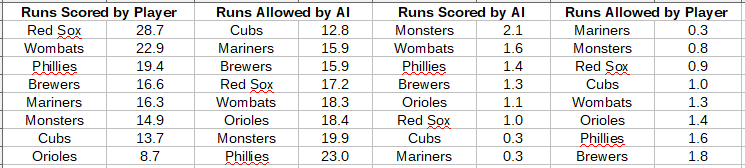
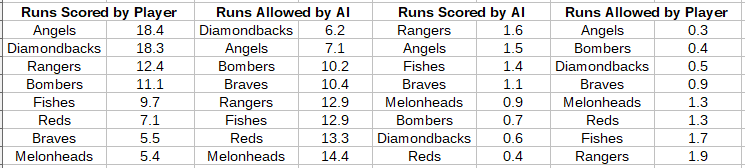
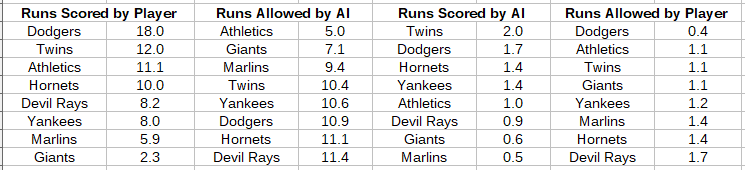
 BBL News Center